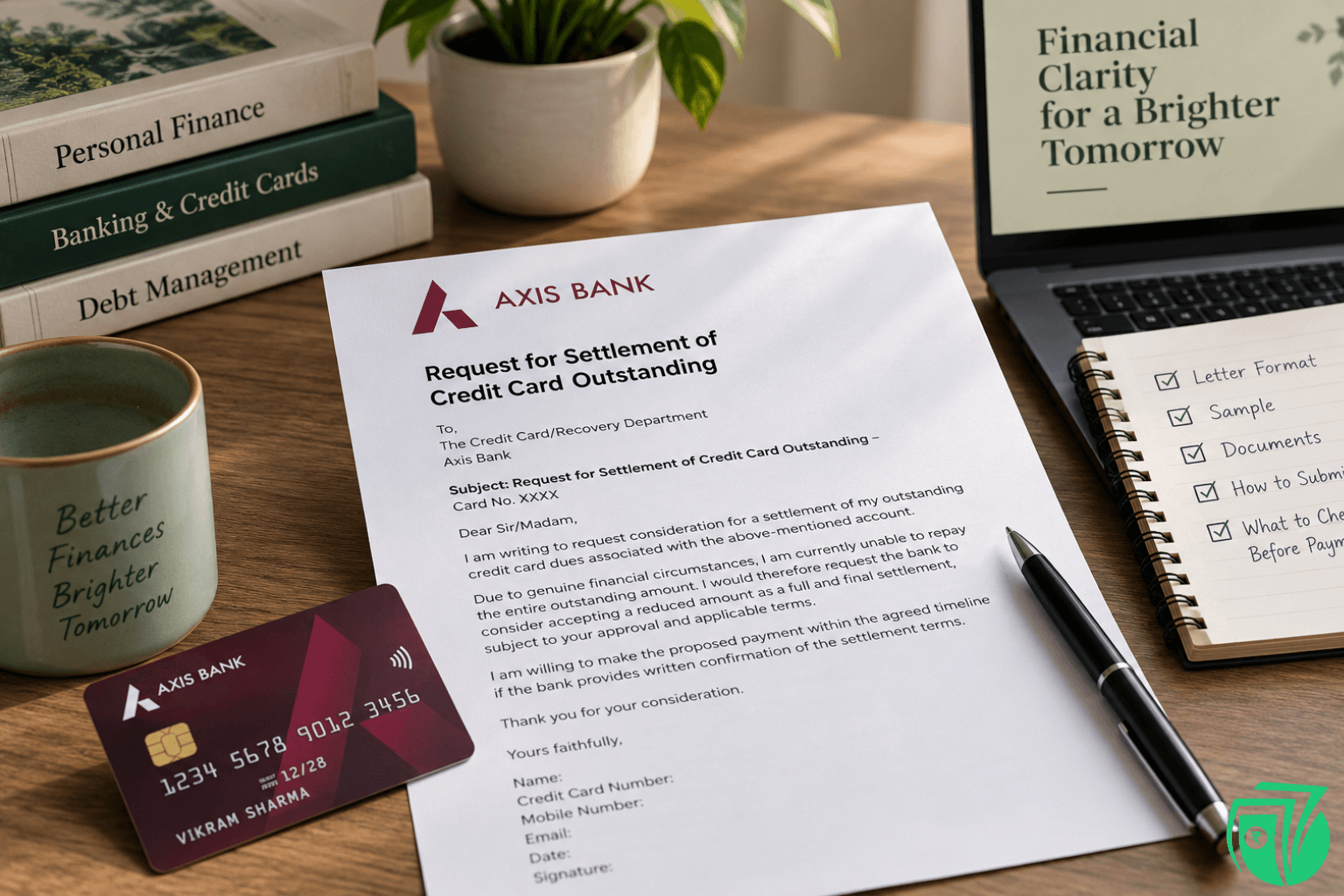
If you’re struggling to repay your Axis Bank credit card dues, you may want to formally request a settlement. A clear, well-written request letter can help you explain your financial hardship and propose a realistic resolution — it’s often the first concrete step in a settlement conversation.
One thing worth understanding right away: sending this letter doesn’t itself create a settlement. The settlement only becomes real once Axis Bank agrees to it and confirms the terms in writing. This guide gives you a practical letter format, a sample you can adapt, and a checklist of what to verify before you pay anything.
What Is a Credit Card Settlement Letter?
People often use “settlement letter” to describe two very different documents. Understanding the distinction matters:
1. Settlement Request Letter
Direction: Borrower → Bank
This is what you send to ask the bank to consider settling your account. It’s a request, not a confirmed agreement.
2. Settlement Letter / Settlement Offer
Direction: Bank → Borrower
This is what the bank sends back if it agrees to settle — it confirms the actual agreed terms: the amount, deadline, and conditions.
Only the second document represents an actual agreement. The first is simply your opening move in the conversation.
Axis Bank Credit Card Settlement Letter Format — Sample
Here’s a template you can adapt to your own situation:
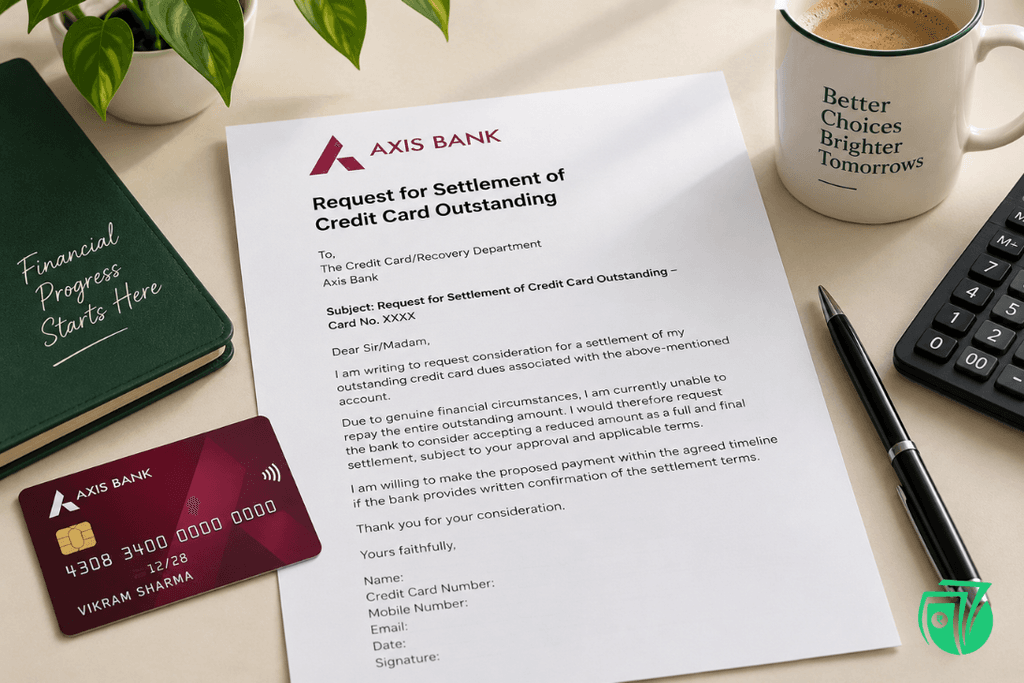
Sample Settlement Request Letter
To,
The Credit Card/Recovery Department
Axis Bank
Subject: Request for Settlement of Credit Card Outstanding – Card/Account No. XXXX
Dear Sir/Madam,
I am writing to request consideration for a settlement of my outstanding credit card dues associated with the above-mentioned account.
Due to [briefly explain genuine financial hardship — e.g., job loss, medical emergency, reduced income], I am currently unable to repay the entire outstanding amount. My present financial circumstances make it difficult for me to continue meeting the outstanding dues in full.
I would therefore request the bank to consider accepting ₹[proposed amount] as a full and final settlement of the outstanding amount, subject to the bank’s approval and applicable terms.
I am willing to make the proposed payment within the agreed timeline if the bank provides written confirmation of the settlement terms.
I request you to kindly consider my circumstances and provide the applicable settlement terms in writing.
Thank you for your consideration.
Name:
Credit Card/Account Number:
Registered Mobile Number:
Email:
Date:
Signature:
Note: This is an illustrative template, not an official Axis Bank form, and sending it doesn’t guarantee the bank will accept your proposed amount.
What Should You Include in an Axis Bank Settlement Request Letter?
Include:
- Your full name
- Your credit card/account number
- Your contact details (mobile number, email)
- Your current outstanding amount
- A brief, honest explanation of your financial hardship
- Your proposed settlement amount
- Your ability and timeline to make the payment
- A clear request for written confirmation of any agreed terms
- The date and your signature
Don’t include:
- False or exaggerated hardship claims
- Unrealistic payment promises you can’t actually keep
- Unverified assertions about what the bank “must” accept
- Sensitive personal information that isn’t actually required for the request
How to Decide What Settlement Amount to Propose
A useful way to think through this:
Your outstanding debt → your available funds → your essential expenses → a realistic lump sum → your proposed offer
For example:
- Outstanding balance: ₹2,00,000
- Amount realistically available to you: ₹90,000
- Proposed offer: ₹80,000–₹90,000
This is purely an illustrative example to show the reasoning process — it doesn’t reflect an Axis Bank-approved settlement percentage or any figure the bank has committed to accepting. Your own numbers should come from your actual financial position, not from this example.
Documents You Can Attach to Support Your Request
Depending on your specific circumstances, consider including:
- Salary slips
- Bank statements
- Termination or job-loss documentation
- Medical bills
- Proof of reduced income
- Other relevant financial documents
- Your credit card statement
- Previous correspondence with the bank
Whatever you attach should be genuine and directly relevant to your hardship — padding your request with unnecessary documents doesn’t strengthen it.
Where and How to Submit a Settlement Request
You can generally route your request through:
- Axis Bank’s authorised communication channels
- The relevant collections or recovery contact assigned to your account, if you’ve already been contacted
- Written correspondence (email or postal, depending on what the bank accepts)
- Official customer-service channels
Important: Always verify contact details through Axis Bank’s official website or a communication you know to be authenticated before sending any sensitive financial information. Don’t rely on a phone number or email address forwarded informally without confirming it’s genuinely Axis Bank’s.
What Does an Actual Axis Bank Settlement Letter Need to Contain?
Before you make any payment, the written settlement communication you receive back from the bank should clearly state:
- Your name
- Your credit card/account number
- The outstanding amount
- The agreed settlement amount
- The payment deadline
- The payment method/channel to use
- The terms governing the settlement
- How any remaining dues or liability will be treated
- The credit-bureau reporting status that will follow
Important distinction to remember: the letter you send is a request. It is not the same thing as the bank’s approval. Don’t make any payment simply because you sent a request letter, or because someone gave you an informal verbal assurance over the phone — wait for the bank’s own written confirmation.
Settlement Letter vs No Dues Certificate
| Document | Purpose |
|---|---|
| Settlement Request Letter | You ask the bank to consider a settlement |
| Settlement Letter/Offer | The bank communicates the agreed settlement terms |
| Payment Receipt | Evidence that your payment was actually made |
| No Dues Certificate | Evidence that the account is resolved with no further dues, where applicable |
Each of these serves a different purpose, and you’ll want to keep all of them once you’ve gone through the process — not just the final one.
How Credit Card Settlement Affects Your CIBIL Report
A few things worth understanding before you proceed:
- Settlement is different from full repayment, and credit bureaus treat it accordingly.
- A settled account can negatively affect your credit history — this is a genuine trade-off for the relief settlement provides.
- “Settled” is not the same as “Closed.” These are distinct statuses, and future lenders read them differently.
- Check your credit report after the bank updates your account, to confirm the settlement was reported accurately.
It’s not possible to state a fixed number of CIBIL points every borrower will lose — the actual impact depends on your existing credit profile and history.
What to Do After Paying the Settlement Amount
1. Make payment through the agreed channel
↓
2. Save your payment confirmation
↓
3. Obtain the applicable NOC/No Dues documentation
↓
4. Keep the settlement letter safely (physical and digital copies)
↓
5. Check your credit report after the expected update period
↓
6. Dispute any inaccurate information through the appropriate channel if something doesn’t match what was agreed
Common Mistakes When Sending a Settlement Request
- Sending the letter to an unverified email or contact without confirming it’s genuinely Axis Bank’s.
- Offering an amount without assessing your actual affordability first.
- Making false hardship claims — this can undermine your credibility if discovered.
- Assuming the request automatically means approval. It doesn’t — it’s just the opening step.
- Paying before receiving written settlement terms from the bank.
- Failing to keep payment records once you do pay.
- Ignoring the impact of “Settled” status on your credit history going forward.
Frequently Asked Questions
How do I write an Axis Bank credit card settlement letter?
Clearly state your account details, explain your financial hardship honestly, propose a realistic settlement amount, and request written confirmation of any agreed terms — the sample template above is a good starting structure.
Can I request Axis Bank to settle my credit-card dues?
Yes, you can submit a request, though whether the bank agrees to settle — and on what terms — depends on their assessment of your account and circumstances.
What should I include in a credit-card settlement request letter?
Your name, account number, contact details, outstanding amount, a brief explanation of hardship, your proposed amount, and a request for written confirmation.
Can I submit a credit-card settlement request online?
Often, yes, through Axis Bank’s official customer service or communication channels — confirm the correct, authenticated channel before sending sensitive details.
What documents should I attach to my settlement request?
Relevant, genuine documentation supporting your hardship — salary slips, bank statements, termination or medical documents, and your card statement, as applicable.
How much should I offer for credit-card settlement?
Base your offer on what you can realistically pay as a lump sum, after accounting for your essential expenses — not on an assumed percentage or another borrower’s outcome.
Does sending a settlement request affect my CIBIL score?
The request itself typically doesn’t directly change your score, but your existing overdue status likely already does. The actual settlement, if agreed and completed, is what gets reported and affects your credit profile.
What is the difference between a settlement request and a settlement letter?
A settlement request is what you send to the bank asking them to consider settling. A settlement letter is what the bank sends back confirming the agreed terms, if they accept.
Should I pay before receiving a written settlement offer?
No. Always wait for the bank’s written confirmation of the settlement terms before making any payment.
What should I do after paying the settlement amount?
Save your payment confirmation, collect the NOC or No Dues Certificate if applicable, keep the settlement letter safely, and check your credit report once it’s updated.
If you’re not sure how to approach Axis Bank about settling your credit card dues, or want a second opinion on what amount is realistic for your situation, it helps to get guidance before you send your request.
👉 Get a free debt assessment with TrueSettle to understand what’s realistic for you.
👉 Explore your debt settlement options before approaching Axis Bank.