Nobody takes a loan planning to default on it. You sign the papers, you make the EMIs, and life goes on. Then something changes. A job disappears, a business has two bad quarters, or a family member ends up in hospital. Suddenly the Bank of Baroda EMI that felt easy is the hardest bill of the month.
If that sounds familiar, you are not alone, and you are not out of options. Many borrowers in this situation start searching for how to settle Bank of Baroda loan dues without losing everything. This guide walks you through it honestly: what settlement really means, how the One Time Settlement (OTS) route works, what the bank looks for, and what it costs you in the long run.
One thing upfront: settlement is not a right, and nobody can guarantee you a fixed discount. But with the right preparation and paperwork, it can be a realistic way out.
What Is Bank of Baroda Loan Settlement?
Bank of Baroda loan settlement is an agreement where the bank accepts a reduced, one-time amount to close your loan account, because you genuinely cannot repay the full dues. The bank writes off the remaining balance, and your account is closed with a “settled” status rather than “closed”.
Understanding One Time Settlement (OTS)
OTS is the formal name banks use for this kind of deal. You and the bank agree on a single amount, sometimes payable in one go and sometimes in a few short instalments, and the bank treats the account as resolved once you pay it in full and on time.
Bank of Baroda’s own Code of Bank’s Commitment to Customers says the bank considers cases of genuine financial difficulty sympathetically. It also says the bank should explain OTS terms, and how they affect your credit history, in writing.
How Does Loan Settlement Work?
In simple terms, it works like this:
- Your account falls overdue and is usually classified as a non-performing asset (NPA) after sustained non-payment.
- You, or the bank, propose a settlement.
- The bank reviews your finances and your reason for default.
- Both sides agree on an amount, and the bank issues a written settlement letter.
- You pay as per that letter and collect your closure documents.
The bank is weighing one question: is it better to recover part of the money now, or chase the full amount through a long recovery process? Your job is to show, honestly and with documents, that settlement is the more practical choice.
Loan Settlement vs Loan Waiver
People often mix these up. A loan waiver is usually a government-announced scheme that cancels dues for a specific group, such as farmers, and it typically does not hurt the borrower’s credit record in the same way. A loan settlement is a private, case-by-case deal between you and the bank. You still pay a negotiated amount, and the settled status shows on your credit report.
Does Bank of Baroda Offer a One Time Settlement Scheme?
Yes. Like most public sector banks, Bank of Baroda does settle overdue accounts through OTS, either under a scheme it announces for a period or on a case-by-case basis. The final decision always rests with the bank.
Bank of Baroda OTS Policy Explained
Public sector banks run OTS under board-approved policies. The specific terms, such as which accounts qualify, the minimum amount and the payment window, can change from one scheme to the next. That is why it is worth asking your branch directly whether any OTS scheme is currently active for your type of loan.
Is Every Borrower Eligible for OTS?
No. There is no rule that says you automatically qualify after missing a set number of EMIs. Banks generally consider settlement for accounts that are already overdue or classified as NPA, where the borrower can show genuine hardship. A borrower who simply does not want to pay, but clearly can, is unlikely to get a settlement offer.
Does OTS Apply to Personal Loans and Credit Cards?
It can. Bank of Baroda personal loan settlement is possible because personal loans are unsecured, so the bank has no asset to sell. Credit card dues issued through BOBCARD can also be settled on a case-by-case basis. Home loans, vehicle loans and business loans backed by property are different: the bank can usually recover dues by selling the asset, so settlement is harder to negotiate.
Who Is Eligible for Bank of Baroda Loan Settlement?
The bank looks for a real, documented reason why you cannot keep paying. Here are the situations it most often considers.
Job Loss or Unemployment
If you lost your job and your income has dropped sharply, a termination letter and your recent bank statements make a strong case. Show the bank what you earn now, not what you used to earn.
Business Losses or Financial Crisis
Self-employed borrowers can use ITRs, GST returns and profit-and-loss statements to show a genuine downturn. A business that has shut down or is running at a loss is a common ground for settlement.
Medical Emergencies
A serious illness in the family can drain savings quickly. Hospital bills, discharge summaries and treatment records help the bank understand where the money went.
Other Genuine Financial Difficulties
The death of an earning family member, a natural disaster, or a sudden large liability can also qualify. What matters is that the hardship is real, recent and backed by paperwork.
Already struggling to keep up? A short consultation with TrueSettle can help you understand whether settlement is the right fit for your situation, before you approach the bank.
How to Settle Bank of Baroda Loan? Step-by-Step Process
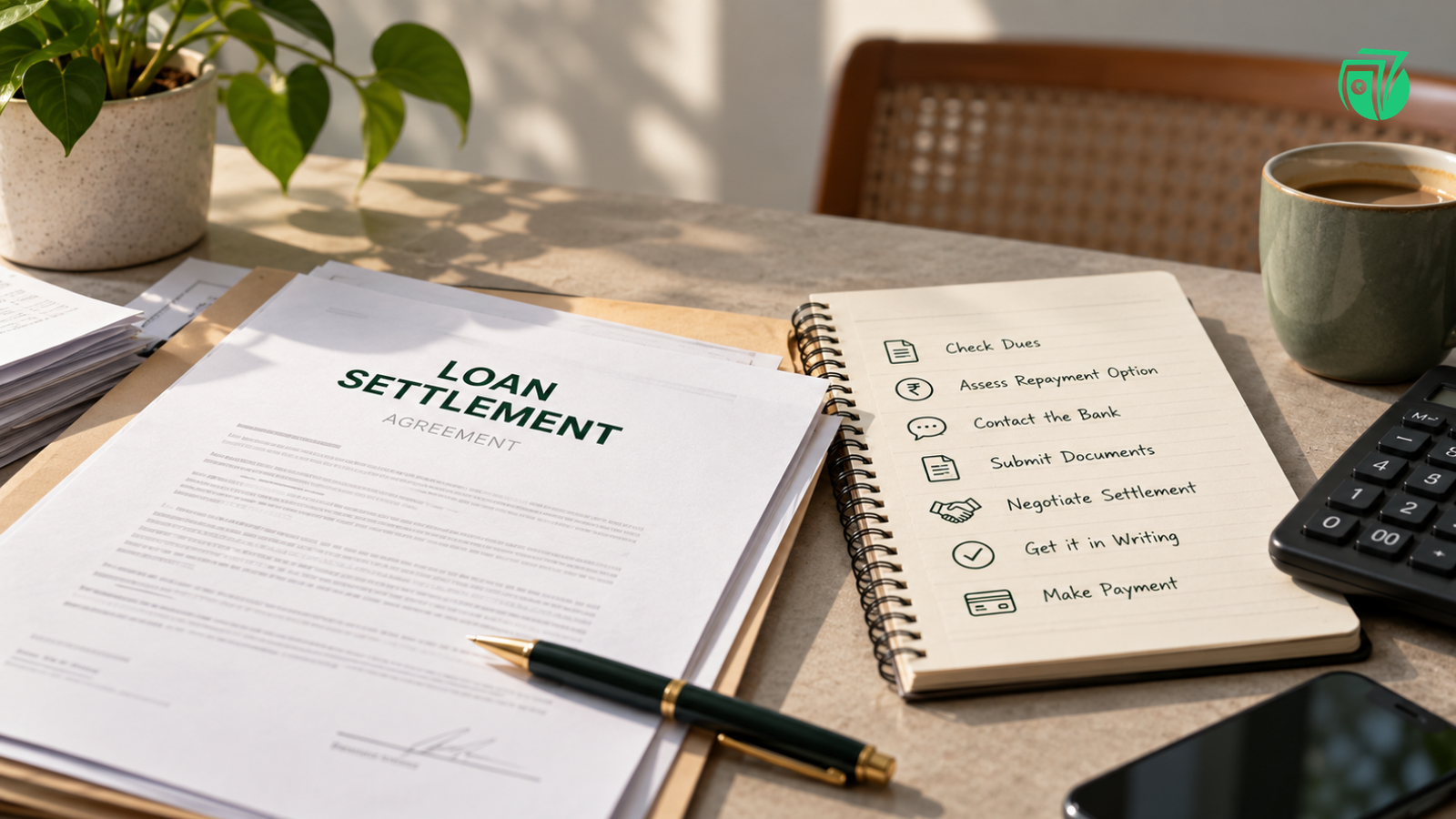
Here is the Bank of Baroda loan settlement process, broken into simple steps. Take them in order and keep a copy of everything.
Step 1 – Review Your Outstanding Loan Amount
Ask your branch for a full loan account statement. Check the principal, interest, penal charges and any other fees. You cannot negotiate well if you do not know exactly what the bank says you owe.
Step 2 – Assess Your Financial Situation
Work out what you can realistically pay as a lump sum, using savings, family support or the sale of an asset. Be honest with yourself here. Offering an amount you cannot actually arrange will only lead to a failed settlement.
Step 3 – Contact Bank of Baroda
Visit your home branch, or the branch that handles recovery for your account, and ask about OTS. Speak to the branch manager or the recovery officer rather than relying on calls from agents.
Step 4 – Submit a Settlement Request
Write a short, clear application. Explain why you defaulted, what has changed in your income, and what amount you can offer. Attach your supporting documents and get a stamped acknowledgement of receipt.
Step 5 – Negotiate the Settlement Amount
The bank may reject your first offer or come back with a higher figure. That is normal. Stay polite, back your position with numbers, and do not agree to something you cannot pay.
Step 6 – Review the Official Settlement Letter
Never pay on a verbal promise. Wait for a written Bank of Baroda settlement letter on the bank’s letterhead. It should state the agreed amount, the payment deadline or instalment dates, and confirm that the account will be closed once you pay.
Step 7 – Pay the Agreed Settlement Amount
Pay only into the bank’s official account, or through a demand draft or the branch itself. Keep every receipt. If the letter sets instalments, pay each one on time: missing a date can cancel the settlement.
Step 8 – Obtain No Dues Certificate
Once the full settled amount is paid as per the letter, ask the bank for a No Dues Certificate or closure letter. This is not automatic, so follow up in writing until you have it. Keep it safely, along with your settlement letter and payment receipts.
Documents Required for Bank of Baroda Loan Settlement
Keep these ready before you approach the bank:
- Identity and KYC documents: PAN card, Aadhaar and address proof
- Loan account statement: showing the outstanding dues
- Bank statements: usually for the last 6–12 months
- Salary or income proof: salary slips, ITRs or business financials
- Hardship proof, where applicable: termination letter, medical records or business closure papers
- Relevant legal notices: copies of any recovery, cheque bounce or court notices you have received
A neat, complete file shows the bank you are serious, and often speeds things up.
How Much Can You Save Through Bank of Baroda Loan Settlement?
There is no fixed percentage, and anyone promising you a guaranteed discount is not being straight with you. The amount you save depends on several things:
- Outstanding dues: how much principal and interest has built up
- Age of the default: older NPAs are sometimes settled on different terms
- Loan type: unsecured loans are usually easier to settle than secured ones
- Your hardship: how clearly you can prove you cannot pay in full
- Repayment history: a good track record before the default helps
- Bank approval: the final figure is always the bank’s decision
In many cases, the bank will look to recover at least the principal. Penal interest and charges are often where the most room for negotiation lies.
What Happens If You Receive a Bank of Baroda Legal Notice?
A legal notice is serious, but it is not the end of the road. Read it carefully, note any deadlines, and respond in time. Ignoring it is the one thing that almost always makes matters worse.
Loan Recovery Notices
The bank usually starts with reminders and then a formal demand notice. This is often the best moment to propose settlement, before the matter moves to court.
Cheque Bounce Notices
If an EMI cheque or ECS mandate bounced, the bank may send a notice under Section 138 of the Negotiable Instruments Act. These notices have strict timelines, so speak to a lawyer promptly rather than letting the deadline pass.
Lok Adalat Proceedings
Banks often send overdue cases to Lok Adalat, where both sides try to reach a compromise. A Lok Adalat can be a good chance to settle. Remember that an award passed there is final and binding, so only agree to an amount you can actually pay.
SARFAESI Notices for Secured Loans
For secured loans like home or property loans, the bank can act under the SARFAESI Act. It typically sends a demand notice giving you 60 days to pay before it can move to take possession of the asset. Responding within this window, with a settlement or restructuring proposal, matters a great deal.
What Is the Difference Between Loan Restructuring and Settlement?
Before you choose settlement, check whether restructuring could work. It is often the better option if your hardship is temporary.
| Point | Loan Restructuring | Loan Settlement (OTS) |
|---|---|---|
| What changes | Tenure, EMI or interest terms are revised | Bank accepts a reduced lump sum |
| Amount repaid | Full dues, spread over a longer time | Less than the full dues |
| Best for | Temporary drop in income | Long-term inability to repay |
| Account status | Remains active | Closed as “settled” |
| CIBIL impact | Some impact, but recoverable with regular payments | Significant negative remark that stays for years |
| Future borrowing | Easier | Harder, at least for some time |
How Does Bank of Baroda Loan Settlement Affect Your CIBIL Score?
Settlement brings relief, but it comes at a cost to your credit profile. The account is reported to credit bureaus as “settled”, and lenders read this as a sign that you did not repay in full.
What Does Settled Status Mean?
A “settled” status tells future lenders that the bank accepted less than what was owed. It can stay on your credit report for several years and may lead to loan rejections or higher interest rates in the meantime.
Settled vs Closed Status
“Closed” means you repaid the loan in full. “Settled” means you paid a reduced amount. If your finances improve later, you can ask the bank whether paying the written-off balance would let it update the status to “closed”. This is at the bank’s discretion, so get any such commitment in writing.
How Can You Rebuild Your Credit History?
Rebuilding takes time and steady habits, and there is no fixed timeline. A few things help:
- Pay every remaining EMI and bill on time
- Consider a secured credit card against a fixed deposit and use it lightly
- Keep your credit utilisation low
- Avoid applying for several loans at once
- Check your credit report regularly and dispute any errors
What Are Your Rights Against Loan Recovery Harassment?
Owing money does not take away your dignity. The Reserve Bank of India has clear guidelines on recovery agents that banks and their agents must follow:
- Recovery calls and visits are not allowed before 8 AM or after 7 PM
- Agents cannot threaten, abuse or intimidate you, verbally or physically
- They cannot shame you publicly or contact your family, friends or colleagues to embarrass you
- Your privacy must be respected at all times
- Agents should carry proper identification and the bank’s authorisation
If an agent crosses these lines, note the date, time and caller details. Complain to the bank’s grievance cell in writing first. If the bank does not resolve it within 30 days, you can approach the RBI Ombudsman through the RBI’s complaint portal.
Common Mistakes to Avoid During Loan Settlement
We see the same mistakes again and again. Avoiding them can save you money and stress:
- Relying on verbal promises: a phone call or a branch conversation is not a settlement
- Paying without an official settlement letter: always get the terms in writing first
- Ignoring legal notices: silence makes court action more likely, not less
- Paying into an unverified account: never pay an agent in cash or into a personal account
- Not collecting the final NOC: without it, you have no proof the account is closed
- Agreeing to an amount you cannot arrange: a failed settlement can put you back where you started
How TrueSettle Can Help You With Bank of Baroda Loan Settlement
Dealing with a bank on your own, while under financial pressure, is exhausting. That is where TrueSettle comes in. Our team helps you:
- Understand whether settlement, restructuring or another option suits your situation
- Organise your documents and draft a clear settlement proposal
- Respond to recovery notices and deal with harassment in line with RBI rules
- Negotiate with the bank based on your real repaying capacity
- Check your settlement letter and make sure you receive your closure documents
We will never promise you a fixed discount, because no honest advisor can. What we do promise is a clear picture of your options and support at every step.
If you have loans with other banks too, you may find these guides useful: SBI loan settlement process, HDFC Bank loan settlement guide, ICICI Bank loan settlement, Canara Bank loan settlement process, Central Bank of India OTS and our overall guide to the loan settlement process in India.
Conclusion
Learning how to settle Bank of Baroda loan dues is really about making an honest, well-documented case to the bank. Know your numbers, explain your hardship clearly, get everything in writing, and never pay without an official letter. Settlement will affect your credit score for a while, but for many borrowers it is a fresh start they genuinely need.
Struggling with your Bank of Baroda loan? Book a free consultation with TrueSettle and let our experts help you find the right way forward.
Frequently Asked Questions
1. Does Bank of Baroda provide loan settlement?
Yes. Bank of Baroda offers One Time Settlement for eligible overdue and NPA accounts, either through announced schemes or case by case. Approval is entirely at the bank’s discretion and depends on your hardship, loan type and outstanding dues.
2. How can I settle my Bank of Baroda personal loan?
Collect your loan statement and hardship documents, then submit a written settlement request at your branch. Negotiate an amount you can actually pay, get an official settlement letter, pay only through official channels, and collect your No Dues Certificate once the payment is complete.
3. What is the Bank of Baroda One Time Settlement scheme?
It is a scheme where the bank accepts a reduced amount, paid in one go or in a few short instalments, to close a loan account that the borrower cannot repay in full. The terms vary by scheme and loan type.
4. Who is eligible for Bank of Baroda loan settlement?
Borrowers facing genuine financial hardship, such as job loss, business losses, medical emergencies or the death of an earning member, are usually considered. The account is typically overdue or classified as NPA. Missing a few EMIs alone does not make you automatically eligible.
5. How much discount can I get on Bank of Baroda loan settlement?
There is no fixed discount. The settlement amount depends on your outstanding dues, loan type, the age of the default, your proven hardship and the bank’s own assessment. Be wary of anyone who guarantees a specific percentage.
6. Can I settle my Bank of Baroda credit card dues?
Yes, credit card dues can often be settled on a case-by-case basis, since they are unsecured. Contact the card issuer, share your hardship documents and insist on a written settlement letter before making any payment.
7. Does Bank of Baroda loan settlement affect my CIBIL score?
Yes. The account is reported as “settled”, which lowers your score and signals to lenders that you did not repay in full. This remark can stay on your report for years, so borrowing may be harder for some time afterwards.
8. What happens if I cannot pay the agreed settlement amount?
If you miss the payment deadline set in your settlement letter, the bank can cancel the settlement. Any amount you already paid is usually adjusted against the dues, and the bank can resume recovery. Talk to the bank before the deadline if you foresee a problem.
9. Can Bank of Baroda take legal action for unpaid loans?
Yes. Depending on the loan, the bank can send recovery notices, file cheque bounce cases, refer the matter to Lok Adalat or the Debt Recovery Tribunal, or act under the SARFAESI Act for secured loans. Responding early gives you more room to settle.
10. What documents are required for Bank of Baroda loan settlement?
You will usually need KYC documents, your loan account statement, recent bank statements, income proof, hardship proof such as a termination letter or medical records, and copies of any legal notices received.
Disclaimer: This article is for general information only and is not legal or financial advice. Settlement terms are decided by the bank. Please consult a qualified professional about your specific case.