The loan default lifecycle in India can move through several stages… Missing one EMI does not mean your loan immediately becomes an NPA. A loan account can move through several stages as payments remain overdue, with different consequences and possible resolution options at each stage.
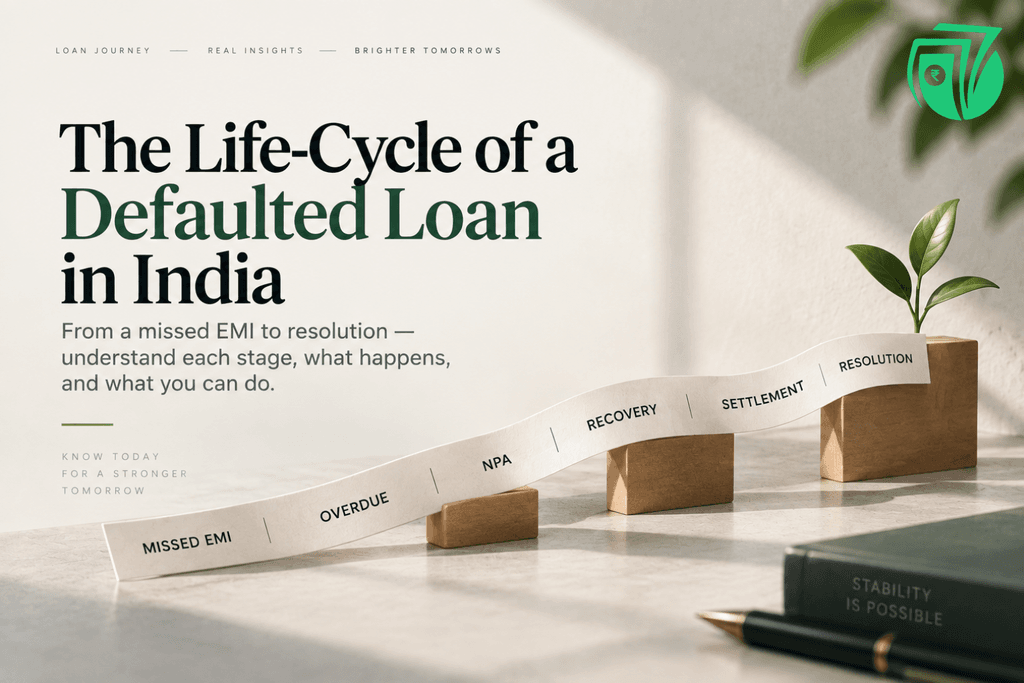
The infographic below provides a simple visual overview of this journey. The sections that follow explain each stage in more detail.
What Is a Loan Default?
A loan default broadly refers to a borrower failing to meet a payment obligation under the terms of a loan agreement.
However, not every missed payment has the same consequences. An account that has just become overdue is in a different position from one that has remained unpaid for an extended period and may eventually meet the applicable criteria for NPA classification.
Understanding how long your payment has been overdue, your loan’s current status, and what options may be available is an important first step toward dealing with the situation.
When Does a Loan Become an NPA?
Under RBI’s income-recognition and asset-classification framework, a loan account is generally classified as a Non-Performing Asset (NPA) when it remains overdue for more than 90 days, subject to the applicable regulatory framework and type of credit facility.
NPA classification is significant because it affects how the lender classifies and accounts for the asset and may also lead to further recovery action.
The 90-day benchmark is the general rule for many bank credit facilities, but borrowers should not assume that every type of credit product is treated identically. The applicable regulatory framework and nature of the facility can affect the classification process.
What Can Happen After a Loan Default?
As an account remains overdue, several things may happen depending on the lender, loan type, account status, and applicable terms:
- Collection communication — reminder calls, messages, emails, and other forms of communication may begin.
- Credit reporting — overdue payments and account status may be reported to credit information companies, which can affect the borrower’s credit profile.
- Additional charges where applicable — late-payment charges, penal charges, interest, or other amounts may apply according to the loan agreement and applicable rules.
- Recovery action — the lender may escalate recovery efforts if the account remains unresolved.
- Legal action where applicable — depending on the loan type, circumstances, and applicable law, the lender may pursue appropriate legal remedies.
- Different treatment for secured and unsecured loans — secured loans are backed by collateral and may give the lender specific enforcement rights subject to applicable law. Unsecured loans do not have the same collateral structure, but lenders may still pursue appropriate recovery or legal remedies.
A missed EMI does not automatically mean that every one of these consequences will occur immediately. The account’s progression depends on the specific circumstances.
Can You Settle a Defaulted Loan?
Depending on the circumstances, a lender may consider a settlement proposal, particularly where a borrower is facing genuine financial difficulty.
However, settlement requires the lender’s agreement. It is not something a borrower can declare unilaterally.
A settlement discussion may involve:
- Understanding the exact outstanding amount.
- Explaining the financial circumstances affecting repayment.
- Proposing an amount that the borrower can realistically arrange.
- Discussing the proposal through the lender’s authorised process.
- Obtaining the agreed settlement terms in writing.
- Making payment through an authorised channel.
- Retaining payment confirmation and other relevant documents.
There is no universal settlement percentage that applies to every loan or lender. Whether a settlement is considered, and what amount may be accepted, depends on the individual account, the borrower’s circumstances, and the lender’s applicable policies and approval process.
Settlement should therefore be considered only after understanding both its benefits and its potential consequences, including its impact on the borrower’s credit history.
Defaulted Loan vs NPA vs Written-Off vs Settled
These terms are often used interchangeably, but they describe different things:
| Status | Basic Meaning |
|---|---|
| Overdue / Default | A required payment remains unpaid according to the applicable loan terms. |
| NPA | The account meets the applicable regulatory criteria for classification as a Non-Performing Asset. |
| Written Off | An accounting treatment used by the lender; it does not automatically cancel the underlying debt or mean recovery efforts must stop. |
| Settled | The lender has accepted an agreed amount, usually lower than the outstanding amount, under negotiated settlement terms. |
Does a Written-Off Loan Mean the Debt Is Gone?
No.
A write-off is primarily an accounting treatment. It does not automatically mean that the borrower has been released from the obligation or that recovery cannot continue.
The exact legal and recovery position depends on the account, loan agreement, applicable law, and actions taken by the lender.
How to Stop a Default From Becoming a Bigger Problem
If you are anywhere in this progression, taking action early can help you understand your options.
1. Contact the Lender Early
If you know that you may struggle to make your EMI, communicate with the lender rather than waiting for the account to deteriorate further.
2. Don’t Ignore Collection Communication
Even if you cannot make the payment immediately, communicating your situation can be more constructive than going completely silent.
3. Explore Restructuring or Repayment Options
Settlement is not the only possible route. Depending on your circumstances and the lender’s policies, you may be able to explore revised repayment arrangements or restructuring options.
4. Create a Realistic Repayment Plan
Base your proposed repayment on what you can actually afford. Avoid making commitments that are unlikely to be sustainable.
5. Keep Everything Documented
Maintain records of important calls, emails, notices, payment receipts, proposals, approvals, and settlement documents.
6. Understand Settlement Consequences Before Choosing It
Settlement can resolve an outstanding account under agreed terms, but it may also affect how the account is reflected in your credit history. Understand the implications before proceeding.
Frequently Asked Questions
What happens after you miss a loan EMI in India?
The account may become overdue, and applicable charges may arise according to the loan terms. The lender may begin reminder or collection communication. Continued non-payment can lead to further recovery action and may affect credit reporting.
How many days before a loan becomes NPA?
For many bank credit facilities, an account is generally classified as an NPA when it remains overdue for more than 90 days, subject to the applicable RBI framework and the type of credit facility.
What is the difference between default and NPA?
Default broadly refers to failure to meet a payment obligation. NPA is a specific regulatory classification that applies when an account meets the applicable asset-classification criteria, generally based on the period for which it has remained overdue.
Can a defaulted loan be settled?
A lender may consider settlement in appropriate circumstances, but settlement is not guaranteed. Any settlement must be approved through the lender’s applicable process and documented in writing.
What happens when a loan is written off?
A write-off is an accounting treatment by the lender. It does not automatically cancel the borrower’s obligation or prevent the lender from pursuing recovery, subject to applicable law and the circumstances of the account.
Does loan default affect CIBIL?
Missed payments and account status may be reported to credit information companies and can negatively affect a borrower’s credit profile. Settlement or write-off can also affect how the account appears in the credit history.
Can a bank take legal action for loan default?
Depending on the loan type, account status, amount involved, and applicable law, a lender may pursue appropriate recovery or legal remedies. Secured and unsecured loans can involve different recovery mechanisms.
What should I do if I cannot pay my EMI?
Contact your lender as early as possible, explain your circumstances, and ask about available repayment or restructuring options. If settlement is being considered, understand the terms and potential credit implications before agreeing.
What is the difference between settlement and restructuring?
Restructuring changes the terms of repayment, such as the repayment schedule or tenure, while the underlying debt generally continues to be payable.
Settlement involves the lender agreeing to accept a negotiated amount to resolve the account, subject to the agreed terms. It can have different implications for the borrower’s credit history.
Can your credit score recover after loan settlement?
Credit health can improve over time through consistent repayment behaviour on other credit obligations, responsible credit utilisation, and maintaining a positive payment history. However, improvement is gradual and there is no fixed timeline that applies to every borrower.
Understand Where You Stand in the Loan Default Cycle
A missed EMI does not automatically mean that your loan has reached the most serious stage of recovery.
The earlier you understand your account status and available options, the better positioned you may be to make an informed decision.
Whether your payment has recently become overdue or your account is already in recovery, understanding the difference between overdue, NPA, restructuring, write-off, and settlement can help you approach the situation more confidently.
👉 Get a free debt assessment with TrueSettle: https://truesettle.in/free-consultation
👉 Explore your debt resolution options: https://truesettle.in/services
Disclaimer: This article is intended for general educational and informational purposes only. Loan classification, recovery processes, settlement outcomes, credit reporting, and legal remedies can vary depending on the lender, credit facility, applicable terms, regulations, and individual circumstances. This content should not be treated as legal or financial advice.