A note on current conditions: this article was originally framed around a rising-rate environment. As of the current data, RBI’s repo rate has actually held steady at 5.25% through 2026 after a series of cuts in 2025, with the Monetary Policy Committee maintaining a neutral stance — meaning India isn’t currently in an active rate-hiking cycle, though inflation has ticked slightly above RBI’s 4% target and a rate cut remains more likely than a hike in the near term. The framework below still applies directly if you’re carrying debt taken on during an earlier, higher-rate period, or if you’re on a floating-rate loan that hasn’t yet repriced downward — but treat any reference to “rising rates” as one possible scenario rather than the current default. Always check the latest RBI monetary policy announcement before assuming rates are moving in either direction.
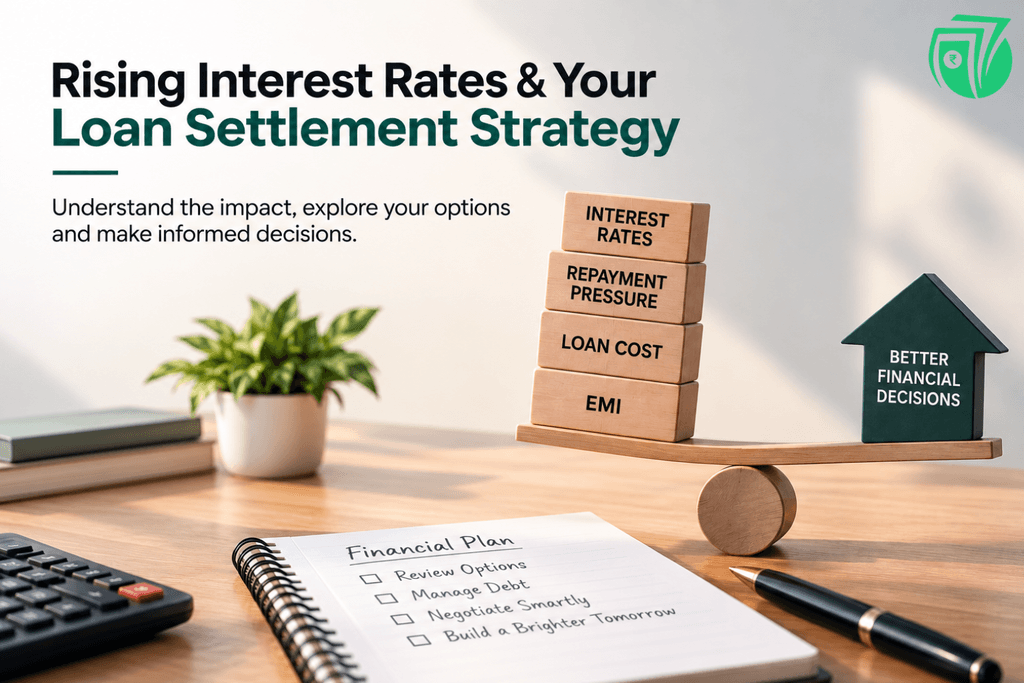
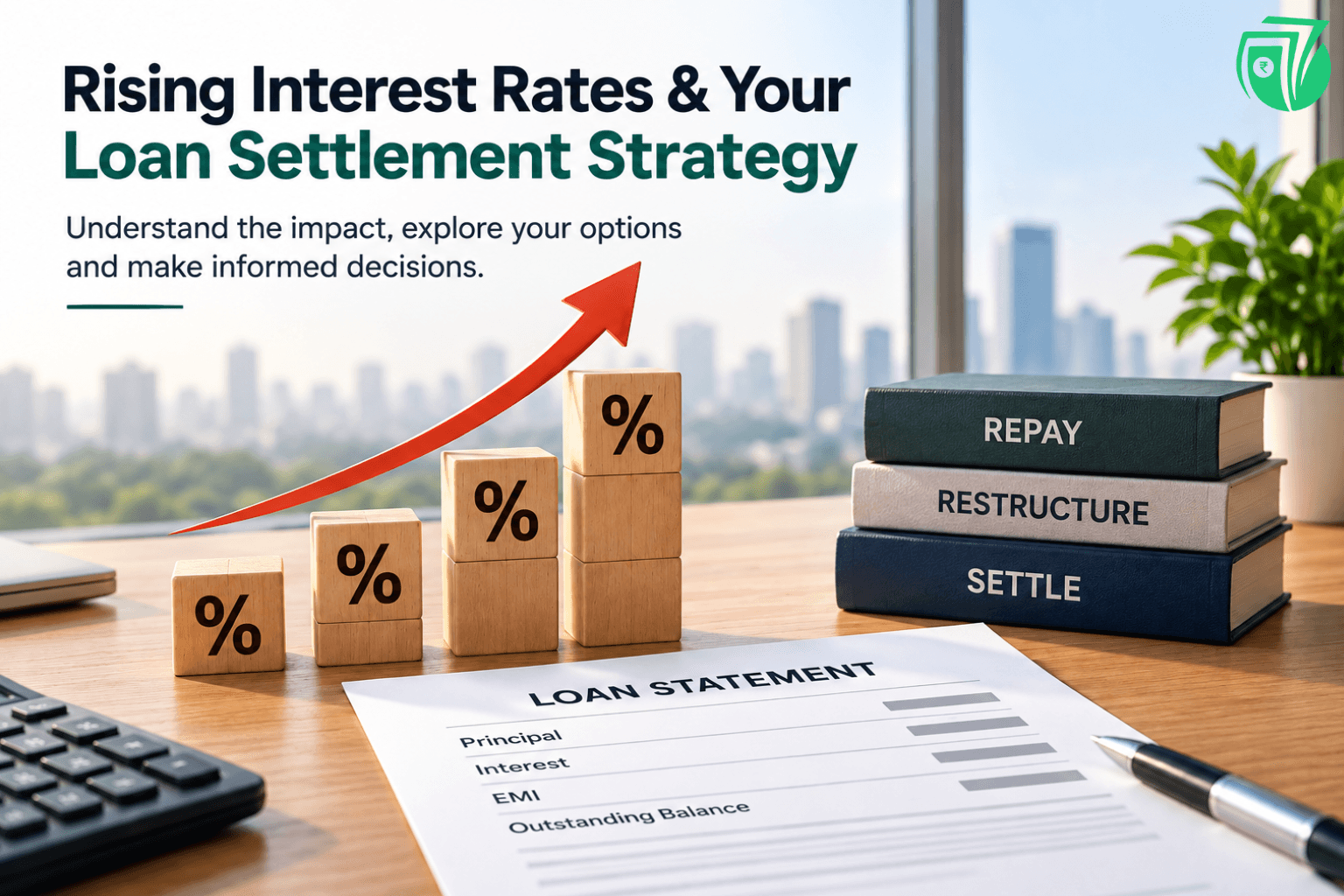
What Rising Interest Rates Mean for Your Loan Settlement Strategy in 2025
Why Interest Rates Matter When You’re Considering Loan Settlement
Interest rates sit quietly behind almost every number on your loan statement. They determine how much of your EMI goes toward interest versus principal, how fast your outstanding balance actually shrinks, and how much room you have left in your monthly budget once the EMI is paid. When rates rise — whether because you took a fresh loan at a higher rate or your existing floating-rate loan repriced upward — your repayment burden increases without you having borrowed a single additional rupee.
That said, here’s an important distinction worth understanding before anything else: a higher interest rate doesn’t automatically mean a lender will accept a lower settlement. Your interest rate affects how expensive your debt is to carry — it doesn’t directly determine what a lender will negotiate. Settlement decisions are driven by the lender’s assessment of your account, your documented hardship, and your realistic repayment capacity, not simply by the rate printed on your loan agreement.
How Rising Interest Rates Increase Borrower Pressure
When borrowing costs go up, the effects tend to show up in a few connected ways:
- Your repayment burden increases, particularly on floating-rate loans, where a rate hike translates directly into a higher EMI or a longer tenure.
- Your disposable income shrinks, since more of your monthly budget is now going toward interest rather than other expenses or savings.
- Existing debt becomes genuinely harder to manage, especially if your income hasn’t grown at the same pace as your borrowing costs.
- The risk of missed payments increases for borrowers who were already financially stretched even before the rate change.
Here’s a simple hypothetical to make this concrete: imagine a personal loan with ₹4,00,000 outstanding and 24 months remaining. At 13% annual interest, the EMI works out to roughly ₹18,970. If the rate rises to 15%, the EMI on the same outstanding balance and tenure increases to roughly ₹19,410 — a modest-looking jump per month, but one that adds up over the remaining tenure and can matter significantly for a borrower whose budget was already tight.
Does a Higher Interest Rate Make Loan Settlement More Attractive?
There are genuinely two sides to this.
On one hand: higher repayment costs can push a loan that was previously manageable into genuinely unaffordable territory. A borrower facing this kind of pressure may reasonably start exploring restructuring or settlement sooner than they otherwise would have.
On the other hand: settlement isn’t a cost-free response to higher interest. It comes with real credit-report consequences, and if you can still afford your repayments — even if they’ve become less comfortable — settlement may not be the most appropriate option. Rate increases alone don’t determine whether you’re eligible for settlement, and they don’t determine what terms a lender will offer if you pursue it.
The honest takeaway: rising rates can be a legitimate trigger to reassess your situation, but they shouldn’t be treated as an automatic case for settlement on their own.
Rising Interest Rates vs Your Settlement Amount
This is worth stating clearly, because it’s a common misconception:
Settlement is generally negotiated based on the lender’s assessment of your account and your circumstances — not simply because interest rates have increased.
What actually factors into a lender’s settlement decision includes:
- Your total outstanding amount
- Your account status (how far into default, if at all)
- Your documented financial hardship
- Your realistic repayment capacity
- The lender’s own recovery assessment and internal policies
- Whether you have a lump sum genuinely available to offer
A higher interest rate might be part of why your situation has become difficult — but it isn’t, by itself, a bargaining chip in the negotiation. Lenders assess your ability to pay, not the abstract fact that rates went up.
How to Reassess Your Debt Before Negotiating
Before deciding on any course of action, get a clear, honest picture of where you stand. Calculate:
- Your current outstanding balance
- Your interest rate
- Your current EMI
- Your remaining tenure
- Your monthly income
- Your essential expenses
- Any other debts you’re carrying
- Your available savings
Once you have these numbers in front of you, ask yourself honestly whether your difficulty is:
- Temporary cash-flow pressure — a short-term squeeze that’s likely to ease
- High-cost debt — manageable in principle, but expensive enough that a better rate or structure would genuinely help
- A long-term inability to repay — where the debt has moved beyond what restructuring alone can fix
Each of these points toward a different next step, which is exactly what the next section covers.
Settlement vs Restructuring When Interest Rates Rise
| Option | When It May Be Considered | Key Consideration |
|---|---|---|
| Continue repayment | EMI remains affordable | Maintains your repayment history |
| Restructuring | Temporary affordability problem | New terms may increase total cost |
| Refinancing | Better terms are genuinely available elsewhere | Fees and eligibility matter |
| Settlement | Full repayment is genuinely unaffordable | Can negatively affect credit reporting |
Notice that settlement sits at the far end of this table — it’s generally the option to consider once the others genuinely don’t fit your situation, not the first response to a rate increase.
How to Prepare for a Settlement Negotiation
If, after reassessing your finances, settlement does seem like the appropriate path, prepare carefully:
- Document your financial hardship — be specific, and gather supporting evidence where you can.
- Calculate what you can realistically afford as a lump sum or resolution amount.
- Review your outstanding amount in full — principal, interest, and any charges.
- Decide your maximum affordable offer before you start negotiating, so you don’t overcommit under pressure.
- Communicate with the lender clearly and factually about your situation.
- Negotiate based on your actual financial position, not on what you’ve heard other borrowers received.
- Obtain written settlement terms before making any payment.
Should You Settle Now or Wait?
This is genuinely a judgment call, and it depends on a combination of factors rather than a single rule:
- Can you currently afford your EMI, even if it’s uncomfortable?
- Is your income likely to recover in the near term, or is the pressure structural?
- Is your debt still increasing, or has it stabilised?
- Do you have a realistic settlement fund available, or would you need to raise one over time?
- What are the credit consequences you’re willing to accept?
- Have you genuinely explored alternative repayment options first?
There’s no universally “right” percentage drop in affordability or specific timeline that makes settlement the obvious choice — it depends entirely on your own numbers and circumstances, reassessed honestly.
How Rising Rates Affect Different Types of Debt
Interest rate changes don’t hit every kind of debt the same way:
- Personal loans — typically unsecured, and often at higher fixed or floating rates; a rate increase can meaningfully affect affordability.
- Credit cards — carry some of the highest ongoing interest rates already, so further pressure compounds quickly if balances aren’t cleared.
- Home loans — usually floating-rate and large in absolute terms, so even a small rate change can shift the EMI meaningfully in rupee terms.
- Vehicle loans — often fixed-rate for the loan term, so existing borrowers may be insulated from rate changes unless refinancing.
- Other variable-rate borrowing — directly exposed to rate movements, for better or worse.
It’s also worth remembering that secured and unsecured debt carry very different settlement and enforcement consequences. A secured loan (like a home or vehicle loan) gives the lender rights over the pledged asset; an unsecured loan (like a personal loan or credit card) generally doesn’t, which affects both your negotiating position and the lender’s likely approach to recovery.
Common Mistakes Borrowers Should Avoid
- Assuming rising rates guarantee a better settlement. They don’t — settlement terms depend on your account and hardship, not the rate environment.
- Stopping EMI payments just to negotiate. This damages your credit history and repayment record, which works against you.
- Ignoring restructuring options in favour of jumping straight to settlement.
- Taking another high-interest loan to fund a settlement, without calculating the total cost of doing so.
- Negotiating without calculating affordability first, leading to an unrealistic offer or overcommitment.
- Paying without a written settlement agreement in hand.
- Ignoring the credit-report impact of settlement, and being surprised by it later.
Frequently Asked Questions
How do rising interest rates affect loan settlement?
Rising rates can increase your repayment burden and push a previously manageable loan toward genuine unaffordability, which may lead some borrowers to consider settlement sooner — but the rate itself doesn’t determine settlement terms.
Does a higher interest rate mean I can settle my loan for less?
No. Settlement amounts are based on the lender’s assessment of your hardship, repayment capacity, and account status — not directly on your interest rate.
Should I settle my loan if interest rates rise?
Not automatically. First reassess whether you can still afford your EMI, whether the pressure is temporary, and whether restructuring or refinancing might address the issue before considering settlement.
Can rising interest rates increase my loan outstanding?
On floating-rate loans, yes — a rate increase can raise your EMI or extend your tenure, and if payments don’t keep pace, your effective interest burden grows.
Is restructuring better than settlement when rates are high?
Often, if your difficulty is genuinely temporary. Restructuring can adjust your terms to make repayment manageable, whereas settlement is generally reserved for situations where full repayment isn’t realistically achievable.
Can I negotiate a lower interest rate instead of settling?
In many cases, yes, particularly with a good repayment history — this is worth exploring before considering settlement, since it addresses the cost problem directly rather than resolving the debt through a reduced payment.
Does loan settlement affect CIBIL score?
Yes. A settled account is typically reported as “Settled” rather than “Closed,” which generally has a negative impact on your credit score and profile for a period of time.
How should I calculate what I can afford to offer in settlement?
Start with your available savings and realistic future capacity, subtract essential expenses and other obligations, and arrive at a genuine, sustainable lump-sum figure — rather than anchoring to what you’ve heard another borrower settled for.
Should I stop paying EMIs before negotiating settlement?
No. Missing payments damages your credit history and repayment record — exactly what can work against you in a negotiation. Reach out to your lender while you’re still current, if possible.
What documents can strengthen a settlement request?
Income proof, evidence of financial hardship (such as job loss or medical documentation), your loan and account statements, and any prior correspondence with the lender.
Rate environments shift, but the fundamentals of a good settlement decision don’t — genuine affordability, honest documentation, and a realistic offer. If you’re unsure whether your current situation calls for restructuring, refinancing, or settlement, it helps to look at the full picture before deciding.
👉 Get a free debt assessment with TrueSettle to understand which option fits your situation.
👉 Explore your debt resolution options before you decide on a strategy.