Note: Webinar date, speaker name, duration, and timestamps below are placeholders — [WEBINAR DATE], [SPEAKER NAME], [DURATION], and the chapter timestamps all need to be replaced with the actual details once the recording is finalised. The Q&A content itself is written to be usable as-is, or adapted to match what was actually discussed live.

Webinar Replay: Live Q&A on Credit-Card Settlement
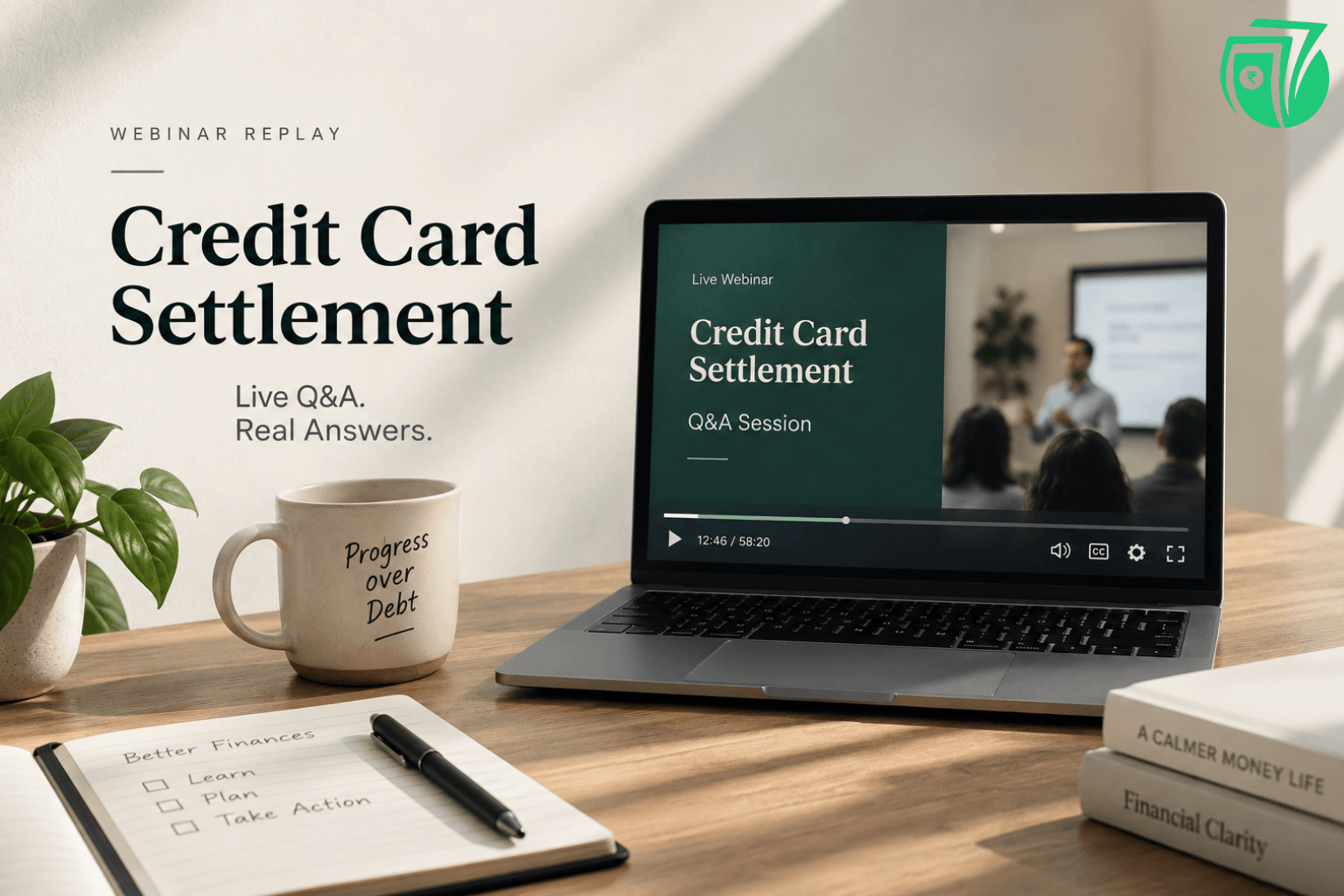
Missed our live Q&A on credit-card settlement? Watch the full replay below and get answers to the most common questions about settlement, negotiation, documentation, payment, and credit impact — straight from the session.
Webinar date: [WEBINAR DATE]
Speaker: [SPEAKER NAME], [SPEAKER TITLE]
Duration: [DURATION]
Key topics covered: What credit card settlement is, who it may suit, how negotiation works, CIBIL impact, and the settlement-to-NOC process.
Watch the Full Credit-Card Settlement Webinar
[Embed webinar video here]
[Webinar Title]
Duration: [DURATION]
In this session, [SPEAKER NAME] walks through how credit card settlement actually works in India, what borrowers should check before negotiating, and answers live questions submitted by attendees during the Q&A segment.
A full transcript is available below for anyone who prefers to read rather than watch, and for reference after viewing.
What We Covered in the Live Q&A
| Topic | Timestamp |
|---|---|
| What is credit-card settlement? | [00:00] |
| Who may consider settlement? | [00:00] |
| How negotiation works | [00:00] |
| Settlement amount | [00:00] |
| CIBIL impact | [00:00] |
| Settlement letter & payment | [00:00] |
| Audience Q&A | [00:00] |
Replace the placeholder timestamps above with the actual points in the recording once it’s edited.
Top Credit-Card Settlement Questions Answered
Q1. What is credit-card settlement?
Credit card settlement is an arrangement where the card issuer agrees to accept less than the full outstanding amount as a final, one-time resolution of the account. Instead of continuing to pay off the entire balance, the borrower and lender negotiate a reduced amount that, once paid, closes the account under agreed terms.
Q2. How do I know if settlement is appropriate?
Settlement is generally worth considering when you’re facing genuine financial hardship and full repayment isn’t realistically achievable within a reasonable timeframe — not simply when payments feel inconvenient. Before settlement, it’s worth exploring whether restructuring your repayment terms, or continuing standard repayment with some budget adjustments, could resolve the situation without the credit-report consequences that come with settlement.
Q3. How do I negotiate with a credit-card company?
A few things make a real difference:
- Understand your outstanding dues precisely — principal, interest, and any charges — before you start the conversation.
- Document your hardship clearly, with supporting evidence where possible (income disruption, medical costs, etc.).
- Make a realistic proposal — a lump-sum figure you can genuinely follow through on, not an optimistic guess.
- Obtain written terms before making any payment based on what’s discussed.
Q4. How much can a credit-card company reduce the outstanding amount?
There’s no fixed or guaranteed percentage. The final settlement amount depends on the specific lender’s policies, your account status, your documented hardship, and your ability to offer a realistic lump sum. Treat any percentage you’ve heard from another borrower’s experience as an illustration, not a benchmark for your own negotiation.
Q5. Does credit-card settlement affect CIBIL?
Yes. A settled account is generally reported as “Settled,” which is distinct from “Closed” — the status used when the full amount is repaid according to the original terms. A “Settled” remark typically has a negative impact on your credit score and remains visible on your credit report for a number of years, which is worth factoring into your decision upfront.
Q6. What should a settlement letter contain?
Before making any payment, make sure the written settlement letter includes:
- The account number
- The agreed settlement amount
- The payment deadline
- The approved payment method
- The terms governing the resolution
- Confirmation of what liability, if any, remains after payment
Q7. What happens after settlement?
Once you’ve made the agreed payment:
- Collect written confirmation from the lender that the payment was received.
- Request a No Dues Certificate or NOC, where applicable.
- Check that the credit bureau update reflects the settlement accurately once it’s reported.
- Shift focus to rebuilding your credit profile — paying other obligations on time, keeping utilisation low, and being patient, since recovery happens gradually.
Key Takeaways From the Webinar
- Settlement is a negotiated resolution, not automatic debt forgiveness.
- Don’t rely on verbal promises — get everything in writing.
- Obtain settlement terms in writing before making any payment.
- Understand the credit-report consequences before you commit.
- Keep every payment record and confirmation.
- Don’t assume every borrower receives the same settlement offer — outcomes are case-specific.
- Explore alternatives, like restructuring, if full repayment genuinely remains possible.
Download the Webinar Resources
- 📄 Webinar Transcript (PDF) — the full session, word for word
- ✅ Credit Card Settlement Checklist — what to verify before you negotiate
- 📋 Settlement Document Checklist — everything to gather before contacting your lender
- 🧮 Debt Assessment Worksheet — a simple starting point to organise your numbers
- 📝 Q&A Summary — a condensed version of this page for quick reference
[Link each resource once the corresponding file is finalised.]
Still Have Questions About Credit-Card Settlement?
Have a debt question we didn’t answer in the session?
👉 Submit a Question — we may cover it in a future webinar.
👉 Book a Free Call — talk through your specific situation directly.
👉 Get a Debt Assessment — understand your options before deciding on a next step.
Frequently Asked Questions
What is credit-card settlement?
An arrangement where the card issuer agrees to accept a reduced, negotiated amount as full and final resolution of your outstanding balance, instead of the complete amount owed.
How does credit-card settlement work in India?
The borrower demonstrates financial hardship, negotiates a settlement amount with the issuer, receives the terms in writing, makes the agreed payment, and collects confirmation and an NOC once it’s processed.
Can credit-card debt be settled for less than the outstanding amount?
Yes, that’s the core premise of settlement — the issuer accepts less than the full amount owed, based on their assessment of your account and hardship.
How does settlement affect CIBIL?
Settled accounts are typically reported as “Settled” rather than “Closed,” which generally has a negative impact on your credit score and stays visible on your report for a number of years.
What documents are needed for credit-card settlement?
Typically identity proof, your card/account statements, income proof, and documentation supporting your financial hardship.
What should I check before making a settlement payment?
Verify the account number, agreed settlement amount, payment deadline, approved payment method, and confirmation of what happens to any remaining liability — all in writing before you pay.
What is the difference between credit-card settlement and closure?
Closure means the full outstanding amount was repaid as originally agreed. Settlement means the issuer accepted a reduced amount, and this is reported differently on your credit report.
Can I negotiate credit-card settlement myself?
Yes, many borrowers negotiate directly with their issuer. Having your documentation and numbers organised in advance makes the process considerably smoother.
What happens after credit-card settlement?
You should receive written confirmation and, where applicable, a No Dues Certificate. Your account will be reported to credit bureaus as “Settled,” and rebuilding your credit profile becomes the next focus.
Is credit-card settlement suitable for everyone?
No. It’s generally appropriate for borrowers facing genuine, documented financial hardship where full repayment isn’t realistically achievable — not simply as a shortcut to reduce a manageable balance.
Didn’t get your specific question answered in the webinar or on this page? Our team can walk through your exact situation and help you figure out the right next step.