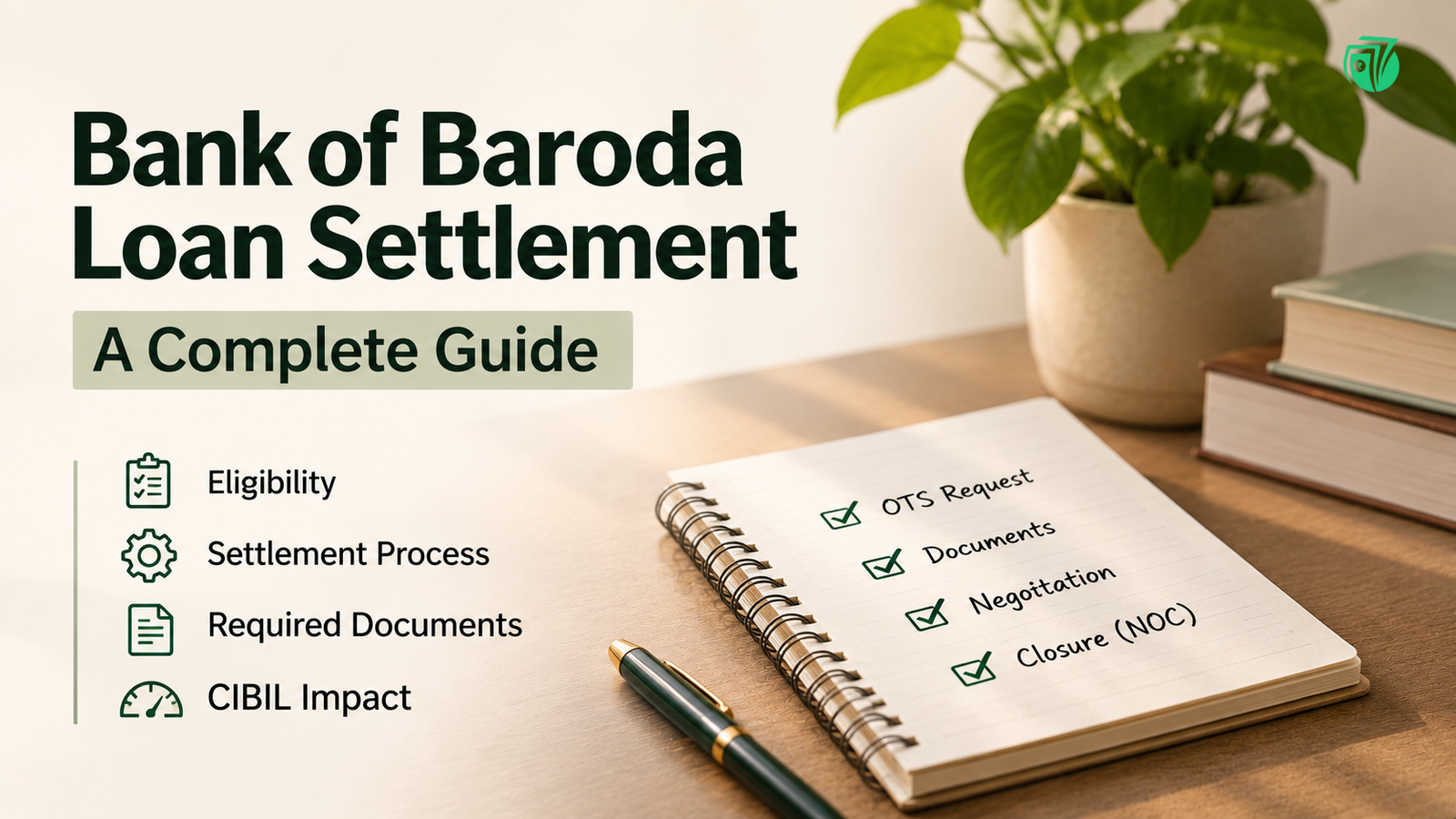
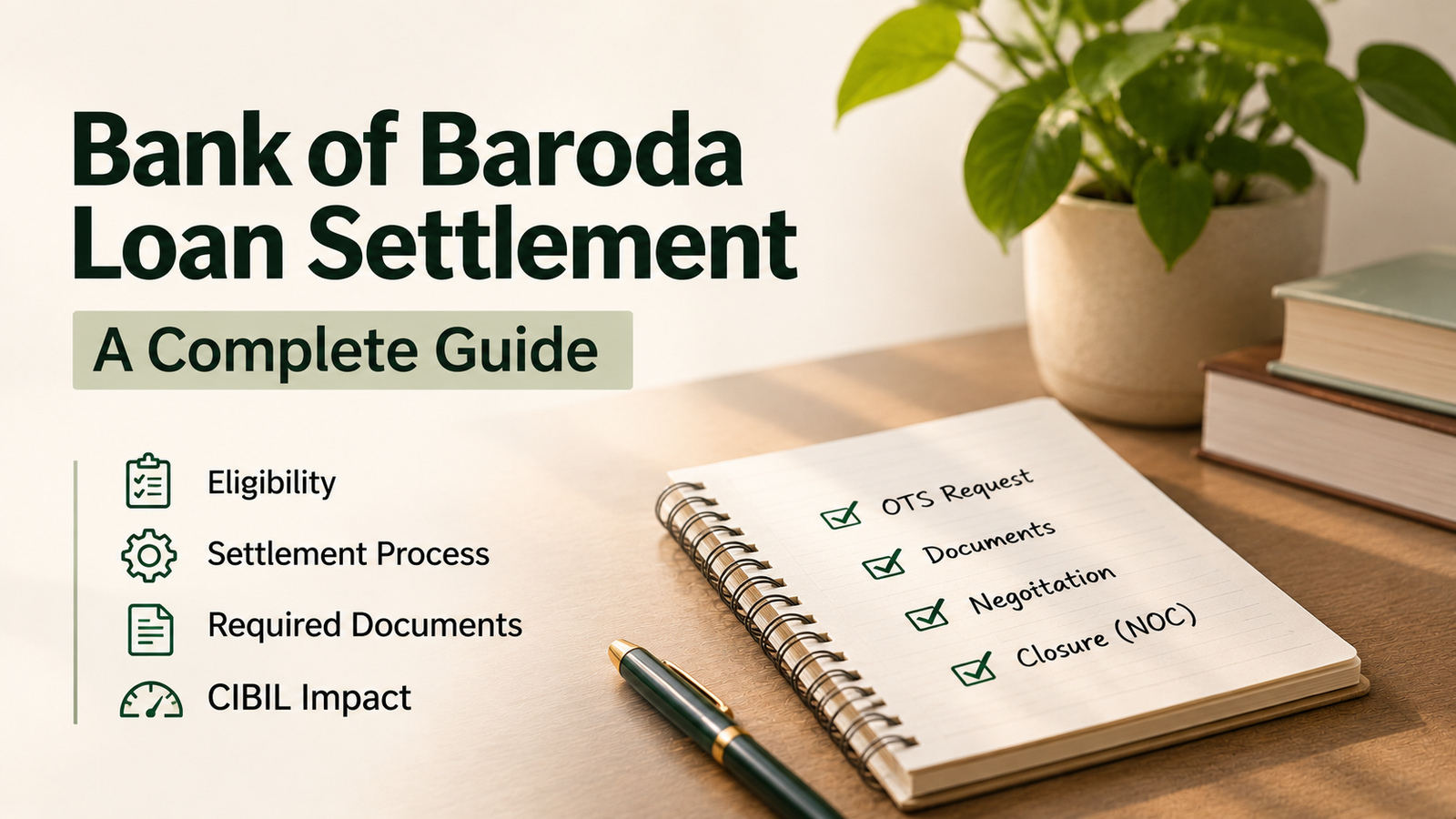
Central Bank of India Loan Settlement can be an option for borrowers struggling with loan repayments due to financial difficulties. A job loss, medical emergency or business slowdown can make regular EMIs difficult to manage. If your loan payments are piling up, understanding the One Time Settlement (OTS) process may help you explore possible repayment solutions.
Settlement can help in the right situation, but it is not a magic eraser. In this guide, we explain in plain language what a One Time Settlement (OTS) is, who may be eligible, how to apply (including online), which documents you need, what RBI rules say, and how it can affect your CIBIL score. We will also cover the alternatives you should look at first.

1. What Is Central Bank of India Loan Settlement?
Loan settlement is an agreement where the bank accepts a lower amount than your full outstanding dues and closes the account. You pay the agreed amount, usually in one go or within a short window, and the bank stops chasing the rest.
Meaning of One-Time Settlement (OTS)
OTS simply means you clear the agreed settlement amount at once (or in a few instalments within a fixed period), instead of continuing regular EMIs. Banks offer OTS mainly for accounts that are already overdue or classified as a Non-Performing Asset (NPA). For the bank, recovering something now is often better than a long, uncertain recovery process.
Loan Settlement vs Loan Waiver
People often mix these two up. A waiver usually comes through a government or bank scheme where a part of the loan is forgiven for a group of borrowers. A settlement is negotiated for your individual account. You still pay a reduced amount, and the bank reports the account as “Settled” rather than “Closed”. For a deeper look, read our guide on the difference between settlement and waiver.
How Does a Compromise Settlement Work?
RBI calls this a “compromise settlement”. The bank looks at your outstanding dues, your current financial position, the value of any security, and how likely it is to recover the full amount. Based on this, it may offer a settlement figure. The key word is may. The bank decides, not the borrower.
2. Does Central Bank of India Offer a One-Time Settlement Scheme?
Yes, Central Bank of India does settle loans through OTS, but not for everyone and not on fixed terms. Every settlement is decided under the bank’s own board-approved policy and the scheme that applies to your loan type.
Understanding the Bank’s OTS Policy
Like all regulated banks, Central Bank of India must follow a board-approved policy for compromise settlements. This policy sets out who can approve a settlement, how the amount is worked out, and what documents are needed. As a borrower, you will not see the full internal policy, but you can always ask your branch which OTS option applies to your account.
Central Bank of India Online OTS (e-OTS)
Here is something many borrowers do not know. Central Bank of India lists an Online OTS facility among its online banking services on its official website. This lets eligible borrowers start the settlement process online instead of only through the branch.
One honest caution: an online form being available does not mean your account qualifies, and it does not mean approval is guaranteed. It is just a door. What happens next still depends on the bank’s assessment.
Are Previous Special OTS Schemes Still Valid?
You may come across older news about a “Special OTS Scheme for MSE borrowers” from Central Bank of India. As per the bank’s scheme page, that scheme was valid only until 31 March 2024. It has expired, so please do not plan your settlement around its old terms. Always check the bank’s website or your branch for what is active today.
3. Who Is Eligible for Central Bank of India Loan Settlement?
There is no public, one-size-fits-all eligibility list. In practice, the bank considers settlement when a borrower genuinely cannot repay the full loan and recovery through normal EMIs looks unlikely.
Financial Hardship and Repayment Capacity
The bank wants to see a real reason why you cannot pay. Common reasons include job loss, a serious illness in the family, a big drop in business income, or the death of an earning member. The stronger and better documented your hardship, the more seriously your request is likely to be taken.
Overdue and NPA Loan Accounts
Most OTS offers are made on accounts that are already overdue for a long time or classified as NPA. Generally, a loan becomes an NPA when payments remain unpaid for more than 90 days. If your loan is regular and you are only slightly stretched, the bank is more likely to suggest restructuring than settlement.
Factors Considered by the Bank
- Total outstanding amount, including interest and charges
- How long the account has been overdue
- Your current income and assets
- Any security or collateral against the loan
- Your past repayment behaviour
- Whether the loan is under legal or recovery proceedings
Struggling to repay your Central Bank of India loan? Understanding your options is the first step towards a sensible decision. Connect with TrueSettle to explore debt-resolution options based on your situation. [GET A FREE CONSULTATION]
4. How to Settle Central Bank of India Loan? Step-by-Step Process
The Central Bank of India loan settlement process is fairly simple on paper. Most of the effort goes into preparing well and reading every document before you pay.
Step 1 – Review Your Outstanding Loan Amount
Ask the branch for a written statement showing principal, interest, penal charges and other fees. You cannot negotiate sensibly if you do not know the real number.
Step 2 – Contact Your Bank Branch
Visit the branch where your loan account is held and speak to the branch manager or the recovery officer. Ask directly whether your account can be considered for OTS.
Step 3 – Submit a Loan Settlement Application
Write a short, honest letter requesting settlement. Mention your loan account number, the reason for your hardship and the amount you can realistically pay. Keep a stamped acknowledgement copy. Our loan settlement letter format can help you draft it.
Step 4 – Provide Financial Hardship Documents
Attach proof that supports your story, such as a termination letter, medical bills or bank statements showing reduced income.
Step 5 – Wait for the Bank’s Settlement Decision
The bank will review your request internally. It may accept, reject or come back with a different figure. This can take a few weeks, so follow up politely in writing.
Step 6 – Review the OTS Approval Letter
Never pay on a verbal promise. Wait for the written OTS sanction letter and check the settlement amount, payment deadline, number of instalments (if any) and what happens if you miss a date.
Step 7 – Pay the Agreed Settlement Amount
Pay only through official banking channels into your loan account or the account named in the letter. Never pay cash to an agent and keep every receipt.
Step 8 – Collect the Settlement Letter and No-Dues Confirmation
Once payment is complete, ask for a final settlement letter and a No Dues Certificate (NDC). Keep these safely. You may need them years later to prove the matter is closed.
Quick Summary: The OTS Process at a Glance
| Step | What you should do |
|---|---|
| 1 | Check your exact outstanding dues |
| 2 | Confirm your loan account status |
| 3 | Contact the bank branch |
| 4 | Submit a written settlement request |
| 5 | Share proof of financial hardship |
| 6 | Review the written OTS offer |
| 7 | Pay as per the approved terms |
| 8 | Collect settlement letter and NDC |
A Simple Example
Let us take Rohit (name changed for illustration), a salaried borrower from Indore. He has an outstanding personal loan of ₹5 lakh with Central Bank of India. After losing his job, he misses EMIs for several months.
Rohit first collects his loan statement and confirms the full dues. He then visits the branch, explains his situation and submits a written settlement request with his termination letter and bank statements. He tells the bank honestly what he can arrange with help from family. The bank reviews his file and later issues a written offer. Rohit reads it carefully, pays within the deadline and collects his settlement letter and NDC.
Please note: this is a hypothetical example. It does not represent any actual Central Bank of India offer, settlement percentage or guaranteed outcome.
5. How to Apply for Central Bank of India Loan Settlement Online?
You can begin the process online if your account is eligible, but you should still treat the branch as your main point of contact.
Where to Find the Official Online OTS Facility
Go to the official Central Bank of India website and open the Online Banking section. Look for the Online OTS option. Use only the official website (centralbank.bank.in). Do not use links sent by unknown callers or WhatsApp messages.
How to Check Whether Your Account Is Eligible
The online facility usually asks for your loan account details and verifies them against the bank’s records. If your account is not covered, the system may not allow you to proceed. In that case, visit your branch and ask which settlement route applies to you.
Important Things to Verify Before Applying
- The website address is the bank’s official domain
- Your loan account number and personal details are correct
- You understand the amount and the payment timeline shown
- You receive an acknowledgement or reference number
- Any final offer is confirmed in writing by the bank
6. Documents Required for Central Bank of India Loan Settlement
Keeping your papers ready speeds things up and shows the bank you are serious. The exact list can vary by branch and loan type, but you will usually need:
- Identity and address proof: Aadhaar, PAN, passport or voter ID
- Loan account details: sanction letter, account number and latest loan statement
- Bank statements: usually the last 6 to 12 months
- Income proof: salary slips, ITR or business records
- Hardship evidence: termination letter, medical reports and bills, or proof of business loss, where applicable
- Written settlement application: signed and dated, with an acknowledgement copy for your records
The bank may ask for more documents depending on your case.
7. What Are the RBI Guidelines for Loan Settlement?
RBI does not decide individual settlements, but it sets the rules banks must follow. These rules now sit in RBI’s Commercial Banks – Resolution of Stressed Assets Directions, 2025. Here is what they mean for you.
Board-Approved Settlement Policy
Every bank must have a settlement policy approved by its board. This keeps the process structured, with clear approval levels and documented reasons for each decision.
Is Loan Settlement a Borrower’s Legal Right?
No. Settlement is not something you can demand. Approval is entirely at the bank’s discretion and based on its commercial judgement. Anyone who promises you a guaranteed settlement is not being honest with you.
Three-Month Payment Rule
If the time given to pay the agreed settlement amount is more than three months, RBI treats it as a restructuring, not a settlement. In simple words, a true OTS is expected to be paid within a short window.
Cooling Period After Settlement
After a compromise settlement, there is a minimum cooling period of 12 months before the bank can give you fresh credit (for non-farm loans). Banks can set a longer period in their own policy. So plan for a phase where new borrowing from that bank may not be possible.
8. How Does Central Bank of India Loan Settlement Affect CIBIL Score?
This is the part most borrowers underestimate. Settlement ends the immediate pressure, but it leaves a mark on your credit report.
Settled vs Closed Status
When you repay a loan in full, it shows as Closed. When you settle, the bank reports it as Settled, which tells future lenders that you did not repay the full amount. Settlement does not automatically improve your CIBIL score. Your score has usually already dropped because of the missed EMIs.
Impact on Future Loan Applications
Lenders look closely at a “Settled” remark. You may face rejections, higher interest rates or lower loan amounts for some time. Credit cards and home loans can be harder to get in the short term.
How to Rebuild Your Credit Profile
- Check your credit report a month or two after settlement to confirm it is updated correctly
- Raise a dispute with the credit bureau if anything is wrong
- Pay every remaining bill and EMI on time
- Consider a secured credit card and use it lightly
- Avoid applying for many loans at once
Over time, steady and responsible behaviour helps your profile recover.
Worried about your CIBIL score after settlement? TrueSettle can help you understand the impact and plan your next steps. [GET A FREE CONSULTATION]
9. What Are the Alternatives to Loan Settlement?
Settlement should usually be your last option, not your first. If you can still repay with some breathing room, these routes protect your credit profile better.
Loan Restructuring
The bank changes the terms of your loan, such as extending the tenure or adjusting the interest structure, so the EMI becomes affordable. You still repay the full amount, just more slowly.
EMI Rescheduling
If your problem is temporary, you can ask the bank to shift EMI dates or give a short moratorium. This works well for short gaps in income.
Loan Refinancing
You move your loan to another lender offering a lower rate or longer tenure. This works only if your credit profile is still reasonably healthy.
Debt Consolidation
If you have several loans and cards, you can combine them into one loan with a single EMI. It is simpler to manage and can lower your overall interest cost.
Loan Settlement vs Loan Restructuring
| Point | Loan Settlement | Loan Restructuring |
|---|---|---|
| What changes | Dues settled for a negotiated amount | Repayment terms are changed |
| Amount repaid | May involve waiver of part of the dues | Usually the full outstanding amount |
| Credit report | Usually shows “Settled” | Depends on the arrangement |
| Bank approval | Required | Required |
| Best suited for | Long-term inability to repay | Temporary financial stress |
10. What Should You Do If the Bank Rejects Your Loan Settlement Request?
A rejection is not the end of the road. It usually means the bank needs more information, or that it expects you to repay in another way.
Request Written Clarification
Ask the branch to tell you, in writing if possible, why the request was declined. Sometimes it is a missing document or an amount the bank feels is too low.
Explore Repayment Alternatives
Ask whether restructuring or EMI rescheduling is possible instead. You can also revise your offer if your circumstances or family support change.
Follow the Bank’s Grievance Redressal Process
If you feel you were treated unfairly, or recovery agents are harassing you, raise a complaint through Central Bank of India’s grievance redressal channels. If you do not get a satisfactory reply within 30 days, you can approach the RBI Ombudsman through the RBI CMS portal.
11. Important Things to Check Before Accepting a Loan Settlement
Before you say yes and transfer money, slow down and tick off this list:
- The offer is on the bank’s official letterhead and signed by an authorised officer
- The settlement amount and payment deadline are clearly stated
- The letter says the account will be treated as fully settled once you pay
- There is no hidden balance, extra charge or condition you did not agree to
- Payment goes to the bank’s official account, never to an individual
- You know when you will get the final settlement letter and NDC
- You have thought about the CIBIL impact and whether you can avoid settlement
If something is unclear, ask before you pay. Changing terms after payment is much harder.
12. How TrueSettle Can Help You Explore Loan Settlement Options
Dealing with a bank when you are already under stress can feel overwhelming. That is where TrueSettle steps in.
Our team helps you understand your loan position, prepare your documents, write a clear settlement request and weigh settlement against restructuring and other options. We also guide you on handling recovery calls and what to check before signing anything. We do not promise a fixed settlement amount, because the final decision is always the bank’s. What we promise is honest guidance at every step.
You can also read our guides on the SBI loan settlement process, Canara Bank OTS process, Union Bank loan settlement and the HDFC Bank loan settlement guide.
Struggling to Repay Your Central Bank of India Loan? Understanding your repayment options is the first step towards making an informed financial decision. Connect with TrueSettle to explore possible debt-resolution options based on your financial situation. [GET A FREE CONSULTATION]
Frequently Asked Questions
Does Central Bank of India offer loan settlement?
Yes. Central Bank of India settles loans under its applicable policies, including an online OTS facility. Eligibility and approval depend on the bank’s assessment of your account and the scheme terms that apply.
Can I apply for Central Bank of India loan settlement online?
Central Bank of India lists an Online One Time Settlement facility on its official website. You should check whether your particular loan account is eligible and confirm any offer in writing.
Is loan settlement a borrower’s legal right?
No. Under RBI’s compromise settlement framework, approval is at the bank’s discretion and based on its commercial judgement.
Does Central Bank of India loan settlement affect CIBIL?
Yes. A settled loan is reported differently from a fully closed loan. The “Settled” status can affect future credit applications, so check your credit report after settlement.
What documents are required for loan settlement?
Usually identity proof, loan account details, income records, bank statements and evidence of financial hardship. The bank may ask for more documents.
Can Central Bank of India waive loan interest?
In a settlement, the bank may agree to accept less than the total dues, which can include giving up part of the interest and penal charges. There is no fixed waiver percentage, and it depends entirely on the bank’s decision.
How do I get a Central Bank of India No Dues Certificate after settlement?
Once you pay the full settlement amount, request the final settlement letter and NDC from your branch in writing. Keep copies of all payment receipts until you receive them.
Disclaimer: This article is for general information only and is not legal or financial advice. Scheme details can change, so please confirm current terms with Central Bank of India or your branch before acting. Last fact-checked: 12 November 2026.