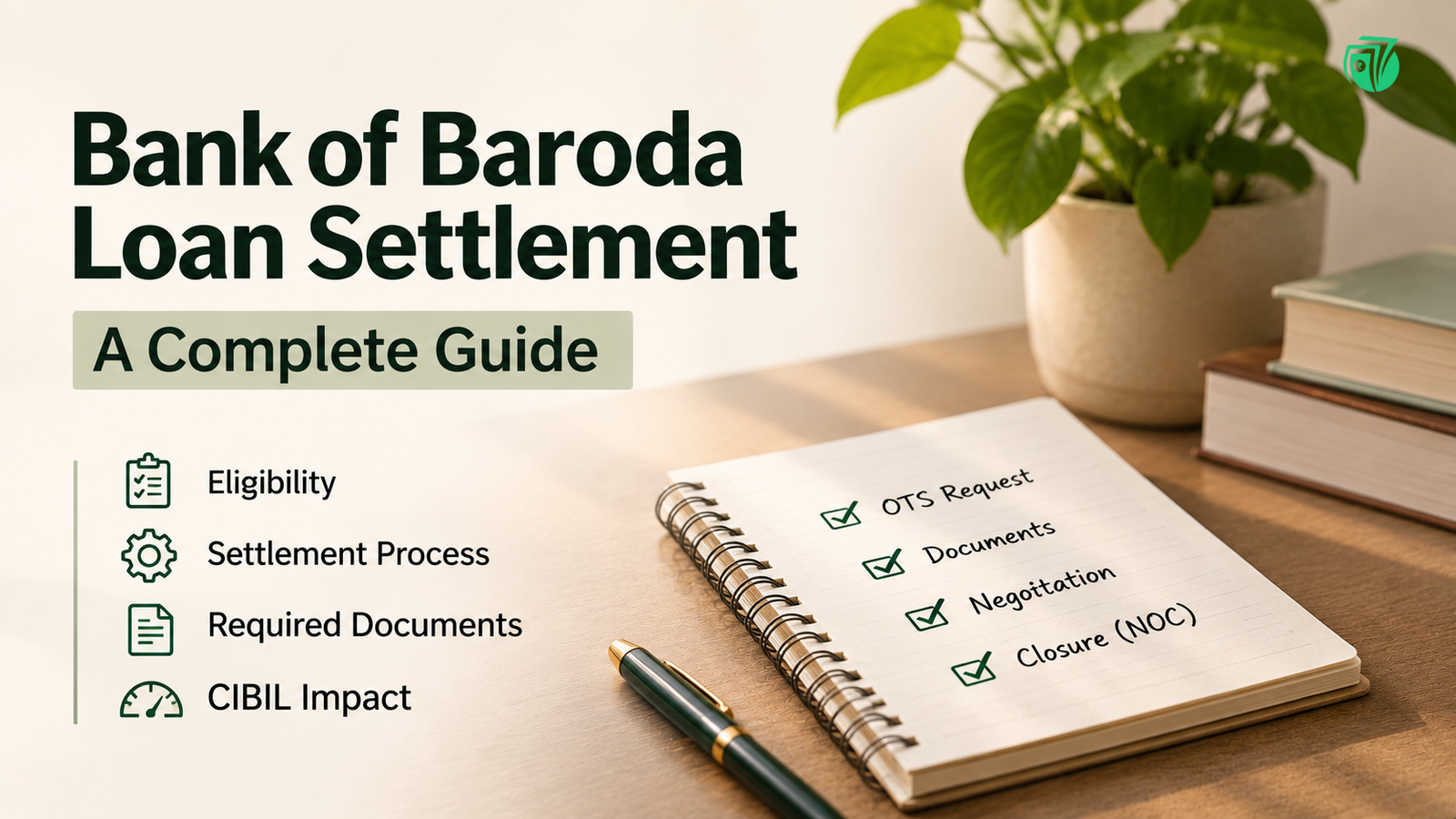
Central Bank of India loan settlement is a process in which a borrower who can no longer repay in full asks the bank to accept an agreed amount to close the outstanding dues. The bank may consider a One Time Settlement (OTS) based on its own policies, the borrower’s financial situation and the loan’s recovery status. Approval is never guaranteed, and a settlement can affect your credit report.
If you are reading this, there is a good chance the EMIs have started to feel heavier than they used to. Maybe a job loss, a business that slowed down, a medical emergency, or simply too many loans at once. The calls from the bank get more frequent, the notices look more serious, and you start wondering whether there is any way out that doesn’t involve paying money you simply don’t have.
There often is a way to talk to the bank. It is called loan settlement, and this Central Bank of India loan settlement guide walks you through it honestly: what it is, how it works with Central Bank of India, what papers you will need, what it does to your CIBIL score, and what to do if the bank says no. No false promises, no magic numbers. Just a clear picture so you can decide your next step with a calmer head.

What Is Central Bank of India Loan Settlement?
A loan settlement is a negotiated deal. You tell the bank, “I cannot repay the full amount, but I can pay this much,” and if the bank agrees, it accepts that amount to close your dues. Banks often call this a One Time Settlement (OTS) or a compromise settlement.
Why would a bank agree to take less? Because chasing a stressed account costs time, staff and legal fees, and recovery is uncertain. A realistic payment today can sometimes make more sense for the bank than a long recovery process. That is the commercial logic behind every settlement.
It is important to understand what settlement is not:
- It is not full repayment. With full repayment, you clear every rupee of principal, interest and charges, and the account is marked closed.
- It is not a waiver you are entitled to. The bank decides whether to settle, and on what terms.
- It is not invisible. A settled account is usually reported to credit bureaus as “settled”, which lenders read very differently from “closed”.
In India, the Reserve Bank of India’s Framework for Compromise Settlements and Technical Write-offs (June 2023) requires banks to have Board-approved policies for such settlements. So Central Bank of India, like other banks, works within its own internal policy and RBI’s broader rules.
Does Central Bank of India Offer One Time Settlement (OTS)?
Yes, Central Bank of India, like most public sector banks, can consider eligible stressed accounts for one-time settlement. But there is a catch many borrowers miss: OTS is decided case by case. There is no single permanent offer that applies to everyone.
From time to time, banks also run special OTS schemes for particular loan types or account categories, with their own eligibility dates and terms. Whether such a scheme is open right now, and whether your account qualifies, is something only the bank can confirm. So before you plan around any scheme you heard about from a friend or a WhatsApp forward, ask your branch or check the bank’s official website.
A useful way to think about it: an OTS scheme, if one is running, may give you a clearer framework. Without one, you can still make a settlement request, and the bank will assess it under its regular policy.
Who Is Eligible for Central Bank of India Loan Settlement?
There is no public checklist that guarantees eligibility. In practice, the bank weighs a few things together:
- Genuine repayment difficulty. Loss of income, business losses, medical expenses or similar hardship that you can show on paper.
- Account status. Settlement is usually discussed for accounts that are overdue or have been classified as a Non-Performing Asset (NPA). A borrower paying EMIs on time will rarely be offered a reduced settlement.
- Your ability to pay a lump sum. The bank wants to know you can actually fund the amount you are offering, either in one go or within a short, agreed window.
- Security and recovery prospects. If the loan is backed by property or other collateral, the bank will compare your offer with what it could realistically recover.
- Documentation. Clear income proof, statements and a consistent story make a proposal far easier to assess.
At the end of the day, it is the bank’s decision. Meeting all these points improves your chances, but it does not create a right to settle.
How to Settle Central Bank of India Loan: Step-by-Step Process
Every case is different, but most Central Bank of India settlements move through these eight stages. Use this part of the guide as your checklist.
- Review your outstanding loan details. Ask the branch for a current statement showing principal, interest, penal charges and the total due. You cannot negotiate a number you don’t fully understand.
- Understand your account and recovery status. Is the account overdue, classified as NPA, or already under legal or recovery action? This shapes how the bank will view your request.
- Prepare your hardship documents. Gather proof of why you can’t pay in full: salary slips or their absence, termination letter, business accounts, medical bills, bank statements.
- Submit a written OTS proposal. Write to the branch or the authorised recovery office. Explain your situation briefly and honestly, and state the amount you can pay and how quickly. Keep a stamped acknowledgement or a dated copy.
- Negotiate with the authorised bank team. The bank may counter your offer or ask for more documents. Stay polite, stay consistent, and don’t promise an amount you can’t arrange.
- Get written settlement approval. Never pay a settlement amount on a verbal promise. Wait for a formal sanction letter that states the agreed amount, the payment deadline and that the dues will be treated as settled on payment.
- Pay exactly as per the approved terms. Pay only into the bank’s official account, on or before the deadlines, and keep every receipt. Missing a deadline can cancel the settlement.
- Collect closure documents and check your credit report. Get the No Dues Certificate or settlement closure letter, take back any original property documents if applicable, and check your CIBIL report after a couple of months to confirm the account is updated correctly.
One honest note on timelines: there isn’t a standard one. A simple personal loan may move faster; a secured loan with legal proceedings can take much longer.
Documents Required for Central Bank of India OTS
The exact list depends on your loan type and the bank’s requirements, but keeping these ready saves a lot of back and forth.
| Document | Why the bank needs it |
|---|---|
| Written settlement application | Your formal request, stating the amount and payment plan you are offering |
| Loan account statement | Confirms the outstanding dues being settled |
| KYC documents (PAN, Aadhaar, address proof) | Identity verification |
| Income proof or proof of income loss | Salary slips, ITRs, termination or salary-cut letter |
| Bank statements (last 6 to 12 months) | Shows your real cash position |
| Hardship evidence | Medical bills, business loss statements, or other supporting papers |
| Source of settlement funds | Shows how you will arrange the lump sum (savings, family support, asset sale) |
| Business financials (for business loans) | Balance sheet, GST returns, profit and loss statements |
Tip: keep photocopies of everything you submit and note who received it and when.
Central Bank of India Personal, Business, Home Loan and KCC Settlement
The basic process stays the same, but the type of loan changes how the conversation goes.
Personal loan settlement. Personal loans are usually unsecured, so the bank has no property to fall back on. That can make it more open to a realistic offer, but it is still under no obligation to accept a reduced amount.
Business loan and MSME settlement. The bank will look closely at the health of the business, its cash flows, any collateral and guarantees. Clean financial records make a big difference here. Small businesses should also ask whether any restructuring option is available before going straight to settlement.
Home loan settlement. Home loans are secured by the property itself, so settlements are less common and the bank compares any offer with the property’s realisable value. If the account has reached the stage of SARFAESI action, get proper advice quickly. A settlement request does not automatically stop recovery proceedings.
Kisan Credit Card (KCC) and farm loan settlement. Farm loans are sometimes covered by special schemes or government relief measures. Check with the branch whether any such scheme currently applies to your account. Under RBI’s framework, banks set their own rules on fresh farm lending after a settlement.
How Does Loan Settlement Affect Your CIBIL Score?
Let’s be straightforward: settlement will hurt your credit profile. When the bank reports the account as “settled”, future lenders see that the full contractual dues were not repaid. That usually means lower scores and tougher approvals for some time.
There is also a lender-side rule to know. Under RBI’s framework, the bank that settles with you must wait at least 12 months before giving you fresh non-farm credit, and it may set a longer period in its own policy.
That said, settlement is often weighed against a worse alternative: months or years of defaults, penal interest and recovery action, which also damage your credit. Many borrowers see settlement as a way to stop the bleeding and start rebuilding.
If you settle, here is how to begin the recovery:
- Keep your settlement letter and No Dues Certificate safe for life.
- Check your credit report and raise a dispute if anything is reported wrongly.
- Pay every other EMI and card bill on time from now on.
- Consider a small secured credit card later to rebuild a positive record.
- If your finances recover, you can ask the bank whether paying the remaining difference would let the account be updated to “closed”. This is at the bank’s discretion.
What Happens if the Bank Rejects Your Settlement Request?
A rejection feels like a door closing, but it is often just the first round of a conversation. Here is what you can do:
- Ask why. Politely request the reason. Sometimes the offer was simply too low, or a document was missing.
- Revisit your offer. If you can arrange a little more, or pay faster, a revised proposal may be considered.
- Explore other options. Depending on your situation, restructuring, a longer tenure or a temporary repayment plan may be possible.
- Use the grievance route if you were treated unfairly. You can raise a complaint with the bank’s grievance cell, and if it is not resolved, approach the RBI Integrated Ombudsman for service-related complaints.
- Get advice if legal action has started. If you have received a legal notice, a SARFAESI notice or a court summons, speak to a qualified lawyer. Don’t ignore deadlines.
Frequently Asked Questions About Central Bank of India Loan Settlement
1. Can I settle my Central Bank of India loan?
You can request a settlement if you are facing genuine repayment difficulty. Approval depends on the bank’s policies, your loan status and its assessment of your proposal.
2. Does Central Bank of India offer an OTS scheme?
The bank may consider eligible accounts for one-time settlement under its policies or under special schemes it runs from time to time. Confirm current availability and eligibility directly with the bank.
3. Can I settle a Central Bank of India personal loan?
Yes, a personal loan borrower can submit a settlement request. The bank, however, is not obliged to accept a reduced amount.
4. How long does Central Bank of India loan settlement take?
There is no fixed timeline. It depends on document checks, negotiation, internal approvals and how complex the account is.
5. Will loan settlement affect my CIBIL score?
Yes. An account reported as “settled” signals that the full dues were not repaid, which usually lowers your score and affects future borrowing.
6. What happens if Central Bank of India rejects my OTS request?
You can ask for the reason, revise your proposal, explore restructuring or other repayment options, and use the grievance process if needed.
7. Can I negotiate a loan settlement without an advisor?
Yes. You can approach the bank directly. Professional help is optional, though cases involving legal or recovery action may benefit from qualified advice.
8. Is loan settlement the same as loan closure?
No. Closure means full repayment. Settlement means the bank accepted a lower amount. The documents and credit reporting differ for each.
9. Should I pay any amount before getting the settlement letter?
Avoid it. Make settlement payments only after you receive written approval with the agreed amount and deadlines, and only to the bank’s official account.
10. Will recovery agents stop calling once I apply for settlement?
Not automatically. Recovery can continue until a settlement is approved. Agents must still follow RBI’s conduct rules, and you can complain to the bank if they harass or threaten you.
How TrueSettle Can Help You Understand Your Settlement Options
This guide gives you the basics, but every loan has its own history, numbers and pressure points. Dealing with that alone can be exhausting, and you don’t have to figure it out in silence.
At TrueSettle, we help borrowers understand their outstanding dues, what settlement could realistically look like, which documents to prepare and what their next steps might be. We explain the trade-offs clearly, including the credit impact, so you can make a decision you are comfortable with.
Need Help Understanding Your Central Bank of India Loan Settlement Options?
Facing difficulty managing your loan repayments? Talk to TrueSettle for a clear, no-pressure look at your options.
Request a Free Consultation
Loan settlement is subject to lender approval. Outcomes and credit-reporting consequences vary by case. This article is for general information and is not legal or financial advice.
Sources
- Reserve Bank of India, Framework for Compromise Settlements and Technical Write-offs, June 8, 2023
- Reserve Bank of India, FAQs on the Framework for Compromise Settlements, June 20, 2023