If you’re negotiating a settlement on your SBI credit card, the settlement letter is the document that actually protects you. It’s the written record of what’s been agreed — and it’s the reason you should never make a settlement payment based on a phone call or an informal message alone.
A settlement letter is different from a regular credit card statement or a collection notice. It’s a specific document establishing the agreed settlement amount and the conditions attached to it. This guide walks through an illustrative sample, the essential details to check for, how to verify a letter is genuine, and what to do once you’ve paid.
What Is an SBI Credit Card Settlement Letter?
A settlement letter is written documentation of the agreed settlement terms between you and SBI Card. It generally specifies:
- The amount you’re required to pay
- The conditions attached to the arrangement
It provides a written record of exactly what’s been agreed — something you can rely on if a question ever comes up later. You should review and verify this document carefully before making any payment.
Important Distinction
Keep these three documents clearly separate:
- Settlement Letter — records the agreed settlement terms.
- Credit Card Statement — shows your transactions, outstanding dues, and applicable charges.
- Post-Settlement Confirmation/No-Dues Document — confirms your account status after the settlement conditions have been fulfilled.
SBI Credit Card Settlement Letter Format – Sample
This is an illustrative reference format only, not an official SBI Card document.
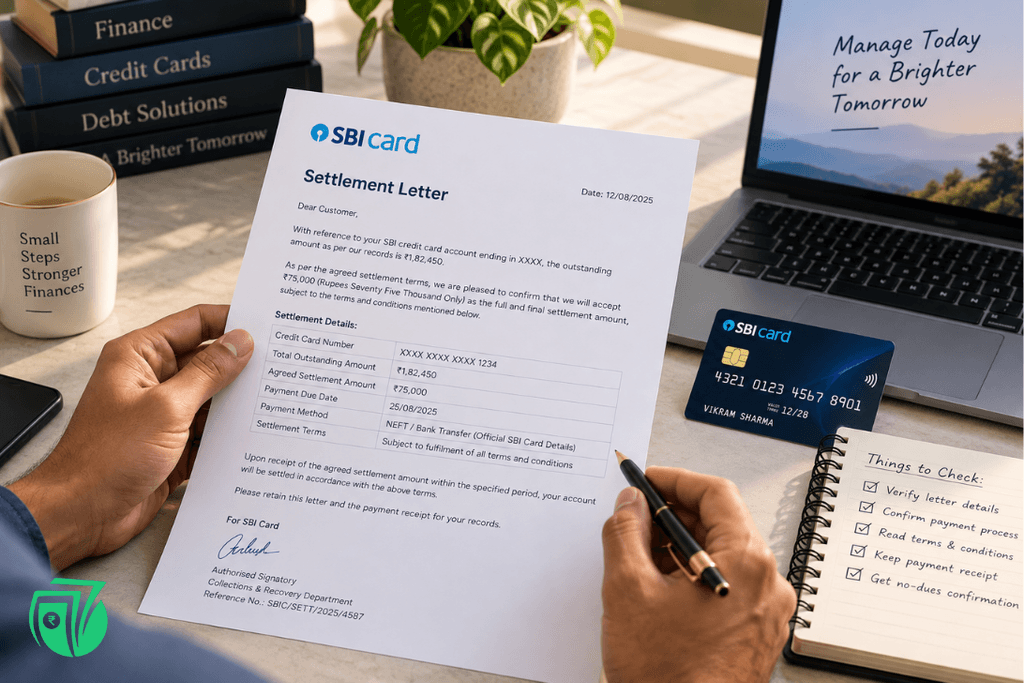
SBI Credit Card Settlement Letter – Illustrative Format
Date: [DD/MM/YYYY]
To,
[Cardholder’s Full Name]
[Address]
Subject: Settlement of SBI Credit Card Account
Dear [Customer Name],
With reference to your SBI credit card account ending in XXXX, the outstanding amount as per the settlement discussion is ₹[Total Outstanding].
As per the agreed settlement terms, the lender has agreed to accept ₹[Settlement Amount] as the settlement amount, subject to the terms and conditions mentioned in this communication.
Settlement Details:
- Credit Card/Account Number: XXXX XXXX XXXX [Last 4 Digits]
- Total Outstanding Amount: ₹[Amount]
- Agreed Settlement Amount: ₹[Amount]
- Payment Due Date: [Date]
- Payment Method/Instructions: [Official Payment Details]
- Settlement Terms: [Applicable Terms]
Upon receipt of the agreed settlement amount within the specified period and subject to the applicable terms, the account will be dealt with in accordance with the settlement arrangement.
Please retain this letter and the payment receipt for your records.
For SBI Card
[Authorised Signatory]
[Department]
[Reference Number, if applicable]
Disclaimer: This is a hypothetical sample created for educational purposes. It is not an official SBI Card settlement letter and should not be used as a substitute for a document issued by SBI Card or its authorised representative.
What Information Should an SBI Credit Card Settlement Letter Contain?
1. Cardholder’s Full Name
Your name should correspond exactly with the lender’s records.
2. Credit Card or Account Details
The relevant card or account should be identifiable using appropriate masked details.
3. Total Outstanding Amount
The document should clearly state the outstanding amount relevant to the settlement.
4. Agreed Settlement Amount
The exact amount you’re expected to pay should be clearly and unambiguously mentioned.
5. Payment Deadline
Check the exact date by which the payment must be completed.
6. Payment Instructions
Verify the authorised payment method and destination carefully before making any transfer.
7. Settlement Terms and Conditions
Read every applicable condition carefully before proceeding.
8. Treatment of Remaining Dues
The document should clearly explain how any remaining balance is treated under the settlement arrangement.
9. Account/Credit-Reporting Status
Understand how your account is expected to be reported after settlement, subject to applicable reporting requirements.
10. Authorised Details
The communication should be verifiable as genuinely originating from SBI Card or an authorised channel.
Why Is an SBI Credit Card Settlement Letter Important?
- Provides written evidence of the agreed arrangement.
- Helps avoid misunderstandings about the settlement amount.
- Establishes the payment deadline and conditions clearly.
- Allows you to review the terms before committing to payment.
- Can be retained with your payment records for future reference, potentially years later.
Key warning: do not rely solely on verbal assurances about a credit card settlement. Obtain and verify the applicable terms in writing before making any payment.
How to Get an SBI Credit Card Settlement Letter
Step 1: Check Your Outstanding Dues
Review your latest SBI Card statement and account information.
Step 2: Contact SBI Card Through Official Channels
Discuss your financial situation and ask about the options genuinely available to you.
Step 3: Explain Your Financial Hardship
If requested, provide relevant supporting documentation.
Step 4: Discuss the Settlement Terms
Understand:
- The settlement amount
- The payment deadline
- The payment method
- Any applicable conditions
Step 5: Request Written Confirmation
Obtain the settlement terms in writing before making the agreed payment.
Step 6: Verify the Document
If you have any doubts, confirm the settlement communication through official SBI Card channels.
How to Verify an SBI Credit Card Settlement Letter
Verification Checklist
- Check your name.
- Check the relevant card/account details.
- Confirm the outstanding amount.
- Confirm the settlement amount.
- Check the payment deadline.
- Verify the payment instructions.
- Review all settlement conditions.
- Check the source of the communication.
- Contact SBI Card through official channels if anything appears unclear.
Red Flags to Watch For
- Requests to transfer money to an unrelated personal account.
- Pressure to pay immediately.
- Missing account information.
- Unclear treatment of the remaining balance.
- Suspicious or altered documents.
- Requests for sensitive information through unverified channels.
What to Check Before Paying the Settlement Amount
☐ Correct name and account details
☐ Correct outstanding amount
☐ Exact settlement amount
☐ Payment deadline
☐ Official payment instructions
☐ Settlement terms and conditions
☐ Treatment of remaining dues
☐ Applicable credit-reporting information
☐ Document/source verification
Don’t make payment until you understand the applicable terms and have verified the communication.
What Happens After You Pay the SBI Credit Card Settlement Amount?
Keep Your Payment Proof
Save:
- Your transaction receipt
- A bank statement showing the payment
- The settlement letter
- Relevant emails or messages
Obtain Appropriate Post-Settlement Documentation
Request relevant confirmation or documentation regarding your account once you’ve fulfilled the settlement terms.
Check Your Credit Report
After the applicable reporting period, review your credit report to confirm the account information is accurate.
SBI Credit Card Settlement vs Credit Card Closure
| Factor | Full Payment/Closure | Settlement |
|---|---|---|
| Amount paid | Full dues | Reduced amount agreed with lender |
| Remaining dues | None after full repayment | Handled according to settlement terms |
| Credit reporting | Generally more favourable | May be reported as “Settled” |
| Credit impact | Generally better | Can negatively affect future borrowing |
| Suitable for | Borrowers able to repay | Certain financial-hardship situations |
Does SBI Credit Card Settlement Affect CIBIL?
- The settlement letter itself does not determine your CIBIL score.
- Settlement of the account can affect your credit profile.
- A settled account may be reported as “Settled” rather than “Closed,” subject to applicable reporting.
- Future lenders may consider this information while evaluating credit applications.
- Responsible repayment behaviour after settlement can help rebuild your creditworthiness over time.
There’s no way to state that every borrower will experience a fixed number of CIBIL points lost — the actual impact varies by individual credit profile.
Can You Negotiate the Amount in an SBI Credit Card Settlement?
- Settlement terms may be discussed with the lender where the option is genuinely available.
- Assess your actual repayment capacity honestly before making an offer.
- Keep genuine financial-hardship documentation ready.
- Don’t agree to an amount you cannot realistically pay, just to speed things along.
- Once terms are actually agreed, get them documented in writing.
What If the SBI Settlement Letter Contains an Error?
Possible errors to watch for:
- Incorrect name
- Wrong card/account details
- Incorrect outstanding balance
- Incorrect settlement amount
- Wrong payment deadline
- Unclear settlement conditions
What to Do
Do not make payment based on an incorrect or unclear document. Contact SBI Card through official channels and request clarification or a corrected communication before proceeding.
What If You Lose Your SBI Credit Card Settlement Letter?
- Keep both digital and physical copies whenever possible, from the outset.
- Check your registered email and SMS records for a copy.
- Contact SBI Card through official channels if you can’t locate it.
- Ask for appropriate confirmation or a copy of the settlement communication where available.
- Keep your payment records safe even if the original document is unavailable.
Common Mistakes to Avoid
1. Paying Before Receiving Written Settlement Terms
Always wait for documentation first.
2. Treating an Online Sample as an Official SBI Card Document
The sample above is educational only.
3. Not Checking the Settlement Amount
Verify every figure carefully.
4. Ignoring the Payment Deadline
This can jeopardize the entire arrangement.
5. Paying Through an Unverified Channel
Confirm the authorised payment method first.
6. Not Keeping Payment Proof
Retain everything, ideally indefinitely.
7. Assuming “Settled” Means “Closed”
These are genuinely different statuses.
8. Ignoring the Credit-Report Impact
Understand this before you commit.
Frequently Asked Questions
What is an SBI credit card settlement letter?
A written document confirming the agreed settlement amount and terms for resolving your SBI credit card dues.
How can I get an SBI credit card settlement letter?
Contact SBI Card through official channels, explain your financial hardship, discuss the settlement terms, and request written confirmation before making any payment.
What should an SBI credit card settlement letter contain?
Your name, card/account details, total outstanding amount, agreed settlement amount, payment deadline, payment instructions, settlement terms, and credit-reporting status.
Can I use an online SBI settlement letter sample?
Only as an educational reference to understand what such a document should contain — never as an official document. The actual letter must come from SBI Card or its authorised channel.
Is an SBI credit card settlement letter important?
Yes, it serves as written evidence of the agreed terms, which matters if any dispute arises later about what was actually agreed.
Should I pay before receiving the settlement letter?
No. Always wait for the official written settlement letter before making any payment.
How can I verify an SBI credit card settlement letter?
Check your name and account details, confirm the settlement amount and deadline, review the payment instructions, and contact SBI Card’s official channels if anything seems unclear.
What happens after paying the SBI credit card settlement amount?
You should receive confirmation of the payment and, where applicable, documentation confirming your account’s resolved status. Your credit report should be updated accordingly.
Does SBI credit card settlement affect CIBIL?
Yes. A settled account is generally reported differently from a fully repaid one, typically as “Settled,” which can negatively affect your credit score and future borrowing.
What is the difference between a settlement letter and a post-settlement/no-dues document?
A settlement letter records the agreed terms before or at the time of payment. A post-settlement or no-dues document confirms afterward that the agreed dues have been resolved.
Final Takeaway
An SBI credit card settlement letter documents the agreed settlement terms between you and the bank. Always check the settlement amount, deadline, payment instructions, and applicable conditions carefully before paying. Online samples should be used only as educational references — the actual settlement communication should always come from SBI Card or an authorised channel. Keep the settlement letter and your payment proof safely, and understand the potential credit-reporting consequences of settlement.
Struggling with your SBI credit card dues? Get a personalised assessment of your debt situation and understand whether settlement or another repayment option may be suitable for you.
👉 Get a free debt assessment with TrueSettle
👉 Explore your settlement options before approaching SBI Card.