A growing business, mounting expenses, and an overdue credit card eventually pushed her account into default. What followed wasn’t a quick fix — it was a slow, deliberate journey from financial uncertainty to resolving the debt and finally holding a piece of paper that confirmed it was over.
This is her story. It’s one case study, not a template — every borrower’s account, lender, and circumstances are different. But the steps she went through, and what she learned along the way, are worth understanding if you’re staring down a similar situation.
Note: This case study illustrates a typical journey from credit card default to resolution. Details have been adapted for illustration, and the outcome described is specific to this scenario — not a guarantee of what any individual borrower will achieve.
Before the Default: How the Debt Started
Like many small business owners, she used her personal credit card to bridge the gaps her business cash flow couldn’t always cover — supplier payments that came due before client invoices were settled, a slow season that stretched longer than expected, the occasional emergency expense that couldn’t wait.
None of this felt reckless in the moment. The card was a tool, a way to keep the business moving without missing a beat. But over time, the balance stopped being something she cleared each month and became something she carried. She made her payments, mostly on time, and told herself she’d catch up once revenue picked back up.
The outstanding balance grew quietly in the background — the kind of debt that doesn’t announce itself until it’s already a problem.
When the Credit Card Account Went Into Default
Eventually, a particularly difficult stretch for the business meant she couldn’t keep up with even the minimum payments. One missed payment became two, then more. Interest and late charges kept adding to a balance that was already stretching beyond what she could realistically clear.
The collection calls started — first as reminders, then with increasing urgency. Each conversation added pressure without offering much clarity on what her actual options were. Meanwhile, running a business while managing this in the background took a toll that went beyond the numbers on the statement. It’s hard to make good financial decisions when you’re constantly reacting to the next call or notice.
The Turning Point: Deciding to Resolve the Debt
At some point, it became clear that continuing on the same path — sporadic payments, mounting interest, ongoing collection pressure — wasn’t leading anywhere productive. The debt wasn’t shrinking. If anything, the gap between what she owed and what she could realistically pay back was widening.
She started looking into her credit card settlement options more seriously. Continuing to service the debt on the original terms didn’t match her actual repayment capacity anymore. A structured repayment plan was one possibility but given how far the account had already slipped into default, she began exploring debt settlement — an arrangement where the lender agrees to accept a reduced, one-time amount to close the account in full.
Before deciding, she took stock of where she actually stood: her total outstanding balance, what she could realistically raise as a lump sum, and what documentation she had to support her financial hardship. That groundwork mattered — going into a negotiation with a clear, honest picture of your own position tends to lead to better outcomes than going in reactively.
Negotiating a Way Forward
The negotiation itself wasn’t a single conversation — it was a process. She laid out her financial hardship clearly, backed by documentation showing the business slowdown and its impact on her personal finances. She was upfront about what she could actually afford to pay as a lump sum, rather than overpromising just to get the conversation moving.
The lender reviewed her account status, her payment history, and what she was proposing. Like most settlement negotiations, it took some back-and-forth before both sides landed on terms that worked — an amount she could genuinely pay, and a resolution the lender was willing to accept given the account’s default status.
The exact figures in her case were specific to her situation — her outstanding balance, her lender’s policies, and what she could offer. That’s worth emphasizing: settlement terms vary considerably from one account to another, and there’s no fixed formula that applies across the board.
From Settlement Payment to NOC
Once terms were agreed, the process moved through a few clear stages:
- Settlement terms were agreed — the amount, the payment deadline, and the conditions under which the account would be considered resolved.
- The terms were documented in writing, before any payment was made. This step matters more than it might seem — a written agreement is what protects you if there’s ever a question about what was actually promised.
- Payment was made according to the agreed conditions, within the specified timeline.
- She collected confirmation from the lender that the payment had been received and processed as agreed.
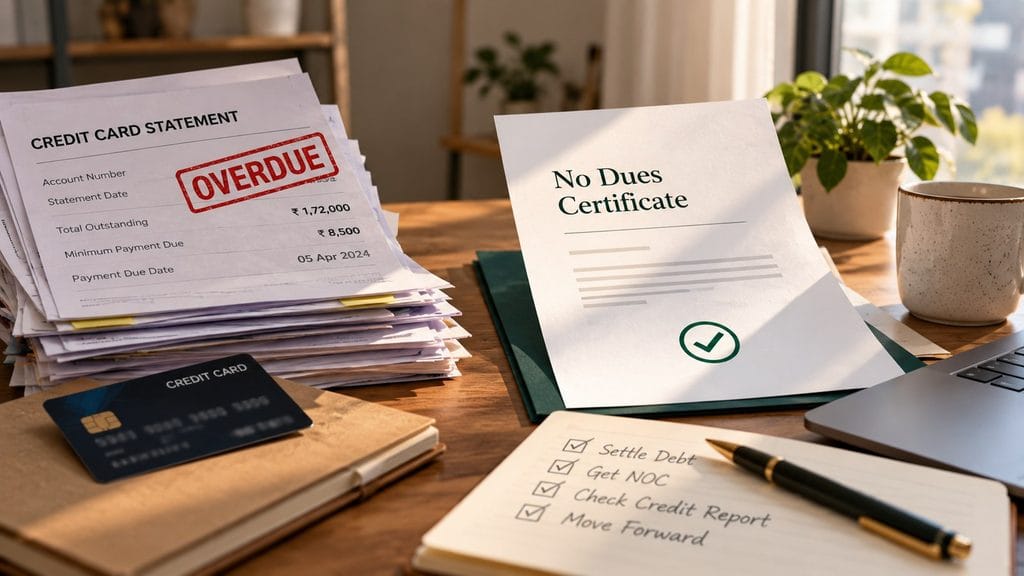
- The lender issued an NOC (No Objection Certificate) / No Dues Certificate, confirming that the account had no further outstanding liability.
- She followed up to check her account and credit report status, rather than assuming everything had updated automatically.
That last step turned out to be important — and it leads into something a lot of borrowers misunderstand.
What the NOC Actually Means
An NOC, or No Objection Certificate (sometimes called a No Dues Certificate), is written confirmation from the lender that you have no further outstanding liability on the account. It’s an important document, and it’s worth keeping safely — ideally both a physical and digital copy — for as long as you might conceivably need to prove the account was resolved.
But here’s the part that surprised her: getting the NOC didn’t automatically mean her credit report would show the account as “Closed.” A settled account is typically reported as “Settled” rather than “Closed,” and that distinction remains on the credit report regardless of the NOC. The NOC confirms your obligation to the lender is over. It doesn’t erase the fact that the account was resolved through settlement rather than full repayment.
Understanding this upfront saved her from a second wave of frustration later — she knew what to expect from her credit report rather than assuming the NOC meant a clean slate.
Rebuilding Her Credit After Default
With the debt resolved, her focus shifted to rebuilding — a slower, less dramatic process, but an important one.
- Paying all current obligations on time, without exception, became the foundation of her recovery.
- She avoided taking on unnecessary new debt, even when offers came in, giving her financial situation room to stabilize.
- She kept credit utilisation manageable on any active credit she had, staying well under her limits.
- She monitored her credit report regularly, checking that the settled account was being reported accurately.
- She confirmed the lender’s reporting matched what was agreed — an important check, since reporting errors do happen and can be disputed.
None of this fixed her credit profile overnight. But consistent, unremarkable financial discipline over time is what actually moves a credit score back in the right direction.
The Biggest Lessons From Her Journey
A few things stand out from how her situation played out:
- Ignoring default doesn’t make the debt disappear. It compounds — in amount and in complexity.
- Understand exactly how much you owe before entering any negotiation. Precision builds credibility.
- Document genuine financial hardship. Specific, supported explanations carry far more weight than general ones.
- Get settlement terms in writing before paying — never rely on a verbal agreement alone.
- Collect the NOC/No Dues documentation after resolution, and keep it accessible indefinitely.
- Settlement and credit recovery are two different stages. Resolving the debt is step one; rebuilding your credit profile is a separate, ongoing process.
- One person’s outcome isn’t a guarantee for another borrower. Her terms reflected her specific account and circumstances.
Can You Recover From a Credit Card Default?
Yes — recovery is possible, but it takes time and it happens in stages. Settlement can resolve the underlying debt, but it typically comes with credit-report consequences that don’t disappear the moment you make your final payment. What follows the settlement — consistent, responsible financial behaviour — is just as important as the negotiation itself.
Individual outcomes depend heavily on the specific lender, the account’s history, and each borrower’s financial circumstances. Her journey is one illustration of how that process can unfold, not a fixed roadmap guaranteed to produce the same result for everyone.
Frequently Asked Questions
What happens after a credit card goes into default?
The account typically accrues additional interest and charges, collection efforts intensify, and the default status gets reported to credit bureaus, negatively affecting your credit score.
Can a defaulted credit card be settled?
Often, yes. Lenders may agree to a reduced, lump-sum settlement on a defaulted account, particularly when the borrower can demonstrate genuine financial hardship and offer a realistic payment.
What is an NOC after credit card settlement?
An NOC (No Objection Certificate), or No Dues Certificate, is written confirmation from the lender that you have no further outstanding liability on the settled account.
How do I get an NOC from my credit card company?
After completing your settlement payment according to the agreed terms, request written confirmation and an NOC from the lender. This is typically issued once the payment has been processed and verified.
Does an NOC remove a credit card default from CIBIL?
No. The NOC confirms your obligation to the lender is resolved, but the account will generally still be reported as “Settled” on your credit report, distinct from a “Closed” status.
Does credit card settlement affect my credit score?
Yes. A settled account is reported differently from a fully repaid one, and this typically has a negative impact on your credit score for a period of time.
How can I rebuild my credit after settlement?
Focus on paying all other obligations on time, keeping credit utilisation low, avoiding unnecessary new debt, and monitoring your credit report to ensure accurate reporting. Recovery happens gradually through consistent financial behaviour.
If default and mounting credit card debt are weighing on you or your business, understanding your actual options — before the situation gets harder to manage — makes a real difference.
👉 Get a free debt assessment with TrueSettle to understand what’s realistic for your situation.
👉 Explore your debt resolution options and take the first step toward a resolution.