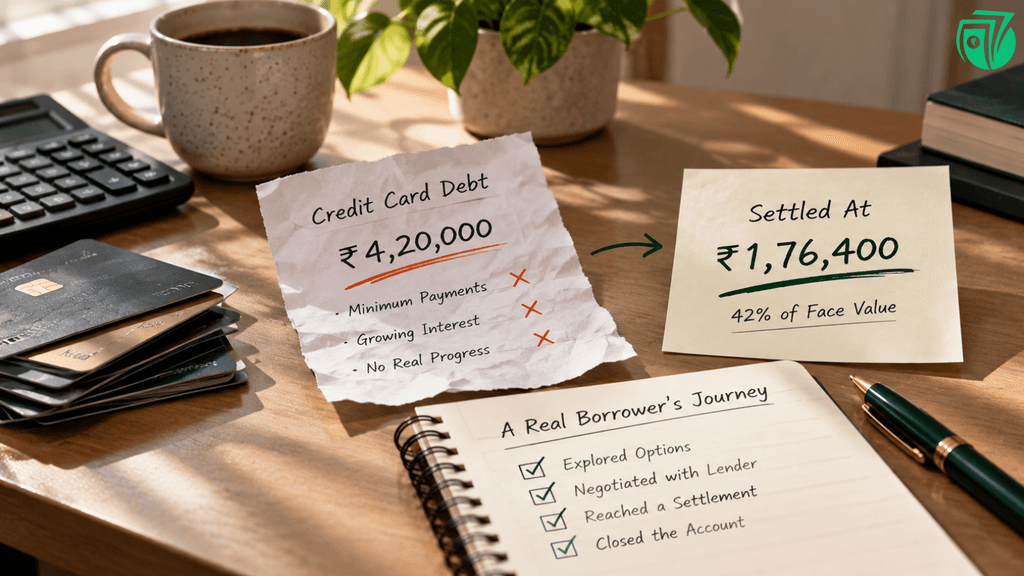
Rohit had ₹4.2 lakh in outstanding credit card debt. Minimum payments were becoming harder to manage every month, interest and charges kept adding to the balance, and no matter how much he paid, the number on his statement barely moved. He needed a realistic way to resolve it — not just another payment plan that pushed the problem a few months further down the road.
Eventually, Rohit settled the debt for ₹1,76,400 — 42% of the original outstanding amount. Here’s how he got there, what the negotiation involved, and what other borrowers can take from his experience.
Note: This case study illustrates a typical credit card debt settlement journey. Details have been adapted for illustration, and the outcome described is specific to this scenario — not a guarantee of what any individual borrower will achieve.
Rohit’s Starting Point: ₹4.2 Lakh in Credit Card Debt
Rohit’s outstanding balance had built up across a couple of credit cards over a few years — a mix of everyday spending, a few larger one-off expenses, and interest that compounded faster than he expected. Individually, none of the charges felt reckless at the time. Together, they added up to ₹4.2 lakh.
Like a lot of borrowers in this situation, Rohit wasn’t ignoring the debt. He was making payments. The problem was that his income and his monthly obligations had stopped lining up. Rent, essential expenses, and minimum payments across multiple cards left very little room to actually reduce the principal. He was current on the surface, but the underlying balance was quietly growing.
Why Rohit Could No Longer Keep Up With the Payments
This is the part of the story a lot of people relate to: the balance didn’t spike overnight. It crept.
Rohit found himself stuck in what’s often called the minimum-payment cycle — paying just enough each month to avoid a missed-payment mark, while interest and charges kept adding back more than he’d paid off. Even disciplined budgeting couldn’t outpace the math. At a certain point, the outstanding amount was growing faster than his repayments could shrink it.
He tried a few things before considering settlement — consolidating spending onto one card, cutting discretionary expenses, even asking for a temporary reduction in minimum payments. These helped slow things down, but they didn’t fix the core issue: the total owed had grown beyond what his monthly cash flow could realistically clear in a reasonable timeframe.
The Turning Point: Exploring Debt Settlement
At this point, Rohit started looking into credit card debt settlement — an arrangement where the lender agrees to accept less than the full outstanding amount as a final, one-time resolution of the account.
It’s worth being clear about what this is and isn’t. Settlement isn’t a discount you can simply request on a whim, and it isn’t the same as a repayment plan or a reduced-EMI restructuring. It’s typically considered when a borrower is in genuine financial difficulty and a lender determines that recovering a lump sum now is more realistic than continuing to chase the full balance over time.
Rohit considered it because the alternative — continuing to make minimum payments indefinitely — wasn’t actually resolving anything. He wanted a defined endpoint, even if it meant accepting the credit report impact that comes with a “Settled” status.
It’s also important to say upfront: eligibility for settlement, and the terms a lender offers, vary significantly based on the account, the lender’s internal policies, and the borrower’s specific circumstances. Rohit’s experience is one outcome among many possible ones.
How the ₹4.2 Lakh Settlement Was Calculated
Here’s the breakdown of how Rohit’s settlement worked out:
| Particular | Amount |
|---|---|
| Original outstanding | ₹4,20,000 |
| Settlement percentage | 42% |
| Settlement amount | ₹1,76,400 |
| Difference from face value | ₹2,43,600 |
In other words, Rohit’s account was resolved with a 58% reduction from the original face value. That’s a meaningful outcome — but it’s important to treat the 42% figure as case-specific, not a benchmark. Settlement percentages depend on factors unique to each account and borrower, and what worked for Rohit won’t automatically apply to someone else with a similar-looking balance.
What Went Into the Negotiation?
A settlement outcome like this doesn’t happen from a single phone call. Several factors typically shape what a lender is willing to accept:
- Financial hardship — a clear, documented reason the full balance can’t realistically be repaid.
- Account status — how far into default the account was, and how the lender’s internal recovery process was already treating it.
- Ability to make a lump-sum payment — lenders are generally far more flexible when a borrower can offer a defined amount upfront rather than a drawn-out plan.
- Documentation — income proof, hardship evidence, and a clear account of the outstanding amount all strengthen a negotiation.
- Overall repayment capacity — lenders weigh what they’re likely to recover through continued collection efforts against what’s being offered now.
For Rohit, being able to demonstrate genuine hardship, combined with the ability to arrange a lump-sum payment, gave the negotiation real substance instead of just being a request for a discount.
The Settlement Offer: ₹1.76 Lakh
The negotiation didn’t land at 42% immediately. Initial offers from the lender’s side were higher, and it took back-and-forth — presenting Rohit’s financial position clearly, proposing a realistic lump-sum figure, and going through a few rounds of counteroffers — before both sides settled on ₹1,76,400.
Once the number was agreed, the terms were put in writing: the settlement amount, the payment deadline, and confirmation that this payment would close the account in full. Rohit didn’t make the payment until he had this documentation in hand — an important step that protects the borrower if there’s ever a dispute about what was agreed.
What Happened After Rohit Made the Payment?
Rohit paid the agreed amount within the timeline specified in the settlement letter. The lender issued written confirmation that the account was settled and closed, along with a No Dues Certificate confirming there was no remaining liability.
That said, settlement isn’t the end of the credit story — it’s the start of a new phase. The account was reported to credit bureaus as “Settled” rather than “Closed,” which is a meaningfully different signal to future lenders. Rohit’s credit score dropped as a result, and the “Settled” remark is expected to remain visible on his credit report for a period of years.
Knowing this going in, Rohit shifted focus to rebuilding responsibly — paying all other obligations on time, keeping credit utilisation low, and avoiding new debt he didn’t need. Recovery isn’t instant, but consistent habits over time do rebuild a credit profile.
What Rohit’s Case Teaches Other Borrowers
A few takeaways stand out from how this played out:
- Don’t ignore growing credit card debt. The earlier you address a balance that’s outpacing your repayment capacity, the more options you typically have.
- Understand your total outstanding before negotiating. Know the exact figure — principal, interest, and charges — rather than working from a rough estimate.
- Document genuine financial hardship. Specifics matter far more than a general explanation.
- Don’t assume another borrower’s settlement percentage will apply to you. Rohit’s 42% reflects his specific situation, not a standard rate.
- Get settlement terms in writing before paying. Verbal agreements offer no protection if there’s a dispute later.
- Understand the impact of a “Settled” status on your credit report before you commit, so there are no surprises afterward.
Could You Settle Credit Card Debt at 42% Too?
It’s a fair question, and the honest answer is: maybe, maybe not. There’s no fixed settlement percentage that applies across lenders or borrowers. The final number depends on your specific outstanding amount, your lender’s internal policies, how far your account has progressed toward default, your documented hardship, and your ability to offer a realistic lump sum.
Rohit’s case should be read as an illustration of how a settlement negotiation can play out — not a promise of a specific outcome. The right way to find out what’s realistic for your situation is to have your account and finances reviewed individually, rather than assuming a case study percentage will carry over to your own debt.
Frequently Asked Questions
What does settling credit card debt at 42% mean?
It means the lender agreed to accept 42% of the original outstanding balance as full and final settlement of the account, writing off the remaining amount.
How much is 42% of ₹4.2 lakh?
42% of ₹4,20,000 is ₹1,76,400 — the amount Rohit paid to close his account.
Can I settle my credit card debt for less than I owe?
In many cases, yes, particularly if you’re in genuine financial hardship and can offer a lump-sum payment. The exact terms depend on your lender and account status.
Does credit card settlement affect CIBIL?
Yes. A settled account is reported as “Settled” rather than “Closed,” which typically lowers your credit score and remains visible on your report for a number of years.
Is a 58% reduction in credit card debt guaranteed?
No. Rohit’s outcome was case-specific. Settlement percentages vary widely based on individual circumstances, and no particular reduction is guaranteed.
What documents may be needed for credit card settlement?
Typically, proof of income or income disruption, evidence of financial hardship, and account statements. Lenders may request additional documentation depending on the case.
What should I do after settling my credit card debt?
Keep the written settlement confirmation and No Dues Certificate safe, then focus on rebuilding credit through on-time payments, low utilisation, and responsible use of any new credit.
If you’re carrying credit card debt that feels harder to manage every month, it’s worth understanding your actual options before assuming settlement is or isn’t realistic for you.
👉 Get a free debt assessment with TrueSettle and find out what’s actually achievable for your situation.
👉 Explore your debt resolution options to compare settlement against other paths forward.