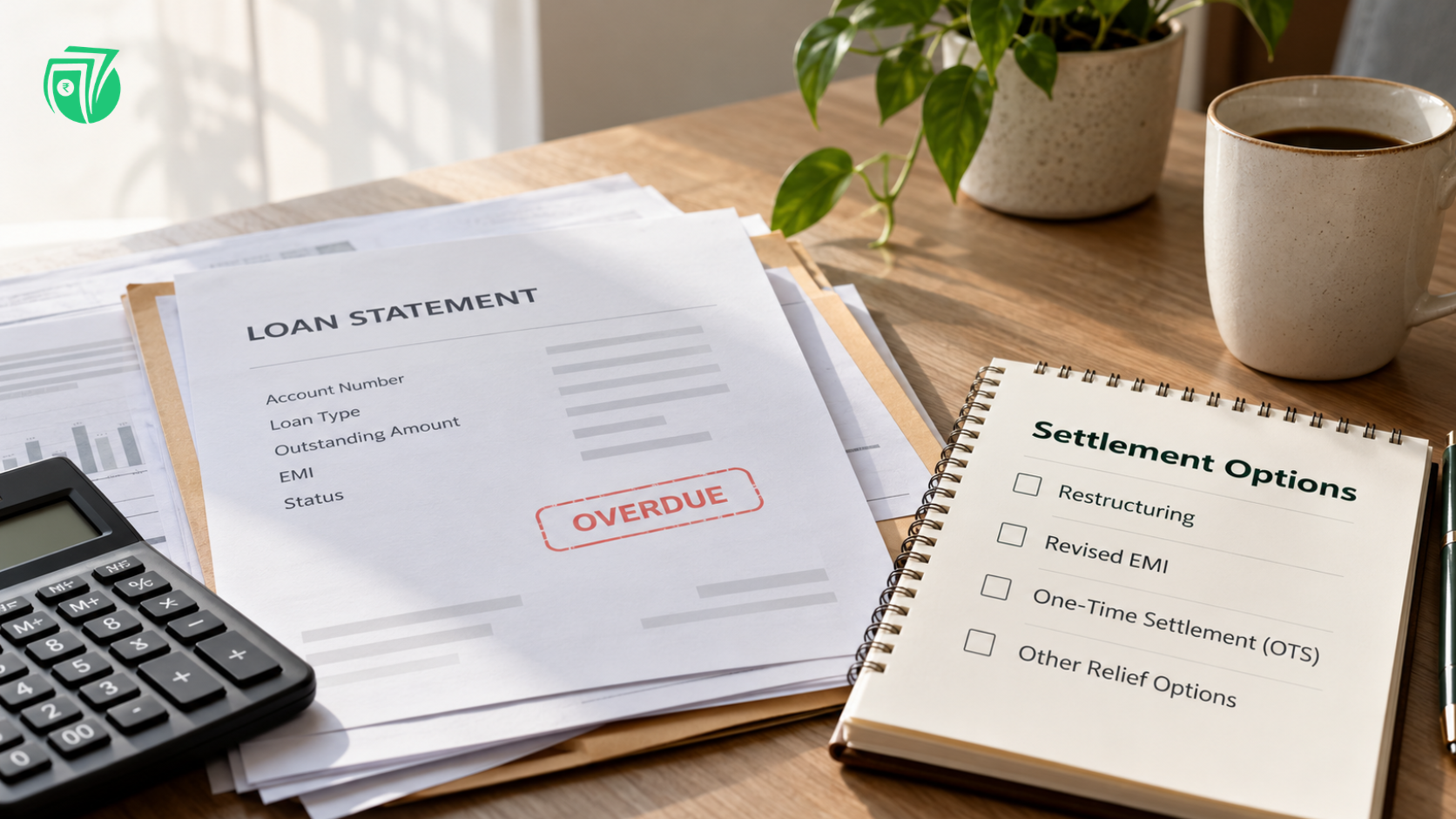
If you’ve fallen behind on a loan or credit card and your lender has started talking about a “settlement,” the first question on your mind is probably the most practical one: how much should I actually offer? Offer too little, and the bank rejects you outright. Offer too much, and you end up paying more than you needed to — money you may not even have. This is exactly where a settlement offer calculator becomes useful. It gives you a structured, numbers-based starting point instead of a guess, so you walk into negotiations with a realistic figure rather than a random one.
This guide walks you through what a settlement offer calculator is, how it works, and how to use it to arrive at a settlement amount your lender is more likely to accept.
What Is a Settlement Offer Calculator?
A settlement offer calculator is a simple financial tool that helps borrowers estimate a fair and affordable amount to propose to a lender in place of paying the full outstanding loan balance. Instead of relying on gut feeling, a loan settlement calculator looks at your outstanding dues, your income, your expenses, and your savings to arrive at a settlement amount that’s realistic on both sides — one you can actually pay, and one a lender might reasonably accept.
Most lenders won’t settle for a token amount. They want to recover as much of the outstanding debt as possible while accepting that full recovery may be unlikely, especially if you’ve missed several payments already. A debt settlement calculator essentially puts a number on that middle ground.
How Much Should You Offer for Loan Settlement?
There’s no single fixed percentage that applies to every case, but as a general starting point, borrowers typically propose somewhere between 30% and 60% of the total outstanding amount, depending on:
- How long the account has been overdue
- Whether it’s already been marked as a write-off or NPA (non-performing asset)
- Your current income and ability to pay
- The lender’s internal recovery policies
If you’re wondering how much to offer for loan settlement, a good rule of thumb is: offer what you can genuinely arrange in a lump sum or over a few months, not what you think “sounds fair.” Lenders respond to numbers backed by real repayment capacity, not emotional appeals.
How the Settlement Offer Calculator Works
A settlement offer calculator works by taking a few financial inputs from you and running them through a simple logic: available funds versus outstanding debt, adjusted for typical settlement ranges accepted in the market. Here’s how the process usually breaks down.
Step 1: Enter Your Total Outstanding Debt
Start with your total outstanding loan amount — the full balance you currently owe, including principal, accrued interest, and any penalty charges. Also note your overdue amount separately, since lenders often weigh how much has actually gone unpaid versus what’s just remaining tenure.
Step 2: Calculate Your Available Funds
Next, the calculator asks for your monthly income and essential monthly expenses (rent, utilities, groceries, other EMIs). Subtracting expenses from income gives you your monthly surplus. Add to this any existing savings you’re willing to use toward the settlement. Together, this tells you your amount available for settlement — the realistic pool of money you can draw from.
Step 3: Determine a Realistic Settlement Offer
Using your available funds and the number of months you can realistically save toward a lump sum, the calculator estimates your settlement capacity. It then compares this to your total outstanding debt to suggest a one-time settlement calculator style range — a low end and a high end — rather than a single rigid number. This gives you room to start the negotiation lower and move up if needed.
Settlement Offer Calculation Example
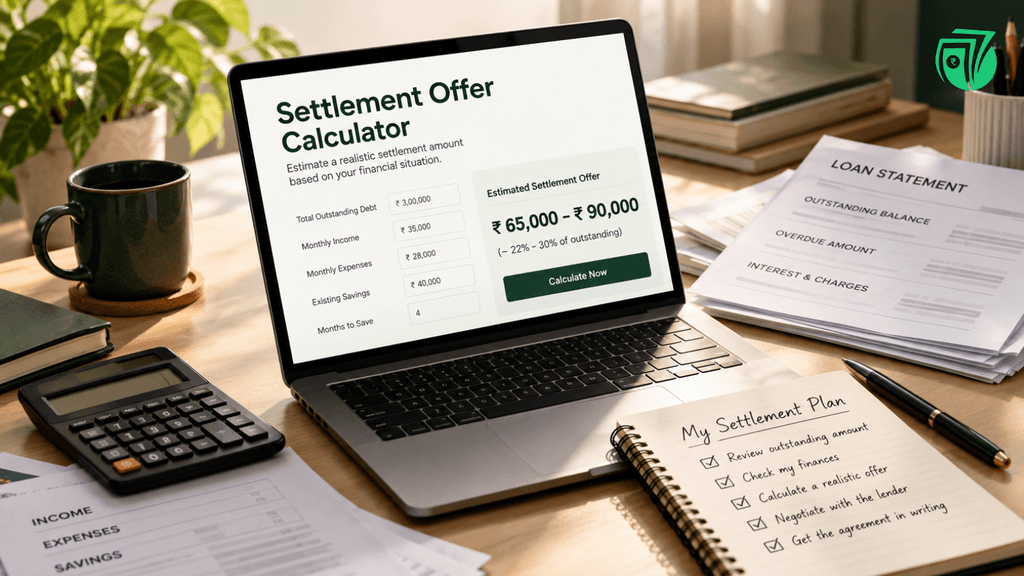
Let’s say you owe ₹3,00,000 on a personal loan that’s been overdue for eight months.
- Total outstanding debt: ₹3,00,000
- Monthly income: ₹35,000
- Essential monthly expenses: ₹28,000
- Existing savings: ₹40,000
- Months available to save: 4
- Monthly surplus: ₹7,000 → ₹28,000 over 4 months
Estimated settlement capacity: ₹40,000 (savings) + ₹28,000 (surplus) = ₹68,000
Suggested offer range: ₹65,000–₹90,000 (roughly 22%–30% of outstanding)
Estimated percentage of outstanding: ~23%–30%
In this case, you might reasonably start the negotiation around ₹65,000–70,000, leaving yourself room to move up to ₹90,000 if the lender pushes back — while still staying within what you can actually pay.
Disclaimer: This calculator provides an estimate only. It does not guarantee that a bank or lender will accept a particular settlement amount — final approval always depends on the lender’s internal policy and discretion.
What Factors Can Affect Your Settlement Amount?
A settlement amount calculator gives you a starting estimate, but real-world negotiations are shaped by several additional factors:
- Account status — Written-off or NPA accounts are often more open to lower settlements than accounts that are only recently overdue.
- Lender policy — Banks and NBFCs each have internal thresholds for how low they’ll go, and this can vary widely.
- Your documented hardship — Job loss, medical emergencies, or income disruption, when documented, can support a lower offer.
- Existing relationship with the lender — Long-standing customers sometimes get more flexibility.
- Third-party involvement — Whether you’re negotiating directly or through a debt settlement service can also influence outcomes.
- Other outstanding debts — If you have multiple loans, lenders may consider your overall debt load when evaluating your offer.
Should You Start With a Lower Settlement Offer?
Generally, yes. Since negotiation is expected, it’s wise to open with a loan settlement offer on the lower end of your calculated range — this leaves room to negotiate upward without exceeding your actual capacity. Starting too high removes your negotiating room entirely, and starting unrealistically low can make the lender dismiss the offer without a counter. The goal is a credible opening number, not the lowest number imaginable.
What to Do After Calculating Your Offer
Once you have a settlement range in hand:
- Get it in writing — Any settlement offer or acceptance should be documented, ideally with a formal settlement letter from the lender.
- Confirm the impact on your credit report — A settled account is typically marked “settled” rather than “closed,” which can affect future loan applications.
- Ask about the payment timeline — Confirm whether it’s a one-time payment or a short instalment plan.
- Keep proof of payment — Retain receipts and the no-dues certificate once the settlement is complete.
Common Mistakes When Making a Settlement Offer
- Offering too low without justification — Lenders are unlikely to accept an offer that seems disconnected from your outstanding balance.
- Not verifying account status first — Your negotiating position differs significantly depending on whether the account is active, overdue, or already written off.
- Skipping written confirmation — Verbal agreements can lead to disputes later; always get settlement terms in writing.
- Ignoring the credit report impact — Many borrowers focus only on the amount and forget to ask how the settlement will be reported.
- Offering a lump sum you can’t actually arrange — Committing to an amount you can’t pay on time can undo the entire negotiation.
FAQs About Loan Settlement Offers
How much should I offer for loan settlement?
Most borrowers start with an offer between 30% and 60% of the total outstanding amount, adjusted based on account status, income, and the lender’s typical recovery approach. A settlement offer calculator can help you narrow this down based on your actual available funds.
Is loan settlement the same as loan closure?
No. Loan closure means the full amount was paid off. Settlement means the lender accepted less than the full amount, and this is usually reflected differently on your credit report.
Will a settlement offer calculator guarantee lender approval?
No calculator can guarantee approval. It only provides a data-based estimate to help you propose a realistic figure — the final decision always rests with the lender.
Can I negotiate after making an initial offer?
Yes. Settlement offers are typically a starting point for negotiation, not a final figure. It’s common for the accepted amount to land somewhere between your initial offer and the lender’s first counter.
Does a one-time settlement affect my credit score?
Yes, typically. A one-time settlement (OTS) is usually reported as “settled” rather than “closed,” which can have a more lasting effect on your credit history compared to a regular loan closure.
Ready to figure out your number?
Calculate Your Settlement Offer — get an instant, personalized estimate based on your outstanding debt and repayment capacity.
Not sure where to start? Get a Free Debt Assessment and talk through your options with a professional before you approach your lender.