Nobody takes a loan planning to fall behind on it. You signed up for EMIs you could afford. Then something changed. Maybe the salary stopped, maybe a parent landed in hospital, maybe the business had three bad months in a row. Now the reminders are coming in, the overdue amount keeps growing, and you’re wondering if there’s any way out that doesn’t involve paying everything at once.
If your loan or credit card is with ICICI Bank, ICICI Bank loan settlement may be one of those ways out. In simple terms, it’s a negotiated deal where the bank agrees to accept an approved amount, sometimes less than the full dues, to resolve your account. But let’s be clear from the start: it isn’t automatic. The bank can say yes, say no, or come back with different terms, depending on its policies and your situation.
This guide walks you through how the process works, what papers to keep ready, how the amount gets decided, what it does to your CIBIL score, and which options you should weigh before choosing settlement.
What Is ICICI Bank Loan Settlement?
Loan settlement is an agreement between you and the bank to close out your outstanding dues on specific terms. In a compromise settlement, often called a One Time Settlement (OTS), the bank may accept less than the full amount you technically owe, as long as you pay what’s agreed within the agreed time.
The RBI allows regulated lenders to offer compromise settlements under their own board-approved policies (RBI framework). That’s why the option exists. It doesn’t mean every borrower qualifies.
Here’s a simple picture. Say Rahul owes ₹2,00,000 on a personal loan and was laid off six months ago. He writes to the bank, explains what happened, and says he can arrange ₹1,20,000 from savings and family. The bank might accept, ask for more, ask for documents, or decline. That’s how it works in real life: a back-and-forth, not a formula. (The numbers here are only an illustration, not ICICI Bank’s actual terms.)
One more thing people often mix up. Settlement is not a waiver. The bank doesn’t forgive your loan just because times are hard. You still pay an agreed amount, and the account carries a record of how it was resolved.
Can You Settle an ICICI Bank Loan?
You can always ask. Whether the bank agrees depends on its policies, your loan agreement, how far behind the account is, and the financial picture you can show.
It’s usually worth starting the conversation if:
- You’ve lost your job or your income has dropped sharply
- Medical bills or a family emergency have eaten into what you can pay
- Your business has been struggling for months, not just a slow week
- Overdue amounts have piled up and paying them in full isn’t realistic
- You have documents that show what happened
These aren’t official ICICI Bank eligibility rules. They’re the kinds of situations where asking for a review makes sense.
Before you go down this road, ask yourself one honest question: could you manage if the EMI were smaller or the tenure longer? If the answer is yes, a revised repayment plan or restructuring may serve you better. Settlement solves today’s problem but leaves a mark on your credit history, so it shouldn’t be the first door you knock on.
ICICI Bank Loan Settlement Process: Step by Step
The exact route and timeline can differ from account to account. But most settlements move through these eight stages.
Step 1: Know exactly where your loan stands
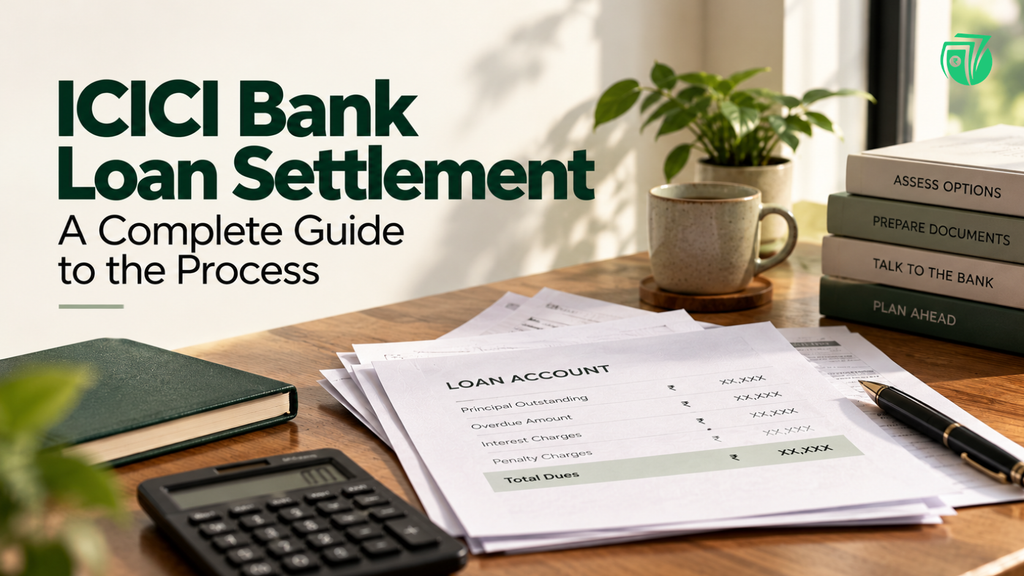
Get your latest loan statement and look at it properly, not just the total at the bottom. Note the outstanding principal, overdue EMIs, interest and penalty charges, your payment history, and any notices or letters the bank has sent.
If you’ve received a legal notice, don’t put it in a drawer. Check the deadline and speak to a lawyer if needed.
Step 2: Work out what you can truly afford
Sit down with a notebook or a spreadsheet. Write your monthly income, your essential expenses like rent, food, school fees and medicines, your other EMIs, and any savings you could use.
What’s left is your real number. Please don’t take a high-interest loan from somewhere else just to fund a settlement. Swapping one debt you can’t afford for another only moves the problem.
Step 3: Reach out to ICICI Bank through official channels
Contact the bank through its official customer care, your branch, or the loan servicing or collections team. Explain what’s happened and ask what options exist for your account. You can ask about:
- A One Time Settlement (OTS)
- A revised repayment arrangement
- Restructuring
- A payment plan for the overdue amount
Note down every reference number, save every email, and keep a simple log of who you spoke to and when. A friendly chat with a recovery agent is not a settlement approval, however sure they sound.
Step 4: Send a written settlement proposal
Put your request in writing. Keep it short and factual:
- Your name and loan account number
- The outstanding amount as per your records
- What happened and whether it’s temporary or long-term
- The amount you can arrange, and by when
- Supporting documents
Submit it through the channel the bank asks you to use, and keep proof that you sent it.
Step 5: Respond to the bank’s review
The bank will look at your account, your papers and your repayment history. It may ask for more documents, come back with a counteroffer, or decline.
There’s no single settlement percentage that applies to every ICICI Bank loan. Secured loans and unsecured loans can be treated very differently too. If you get a counteroffer, check it against your Step 2 number. Agreeing to an amount you can’t pay just to hear a “yes” is how settlements fall apart.
Step 6: Get the approval in writing, and read it
Never pay on the strength of a phone call. Wait for the bank’s formal settlement letter and check:
- The loan account it covers
- The approved settlement amount
- The payment deadline and the payment method
- Whether it’s one payment or instalments
- What happens if you miss a deadline
- How the remaining dues will be treated
- What document you’ll get once you’ve paid
If anything is unclear, ask the bank to clarify in writing before you transfer a single rupee.
Step 7: Pay exactly as agreed
Pay only through the bank’s authorised channels, never to a personal account or a UPI ID someone sends you on WhatsApp. Pay before the deadline. Keep the receipt and the bank statement showing the debit.
If you’re paying in instalments, stick to every date. If something goes wrong and you can’t make a payment, call the bank before the due date, and get any extension confirmed in writing.
Step 8: Collect your confirmation and check your credit report
Once you’ve paid, ask for written confirmation that the settlement is complete. Read the wording carefully: “settled” and “closed” are not the same thing.
After the bank has had time to update the bureaus, pull your credit report and check the account. If something’s wrong, raise it with both the bank and the credit bureau.
Documents Required for ICICI Bank Loan Settlement
What the bank asks for will depend on your loan type and account status. Keeping these ready saves weeks of back-and-forth:
- Loan account statement or account details
- Identity and address proof, if asked
- Signed settlement request letter
- Salary slips, termination letter, or proof of reduced income
- Recent bank statements
- Medical bills or hospital records, if illness is the cause
- Business financials, if business losses affected repayment
- Any collection letters or legal notices you’ve received
- Proof of where the settlement money will come from
You won’t necessarily need all of these. Confirm with ICICI Bank before sharing sensitive documents, and only share them through official channels.
How Is the ICICI Bank Settlement Amount Decided?
This is what everyone wants to know, and the honest answer is that there’s no fixed figure. ICICI Bank doesn’t publish a settlement percentage or a guaranteed discount.
The outcome usually depends on the loan type, the outstanding amount, what caused your difficulty, how long the account has been overdue, your repayment history, any security attached to the loan, and the bank’s own policy.
For illustration only: suppose you owe ₹2,00,000 and the bank approves a settlement of ₹1,40,000. On paper, that’s ₹60,000 less. But this is a made-up example, not a prediction. Your real number comes only from the bank’s written approval.
And a smaller payment today isn’t automatically the better deal. Think about where the money is coming from, whether you can meet the deadline, and what the “Settled” tag will cost you the next time you need a loan.
How Does ICICI Bank Loan Settlement Affect Your CIBIL Score?
This is the part that stays with you after the settlement is done. When a bank accepts less than the full amount, it usually reports the account as “Settled” instead of “Closed.” TransUnion CIBIL explains that future lenders can read a settled status as a sign that the earlier loan wasn’t repaid in full, which can affect new credit applications (CIBIL on settled status).
How much it hurts your score, and for how long, is different for everyone. Anyone promising a specific number of points or a recovery date is guessing.
What you can do:
- Keep the bank’s settlement confirmation safe.
- Check your credit report once the status has been updated.
- Dispute anything wrong or outdated with the bank and the bureau.
- Pay every other EMI and card bill on time.
- Hold off on new loan applications for a while, and borrow carefully when you do.
If you’re later in a position to pay the remaining amount in full, ask the bank how to get the account status updated. A change from “Settled” to “Closed” isn’t automatic. The bank has to verify the account and report it correctly.
Loan Settlement vs Loan Closure vs Loan Restructuring
These three get confused all the time, and the difference matters.
| Loan Settlement | Loan Closure | Loan Restructuring | |
|---|---|---|---|
| What happens | Bank accepts approved terms, possibly less than full dues | You repay everything owed under the loan agreement | Bank changes the repayment terms |
| Full dues paid? | Not necessarily | Yes | Depends on revised terms |
| Credit report | Usually shows “Settled” | Shows “Closed” once updated | Depends on how the bank reports it |
| Best for | Serious, long-term hardship | Borrowers who can pay in full | Temporary trouble where smaller EMIs would work |
Restructuring doesn’t mean any part of your debt is waived. It means the bank reshapes how you repay, for example a longer tenure or revised instalments.
If you expect your income to bounce back, restructuring or a revised plan is usually worth exploring before settlement. Which one suits you depends on what you can afford, where your account stands, and what the bank is willing to offer.
What Should You Do After an ICICI Bank Loan Settlement?
The last payment feels like the finish line. It’s close, but not quite. A few things still need doing:
- Keep the approval letter and every payment receipt in one folder, both paper and digital copies
- Ask for written confirmation that the settlement is complete
- Ask what no-dues or settlement document the bank will issue
- Check your credit report for the correct account status
- Dispute anything that doesn’t match the bank’s records
- Make a realistic budget around your remaining obligations
- Say no to new loans you can’t comfortably repay
A settlement closes this chapter, but it doesn’t erase the account’s history, and it doesn’t guarantee your next loan will be approved. Give yourself time to rebuild.
Common Mistakes to Avoid During Loan Settlement
Ignoring the bank’s messages. Silence rarely helps. Missed notices and deadlines narrow your options, especially if legal action has started.
Trusting verbal promises. “Sir, it’s settled, just pay today” means nothing until it’s on paper.
Expecting a fixed discount. What worked for a friend or a forum post won’t necessarily work for your account.
Paying without reading the settlement letter. Check the amount, the account it covers, the deadline, and what happens if you miss it.
Forgetting about your credit report. Check it after settlement. Mistakes in reporting are more common than you’d think.
Jumping to settlement without comparing options. If a manageable repayment plan is possible, it’s usually the better long-term choice.
Frequently Asked Questions
1. Can I settle my ICICI Bank personal loan?
You can ask ICICI Bank to consider a settlement if you’re facing real financial difficulty. Whether it’s approved depends on the bank’s policy and your circumstances.
2. Is ICICI Bank loan settlement guaranteed?
No. Sending a proposal doesn’t mean it will be accepted. The bank may ask for more information, offer different terms, or say no.
3. What is the minimum amount for ICICI Bank loan settlement?
There’s no fixed minimum that applies to every account. Ask the bank to assess yours, and get any approved amount in writing.
4. How long does ICICI Bank loan settlement take?
It varies with the loan type, your documents, the account status, the bank’s internal review, and any recovery or legal action already underway. Ask the bank for an expected timeline rather than relying on a fixed number of days.
5. Does ICICI Bank loan settlement affect my CIBIL score?
Yes, it can. An account marked “Settled” is viewed differently from one marked “Closed” after full repayment, and that can affect future credit applications.
6. Can I settle my ICICI Bank credit card dues?
You can contact the bank to discuss options for your credit card account. Settlement is the bank’s decision, and the credit report impact works the same way as for loans.
7. What happens if I miss the settlement payment deadline?
That depends on your written settlement terms. The offer may lapse entirely. Contact the bank straight away and get any revised arrangement confirmed in writing.
8. Will I receive an NOC after settlement?
Ask ICICI Bank exactly which document it will issue for your account. A no-dues certificate, a settlement letter and a full closure confirmation aren’t necessarily the same thing.
9. Can I improve my credit profile after loan settlement?
Yes, gradually. Pay your other obligations on time, keep an eye on your credit report, and avoid borrowing you can’t afford. There’s no guaranteed timeline, but consistent habits do help.
Need Help Understanding Your Loan Settlement Options?
When the calls keep coming and the overdue number keeps climbing, it’s hard to think clearly. That’s normal. The first step isn’t picking an option. It’s understanding your dues, what you can genuinely pay, and what’s available for your specific account.
That’s where TrueSettle comes in. We help borrowers understand loan settlement and other debt-resolution options so they can make a calm, informed decision. Before you accept any settlement offer, we’ll help you review its terms, understand what it means for your credit report, and compare it with other repayment options that might work.
We won’t promise you a percentage or a guaranteed approval. No honest advisor can. What we can give you is a clear picture of where you stand.
👉 Talk to TrueSettle about your loan
👉 Read our loan settlement guide
Disclaimer: This article is for general educational purposes only. It is not an official ICICI Bank policy document or legal advice. Settlement eligibility, approval, amount, timelines and documentation depend on your individual account and the bank’s applicable policies. Always verify settlement instructions directly with ICICI Bank.
Sources: RBI compromise settlement framework · TransUnion CIBIL on settled status · ICICI Bank personal loan documentation