How to settle Kotak Mahindra Bank loan is an important question for borrowers struggling with missed EMIs or growing debt. Loan settlement may be an option during genuine financial hardship, but it depends on the bank’s approval and can affect your CIBIL score.
If you have a loan or credit card with Kotak Mahindra Bank and you are in this situation, you are not alone. Thousands of borrowers in India go through it every year. One option many of them explore is a loan settlement, where the bank agrees to accept a lower, one-time amount to close the account.
But settlement is not a magic button. It depends entirely on the bank’s approval, it is not your legal right, and it can leave a mark on your credit report. In this guide, we explain how to settle a Kotak Mahindra Bank loan step by step, in simple language, so you can decide whether it is the right move for you.
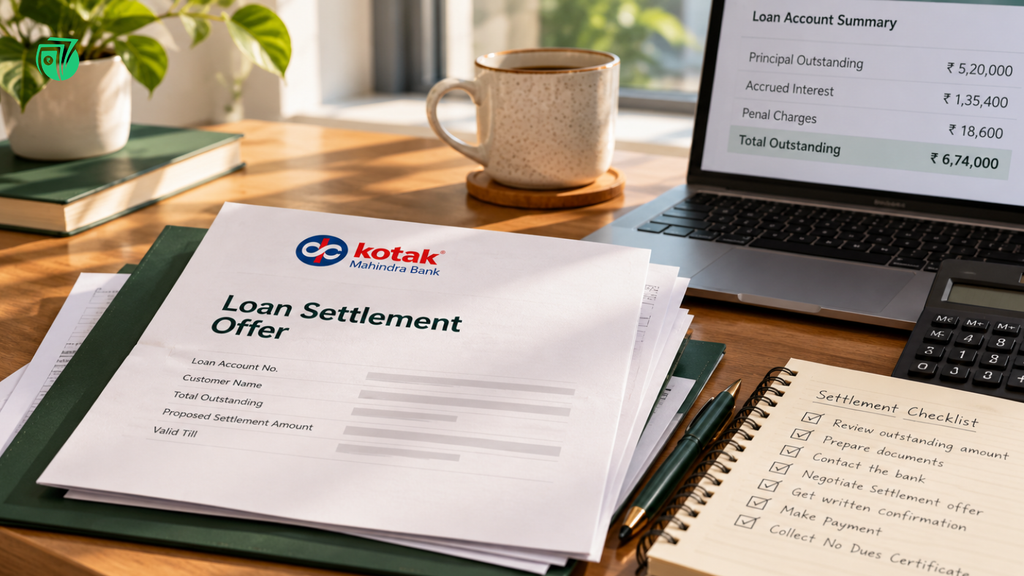
How to Settle Kotak Mahindra Bank Loan: Step-by-Step Process
A loan settlement is a compromise between you and the bank. You pay a part of what you owe, usually as a lump sum or in a few short instalments. In return, Kotak Mahindra Bank closes the account and stops pursuing the remaining balance.
The bank does this when it believes recovering the full amount is unlikely. For the bank, getting some money back now is better than chasing a borrower who genuinely cannot pay. For you, it means an end to the calls, the penalties and the growing interest.
There is a catch, though. Because you did not repay the full amount, the bank reports the account as “Settled” to credit bureaus like CIBIL, not as “Closed”. Future lenders read “Settled” as a sign that you could not repay in full. We cover this in detail in the CIBIL section below.
Settlement is commonly discussed for unsecured loans, such as:
- Kotak Mahindra Bank personal loans
- Kotak credit card dues
- Business loans without collateral
For secured loans like home loans or car loans, the bank can recover its money by selling the asset, so settlement works very differently and is far less common.
Kotak Loan Settlement vs Foreclosure vs Restructuring
People often mix these three up, but they are very different. Settlement should usually be the last option, not the first.
| Settlement | Foreclosure | Restructuring | |
|---|---|---|---|
| What you pay | Less than the full outstanding | The full outstanding, early | The full amount, over a changed schedule |
| Who it suits | Borrowers in genuine financial hardship | Borrowers who have extra money and want to close early | Borrowers facing a temporary cash crunch |
| Credit report status | Usually “Settled” | “Closed” | Account stays active, often flagged as restructured |
| Impact on CIBIL | Negative, can last for years | Neutral to positive | Milder than settlement |
| Needs bank approval | Yes | Yes, as per loan terms | Yes |
In simple words: if you can pay the full amount, even slowly, foreclosure or restructuring protects your credit far better. Settlement makes sense mainly when repaying in full is truly not possible.
Kotak Loan Settlement Eligibility: When Will the Bank Consider It?
Kotak Mahindra Bank does not publish a fixed eligibility rule for settlement. Every case is reviewed on its own. That said, banks generally look at a few common factors before agreeing:
- Genuine financial hardship. Job loss, salary cuts, serious illness, a death in the family or a failed business are the most common reasons banks accept.
- Overdue history. Settlement is usually discussed after several EMIs have been missed and the account has turned overdue or become a non-performing asset (NPA). A borrower who is paying regularly is rarely offered settlement.
- Proof of your situation. The bank will want documents that back up what you are saying, not just a verbal explanation.
- Ability to pay something. The bank needs to see that you can arrange a lump sum, or a short instalment plan, for the agreed amount.
- Type of loan. Unsecured loans are more open to settlement than secured ones.
Even if you tick all these boxes, the final decision rests with the bank. Settlement is a request you make, not a right you can claim.
Step-by-Step Kotak Mahindra Bank Loan Settlement Process
The exact steps can differ from case to case, but the Kotak loan settlement procedure usually follows this path:
- Check your real outstanding amount. Ask Kotak for a statement showing principal, interest, penalties and other charges. You cannot negotiate well without knowing these numbers.
- Be honest with yourself about your budget. Work out how much you can actually arrange, from savings, family support or selling an asset, without falling into a new debt trap.
- Contact the bank in writing. Reach out through your branch, the official customer care channels, or the collections team assigned to your account. Always follow up calls with an email so there is a record.
- Submit a hardship letter. Explain clearly why you cannot repay in full. Keep it factual, short and supported by proof.
- Share your supporting documents. These help the bank verify that your hardship is genuine (see the list below).
- Wait for the bank’s offer or counter-offer. The bank may propose an amount. It may be higher than what you can afford, which is normal.
- Negotiate. Respond politely with what you can realistically pay, and explain why. This can take more than one round.
- Get the settlement terms in writing before paying. Never pay a single rupee based only on a phone call.
- Pay only through official bank channels. Use the bank’s own payment modes and keep every receipt.
- Collect your No Dues Certificate or settlement closure letter. This is your final proof that the account is closed and nothing more is owed.
- Check your credit report after a few weeks. Make sure the account now shows as settled and the outstanding balance is reported as zero.
Documents Required for Kotak Loan Settlement
The bank may ask for different papers depending on your case, but keep these ready:
- Identity and address proof: PAN card and Aadhaar card
- Loan details: loan account number, sanction letter and the latest loan statement
- Hardship letter: a signed letter explaining your situation
- Income proof: recent salary slips or bank statements, or ITRs if you are self-employed
- Proof of hardship: termination or layoff letter, salary-cut notice, hospital bills and medical reports, death certificate of an earning family member, or proof of business losses
- Bank statements: usually the last six months, to show your current cash flow
Organised, complete documents make your request look serious and can speed up the review.
How to Negotiate a Kotak Loan Settlement
Negotiation is where most borrowers either save a lot or lose a lot. A few practical tips:
- Know your numbers first. Separate the principal from the interest and penalties. Banks often have more room to waive penalties and late charges than the principal itself.
- Start with what you can truly afford. Do not promise an amount you cannot arrange. A failed settlement payment can make things worse.
- Stay calm and polite. The person on the other side is also following internal rules. A respectful, consistent tone works better than anger.
- Back every request with proof. “I lost my job” is weaker than “Here is my termination letter and my last six months of bank statements.”
- Ask about penalty waivers. Even if the bank will not reduce the principal much, it may drop late fees or penal charges.
- Do not rush. It is normal for this to take a few rounds. The first offer is rarely the final one.
- Keep a record of everything. Note the date, time and name of every person you speak to, and confirm key points by email.
There is no fixed settlement percentage that applies to everyone. The final amount depends on your outstanding dues, how long the account has been overdue, your documents and the bank’s internal policy. Be cautious of anyone who promises a guaranteed figure.
The Kotak Loan Settlement Letter: What to Check Before You Pay
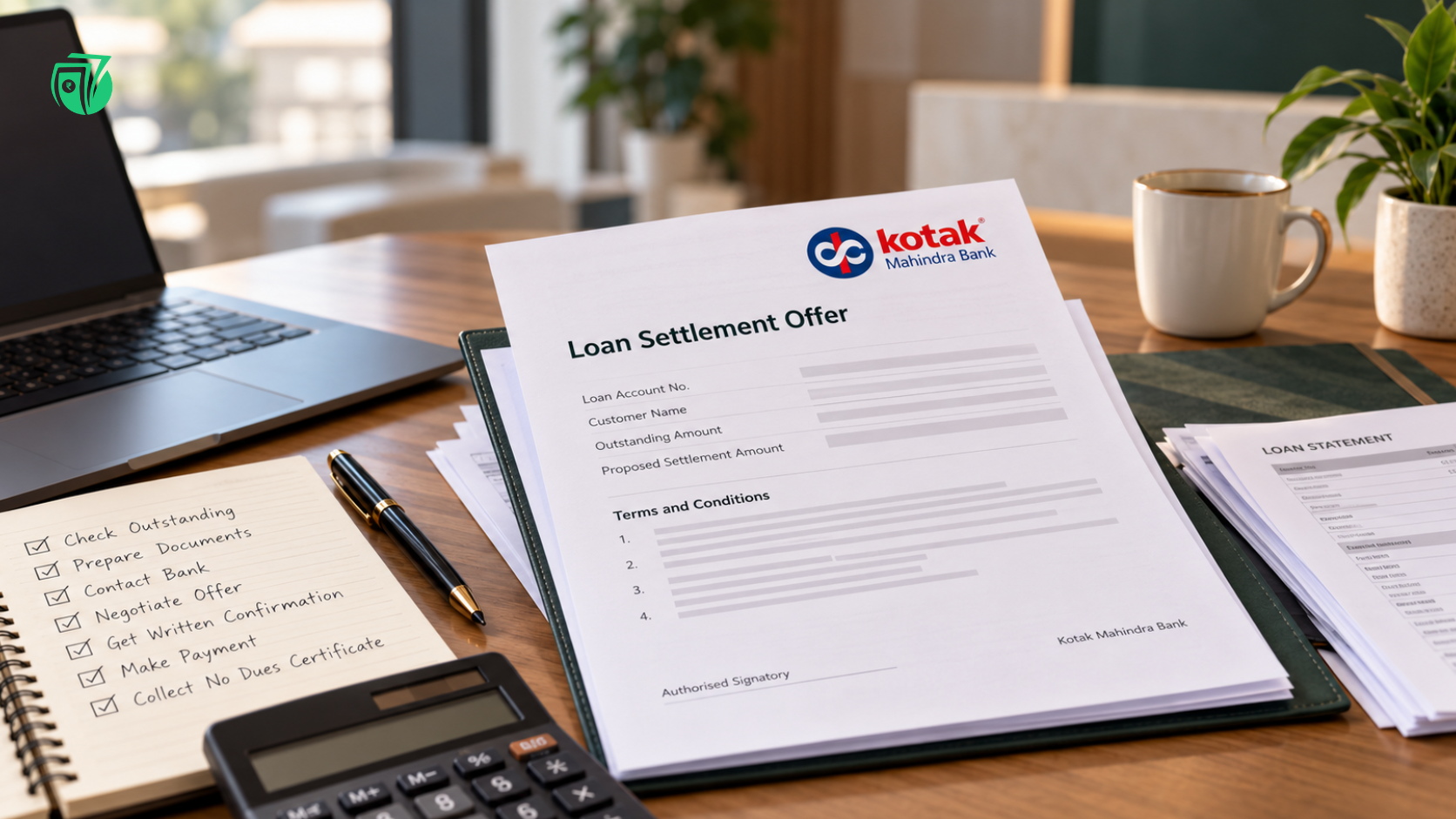
The settlement letter is the most important document in this whole process. Once the bank agrees, ask for an official letter on Kotak Mahindra Bank letterhead before you make any payment. Check that it clearly mentions:
- Your name and loan or card account number
- The total outstanding amount before settlement
- The final agreed settlement amount
- The payment deadline, or the instalment schedule if you are paying in parts
- The approved payment mode
- A clear statement that the account will be closed once payment is made, with no further dues
- Signature or official seal of an authorised bank officer
After paying, you should also receive a No Dues Certificate (NOC) or a closure confirmation. Keep both letters, along with payment receipts, safely for many years. If a recovery call ever comes later, these papers are your protection.
A warning: never pay settlement money into a personal account, a UPI ID of an individual, or through any agent who cannot show official bank authorisation.
Kotak Loan Settlement and Your CIBIL Score
Let us be honest here: a settled loan is not good news for your credit report.
When the account closes through settlement, Kotak reports it to credit bureaus as “Settled”. Future lenders see this and understand that the full amount was not repaid. Along with the missed EMIs before settlement, this can pull your score down and make new loans or credit cards harder to get for some time.
How much your score drops depends on your overall credit history, how many payments you missed, and what else is on your report. There is no fixed number that applies to everyone, so be wary of claims like “your score will fall by exactly X points”.
Can you change “Settled” to “Closed” later?
In many cases, yes. Some borrowers later go back to the bank and pay the remaining difference between the settled amount and the original dues. The bank may then update the status to “Closed”. Ask the bank directly about this option, and get it in writing.
How to rebuild your credit after settlement
- Pay every remaining EMI and credit card bill on time, without exception
- Keep your credit card usage low compared to your limit
- Avoid applying for many loans in a short period
- Consider a secured credit card against a fixed deposit to rebuild a positive record
- Check your CIBIL report regularly and raise a dispute if anything is reported wrongly
Credit recovery takes patience, but consistent good behaviour over time does help.
Your Rights and Common Mistakes to Avoid
Your rights with recovery agents
Being behind on payments does not take away your dignity. RBI guidelines require banks and their recovery agents to behave fairly. Agents should not threaten, abuse or harass you, call at unreasonable hours, or embarrass you in front of family, neighbours or colleagues.
If you face harassment, complain in writing to Kotak Mahindra Bank’s grievance team first. If the issue is not resolved, you can escalate it to the RBI under the Integrated Ombudsman Scheme through the RBI’s official complaint portal.
Mistakes borrowers often make
- Ignoring the bank completely. Silence only adds penalties and makes the bank less flexible.
- Agreeing on the phone and paying immediately. Always wait for the written settlement letter.
- Paying through unofficial channels. Only use the bank’s own payment modes.
- Choosing settlement when restructuring was possible. If you can pay in full over a longer time, ask about that first.
- Not collecting the NOC. Without it, you may struggle to prove the account is closed.
- Trusting “guaranteed settlement” promises. No one can guarantee what the bank will approve.
Frequently Asked Questions
Can I settle my Kotak Mahindra Bank loan?
You can request a settlement, especially if you are facing genuine financial hardship and your account is overdue. Approval is entirely at the bank’s discretion, so it is not guaranteed.
How long does the Kotak loan settlement process take?
There is no fixed timeline. It depends on how quickly you share documents, how many rounds of negotiation happen, and the bank’s internal approvals. It can take anywhere from a few weeks to a few months.
How much will Kotak accept in a settlement?
There is no standard percentage. The amount depends on your outstanding dues, how long the loan has been overdue, your proof of hardship and the bank’s policy.
Will settlement affect my CIBIL score?
Yes. A “Settled” status is viewed negatively by lenders and can make borrowing harder for some time. The exact impact differs from person to person.
Can I settle a Kotak credit card bill the same way?
Generally yes. Credit card dues are unsecured, so the process of requesting, negotiating and getting a written settlement letter is very similar.
Is a settlement letter enough proof?
Keep the settlement letter, all payment receipts and the No Dues Certificate together. These three documents together are your strongest proof.
Conclusion
Settling a Kotak Mahindra Bank loan can give real relief when the EMIs have become impossible to manage. But it works best when you go in prepared: know your numbers, keep your documents ready, negotiate calmly, and never pay without a written settlement letter.
Remember that settlement depends on the bank’s approval, and a “Settled” status can affect your credit for a while. If there is any way to repay in full through restructuring or a longer plan, explore that first. If settlement really is the only path, take it carefully and start rebuilding your credit the very next month.
If you are unsure where to begin, speaking to an experienced loan settlement advisor can help you understand your options and approach the bank the right way.
Disclaimer: This article is for general information only and is not legal or financial advice. Settlement terms and approvals are decided by Kotak Mahindra Bank on a case-by-case basis.