Let’s be honest for a second. If you’re reading this, you’re probably not here out of curiosity. You’re here because you’re staring down a loan you can’t fully repay, and “loan settlement” keeps popping up as an option. Maybe a recovery call pushed you toward it. Maybe you Googled it at 1 AM, stressed out of your mind. Either way, you’re not alone. A surprising number of Indian borrowers are choosing to settle loans right now, especially with EMIs eating into salaries that haven’t kept pace with inflation.
So here’s the real talk: loan settlement can get you out from under an impossible debt. But it comes with a cost. Your CIBIL score takes a hit, sometimes a big one. The good news? That hit isn’t permanent, and if you know what’s coming, you can plan around it instead of getting blindsided.
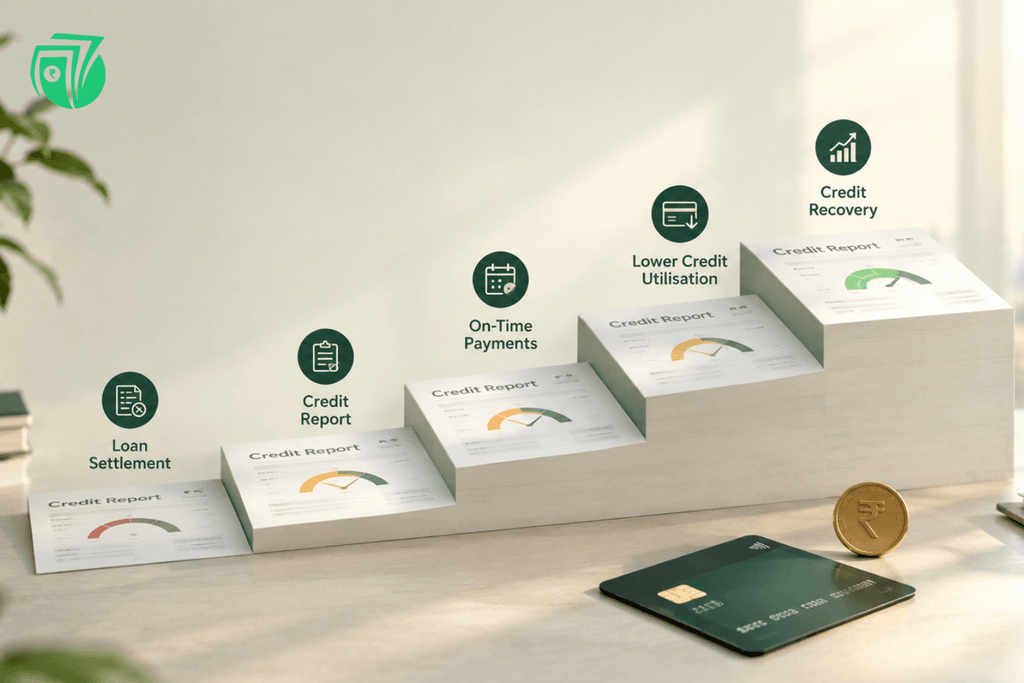
What Actually Happens to Your CIBIL Score When You Settle a Loan
When you settle a loan, you and your lender agree that you’ll pay less than the full outstanding amount. In exchange, the lender stops chasing the rest. Sounds like a win, right? Well, sort of. Here’s the catch: your account doesn’t get marked “Closed.” It gets marked “Settled.”
That one word makes a big difference to anyone reading your credit report later.
- Your CIBIL score can drop anywhere from 75 to 100 points, often within a single reporting cycle, since lenders now update bureau data multiple times a month.
- The “Settled” tag stays visible on your credit report for up to 7 years from the date of settlement.
- Future lenders, whether for a home loan, a car loan or even a credit card, see that tag and read it as “this person didn’t pay back what they owed in full.” Fair or not, that’s the signal it sends.
Compare that to a loan closure, where you’ve paid 100% of what you owed. A closure keeps your score intact, or even helps it, because it shows you honoured the original agreement. Settlement is treated as a compromise. Sometimes it’s necessary, but it’s never free.
Settled vs Written-Off: Don’t Mix These Up
These two terms get confused all the time, and they mean very different things.
A “Settled” status means you and the lender reached an agreement, you paid the agreed amount, and the account is finished. It’s a negative mark, but it shows you dealt with the debt.
A “Written-off” status means the lender has given up on recovering the money through normal means and has moved it off its books as a loss. That doesn’t mean you’re free of it. The lender, or a recovery agency it sells the debt to, can still come after you. And on your credit report, “Written-off” usually looks worse than “Settled,” because it signals the debt was never resolved at all.
If your account is currently showing as written-off, negotiating a settlement can actually be a step up. It turns an open, unresolved problem into a closed one, even if it isn’t a clean one.
Why This Matters More in 2026 Than It Used To
Credit bureaus in India (CIBIL, Experian, CRIF High Mark and Equifax) have become much faster and sharper about reporting. RBI’s push for more frequent, more accurate credit reporting means negative updates land on your file almost in real time now. There’s no more “maybe it won’t show up for a few months.” It shows up fast.
At the same time, your CIBIL score is being used for more than loan approvals. It can come up in places you wouldn’t expect, like rental applications in metro cities, some job background checks and even certain insurance pricing. So a settlement doesn’t just affect your next loan application. It can quietly follow you into other parts of life for a while.
That said, and this is important, a settlement is sometimes genuinely the smarter move. If you’re facing mounting interest, harassment from recovery agents, or a debt spiral that keeps getting worse, choosing to settle loan dues at a reduced amount can stop the bleeding. It’s a tool. Just use it with your eyes open.
How Much Does It Actually Cost You?
Every case is different, but here’s a rough picture. If you owe ₹5 lakh, a typical settlement might land somewhere between ₹1.5 lakh and ₹2.5 lakh. The final number depends on your lender, how overdue the account is, and how the negotiation goes.
After settlement, a score sitting around 600–650 usually means:
- Rejection at most public sector banks for home and personal loans
- Reduced or frozen credit card limits
- Higher interest rates if an NBFC or private lender does approve you
None of that is meant to scare you. It’s meant to help you plan the next 2–3 years realistically instead of assuming things bounce back overnight.
Can You Change “Settled” to “Closed”?
Yes, in many cases you can, and it’s one of the most effective things you can do for your credit report.
Here’s how it generally works. When you settle, the lender waives part of what you owed. If your finances improve later, you can go back to the lender and offer to pay that waived amount. Once it’s paid, the lender can update your account status to “Closed” and report the change to the credit bureaus.
A few things to keep in mind:
- Ask for the exact figure in writing before you pay anything. The lender may add some interest or charges to the original waived amount.
- Get a No Dues Certificate (NDC) or NOC once the payment is done. This is your proof that the account is fully cleared.
- Check your CIBIL report after 30–45 days. If the status hasn’t changed, raise a dispute directly on the CIBIL website and attach your NOC.
Not every lender will agree to this, and policies differ from bank to bank. But it’s always worth asking, especially if you’re planning a big loan like a home loan in the next few years.
So How Do You Rebuild After Loan Settlement?
Here’s where the story gets hopeful. A settled account is not a life sentence. People genuinely do recover. It just takes some discipline and patience.
1. Pay Everything Else On Time, Every Time
This is the single biggest lever you have. Every on-time EMI or credit card payment after settlement starts rebuilding trust with the bureaus. Set up auto-debit if you have to, so you’re not relying on memory.
2. Keep Old Accounts Active
Even if you’ve settled one loan, don’t close your other credit accounts in a panic. A longer credit history generally works in your favour, so keep the good accounts open and healthy.
3. Watch Your Credit Utilisation
Try to keep credit card balances under 30% of your limit. High utilisation signals financial stress to lenders, which is the opposite of what you want right now.
4. Consider a Secured Credit Card or Small Loan
A secured credit card (backed by a fixed deposit) or a small, easily repayable loan can help you show fresh, positive repayment behaviour. It’s a slow rebuild, but a steady one.
5. Check Your Report Regularly
Pull your CIBIL report every few months. Settlement details are sometimes reported incorrectly, with the wrong amount, the wrong date, or an account still showing as overdue. Catching these early and disputing them can save you a lot of trouble later.
6. Give It Time
Most people see meaningful score recovery within 12–18 months of consistent good behaviour, even while the “Settled” tag is still visible. The tag matters less over time as new, positive data starts to outweigh it.
When Can You Get a Loan Again After Settlement?
There’s no fixed rule, but here’s what borrowers typically experience:
- Secured credit card: Usually available right away, since it’s backed by your own fixed deposit.
- Regular credit card: Often 12–24 months after settlement, once your score has climbed back and you have a clean payment record.
- Personal loan: NBFCs and fintech lenders may consider you within 1–2 years, though usually at higher interest rates. Large banks tend to be stricter.
- Home or car loan: Typically 2–3 years or more, and much easier if you’ve converted the account to “Closed” and your score is back above 700.
Every lender looks at the full picture, including your income, your current debts and how you’ve handled credit since the settlement. A strong recent track record can open doors faster than you’d expect.
Frequently Asked Questions
Does loan settlement remove my debt completely?
Yes, once you pay the agreed amount and get written confirmation, the lender can’t ask you for the remaining balance on that account. Always get the settlement letter and NOC in writing.
Can I settle a credit card bill?
Yes. Credit card dues can be settled just like personal loans, and the impact on your CIBIL score works the same way.
Will settlement stop recovery agent calls?
Once the settlement is agreed and paid, recovery efforts on that account should stop. If agents still contact you afterwards, your settlement letter is your proof.
How long does it take for settlement to show on my CIBIL report?
Usually within 30–45 days, as lenders now report updates to the bureaus several times a month.
Is it better to settle or keep paying?
If you can realistically repay in full, even slowly, that’s better for your score. If the debt is clearly beyond your means, settlement can be the more practical way out.
The Bottom Line
Loan settlement isn’t a magic eraser, and it isn’t a disaster either. It’s a trade-off. You get relief from an unmanageable debt today, and in exchange you accept a temporary hit to your credit profile that takes real effort, and some time, to rebuild. If you’re already deep in that stress spiral, the trade can absolutely be worth it.
What matters most is not going into a loan settlement blind. Know the number you’re negotiating toward, know what it will do to your score, and know exactly what your rebuild plan looks like the day after you sign.
Not sure if settlement is even the right move for your situation? That’s exactly what we help with at TrueSettle. Talk to our team for a free consultation to get a clear picture of your options, or run the numbers yourself with our Debt Relief Calculator before you decide anything. You don’t have to figure this out alone.