A lump-sum payment can give a lender faster recovery and greater certainty than waiting on a series of future payments. From a bank’s perspective, money in hand today closes the risk on an account that’s already caused problems — whereas a payment spread over months is still exposed to the same uncertainty that led to the settlement conversation in the first place.
That said, this isn’t a universal rule. Whether a lender accepts a lump-sum or instalment-based settlement depends on its own internal policies, the specific account, and what gets negotiated. Understanding why lump sums tend to be preferred, though, can genuinely help you frame a stronger settlement offer.
What Is a Lump-Sum Settlement?
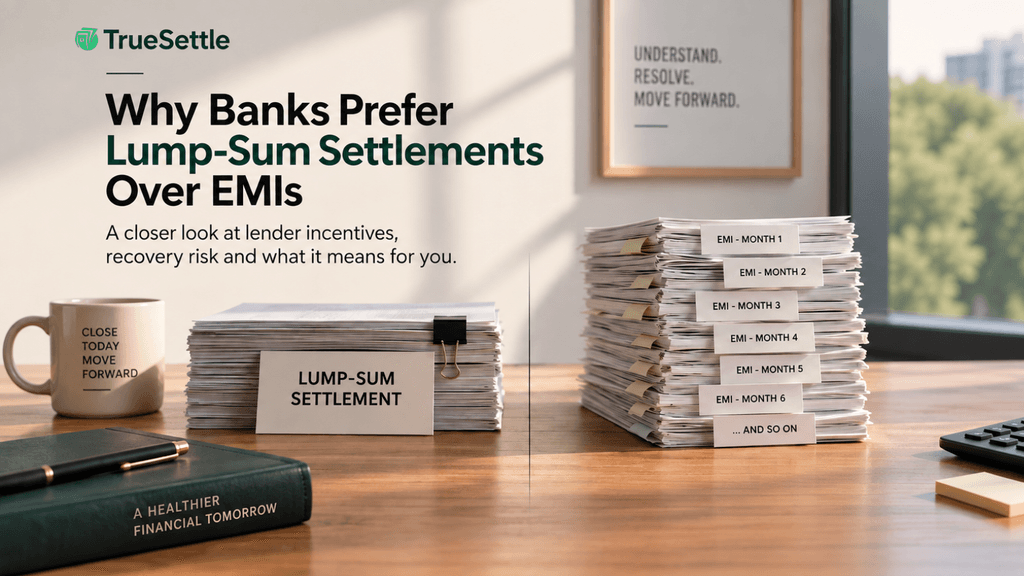
Lump sum loan settlement can give a lender faster recovery and greater certainty than waiting for a series of future EMI payments. From a bank’s perspective, receiving an agreed amount upfront can reduce the uncertainty associated with a loan account that has already faced repayment difficulties.
This is the mechanism behind what’s commonly called a One-Time Settlement (OTS) — the lender agrees to accept less than the total outstanding balance as a final resolution, in exchange for that amount being paid as one consolidated payment (or occasionally in a very short number of instalments, depending on the lender).
It’s worth distinguishing this clearly from normal EMI repayment. In a standard repayment, you’re paying the full amount owed, spread across the agreed loan tenure. In a settlement, you’re paying a reduced amount, generally within a short, defined window — the trade-off being a faster resolution in exchange for the lender accepting less than what’s technically owed.
Lump Sum vs EMI Settlement: What’s the Difference?
| Factor | Lump-Sum Settlement | EMI/Instalment Arrangement |
|---|---|---|
| Payment timing | Immediate or short-term | Spread over an agreed period |
| Lender certainty | Higher, once paid | Depends on future payments actually coming through |
| Recovery speed | Faster | Slower |
| Default risk | Effectively eliminated after payment | Remains throughout the repayment period |
| Negotiation | Often more attractive to the lender | May require a different, more cautious approval process |
It’s important to flag: not every lender offers an instalment-based settlement option at all. Many treat settlement strictly as a lump-sum resolution, and any instalment structure — where offered — tends to come with tighter conditions than a standard lump-sum deal.
The “Insider View”: Why Immediate Cash Matters to Banks
From inside a lender’s recovery process, a few things make lump-sum settlements genuinely more appealing than a drawn-out instalment plan:
- Faster recovery. An account that’s been overdue or in default for months represents ongoing risk. A lump-sum payment closes that exposure immediately, rather than extending it further.
- Reduced collection costs. Every additional month an account stays open involves continued monitoring, communication, and administrative overhead. Resolving it in one transaction cuts that cost.
- Lower uncertainty. A borrower who’s already struggled to keep up with original EMIs is, from a risk standpoint, a less reliable bet for a new instalment schedule — even a discounted one.
- Reduced risk of future missed payments. An instalment-based settlement can still default, which puts the lender right back where they started, except now with a reduced expected recovery.
- Administrative efficiency. Closing an account in a single transaction is simply easier to process, document, and report than tracking a multi-month settlement plan.
- Ability to resolve a delinquent account sooner, which matters for how the lender manages its overall book of stressed or non-performing accounts.
It’s worth being careful here not to generalise too far — internal risk policies vary significantly across banks and NBFCs, and this is a general pattern rather than a fixed rule that applies identically everywhere.
Does Offering a Lump Sum Improve Your Negotiating Position?
Often, yes — having a realistic, immediately available amount can strengthen your position in a negotiation, because it gives the lender something concrete to evaluate rather than a hypothetical future repayment stream. Certainty tends to matter more to a lender than a marginally higher number spread across an uncertain timeline.
But it’s important to be realistic: a lump-sum offer does not guarantee that the lender will accept a lower settlement amount. It may improve your position, but the final decision still depends on your account’s specific status, the lender’s internal thresholds, and what documentation supports your case.
What If You Don’t Have the Full Settlement Amount?
This is a common and completely reasonable situation. A few ways to approach it:
- Assess your available savings honestly, and figure out what you could realistically put toward a settlement without compromising essential expenses.
- Consider whether family support is appropriate, if that’s a genuine option for your situation — some borrowers are able to arrange this, others aren’t, and that’s fine either way.
- Build a realistic settlement fund over a short period, if the lender’s timeline allows it, rather than assuming you need the full amount immediately.
- Ask the lender directly what payment structures it permits. Some may allow a modest instalment structure for settlement, even if lump sum is generally preferred.
- If a lump-sum or short-term settlement genuinely isn’t feasible, consider whether a restructuring of your original loan terms might be a more appropriate path than settlement.
One important caution: don’t borrow more money at unaffordable rates just to fund a settlement. Taking on a new high-interest loan to pay off a settlement can leave you in a worse financial position than the one you started in.
Can a Settlement Be Paid in EMIs?
Sometimes, but it depends entirely on the lender and the specific arrangement:
- Some lenders may permit structured payments under a defined settlement plan — often shorter and stricter than your original loan tenure.
- Others require payment within a fixed, short settlement window, with no instalment option at all.
- The terms need to be confirmed directly by the lender — don’t assume an instalment option exists just because it worked for someone else’s account.
- Never assume an informal instalment promise changes the underlying settlement agreement. If a representative verbally agrees to a payment spread, get it documented in writing before relying on it — otherwise the original lump-sum terms may still be what’s formally on record.
How to Make a Lump-Sum Settlement Offer
A practical sequence to follow:
Calculate your outstanding amount → assess your available funds → document your hardship → make a realistic offer → negotiate → obtain written terms → pay through the lender’s authorised channel → collect post-payment documentation.
Each step matters. Skipping the “written terms” step, in particular, is one of the most common ways borrowers end up in disputes after they’ve already paid.
What Should the Settlement Letter Say?
Before you make any payment, make sure the written settlement letter clearly includes:
- The loan or account number
- The total outstanding amount
- The agreed settlement amount
- The payment deadline
- The approved payment method
- The terms governing any remaining balance
- Confirmation of what the agreed resolution means for the account
- The credit-reporting status that will follow (typically “Settled”)
If any of these are missing or unclear, ask for them to be added before you proceed with payment.
Common Mistakes When Offering a Lump Sum
- Offering money without written terms — never send a payment based purely on a verbal understanding.
- Using borrowed money without calculating affordability — a settlement shouldn’t create a new debt problem to solve the old one.
- Assuming a particular percentage will be accepted — every negotiation is case-specific; don’t anchor your expectations to someone else’s outcome.
- Missing the payment deadline — this can invalidate the offer entirely, with no guarantee of the same terms being available afterward.
- Paying through an unauthorised channel — always use the lender’s official, verified payment method.
- Failing to collect the relevant confirmation or NOC after payment — this documentation is what protects you going forward.
Frequently Asked Questions
Why do banks prefer lump-sum settlements?
Generally because it offers faster recovery, greater certainty, and lower administrative and collection costs compared to a drawn-out instalment arrangement — though this varies by lender.
Can I settle a loan through monthly payments?
In some cases, yes, if the lender specifically permits a structured settlement plan. This isn’t universal, and you’ll need to confirm directly with your lender whether it’s an option.
Is lump-sum settlement better than EMI settlement?
It depends on your situation. Lump sum often resolves the account faster and may strengthen your negotiating position, but an instalment option — where available — can make settlement achievable for borrowers who can’t raise the full amount immediately.
Does a lump-sum offer increase my chances of settlement?
It can, since it gives the lender more certainty of recovery. However, it’s not a guarantee that a lower settlement amount will be accepted.
How much should I offer for a loan settlement?
This depends on your outstanding balance, documented financial hardship, and what you can realistically afford. There’s no fixed percentage that applies universally.
Can I negotiate a lower settlement amount?
Often, yes, particularly with clear documentation of hardship and a realistic, credible offer. The final outcome depends on the lender’s assessment of your case.
What happens after I make the settlement payment?
You should receive written confirmation of the payment and, where applicable, a No Dues Certificate or NOC. The account will typically be reported to credit bureaus as “Settled.”
Does loan settlement affect CIBIL?
Yes. A settled account is generally reported differently from a fully repaid one, which can affect your credit score and future borrowing for a period of time.
If you’re trying to put together a realistic lump-sum settlement offer — or figure out whether an instalment option might work for your situation — it helps to have someone review the numbers with you first.
👉 Get a free debt assessment with TrueSettle and understand what offer makes sense for you.
👉 Explore your debt resolution options before you approach your lender.