If you took out a personal loan through the Navi app and you’re now struggling to keep up with repayments, you’re probably wondering what your options actually are. This guide walks through how Navi loan settlement works, what influences the settlement amount, the step-by-step process, and what it means for your credit profile afterward.
What Is Navi Loan Settlement?
Loan settlement is an arrangement where Navi agrees to accept less than your full outstanding balance as a final resolution of your loan — often called a One-Time Settlement (OTS).
A few things worth understanding upfront:
- Settlement requires Navi’s agreement. You can’t declare a settlement on your own — it has to be negotiated and accepted by the lender.
- It isn’t automatic debt forgiveness. Navi assesses your account and circumstances before deciding whether to offer settlement, and on what terms.
- There’s no fixed, published settlement percentage. Any number quoted elsewhere online is illustrative, not a rate Navi has publicly committed to.
Example
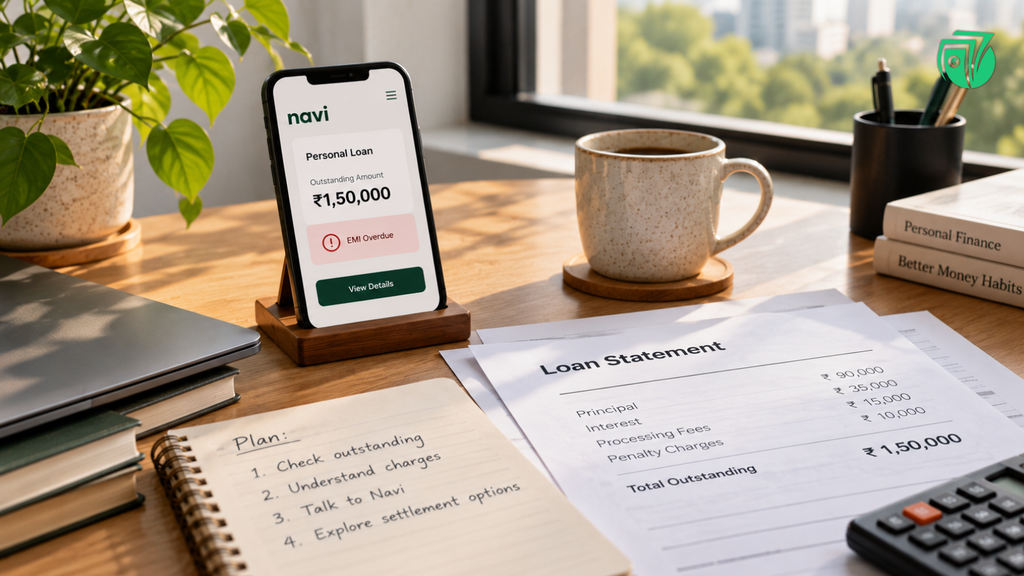
If your outstanding balance is ₹1,50,000 and Navi agrees to accept ₹90,000 as settlement, that works out to 60% of the outstanding amount.
This is a purely illustrative example, not a guaranteed Navi offer.
Who May Be Considered for Navi Loan Settlement?
Settlement discussions tend to be relevant when:
- You’re facing genuine, documented financial hardship — job loss, reduced income, medical emergency, or business loss.
- Your loan has been overdue for a meaningful period, not just a single missed EMI.
- You have a realistic lump sum you can offer, even if it’s less than the full outstanding balance.
- Continuing the original repayment schedule genuinely isn’t achievable.
If you can still manage your EMIs, even with some strain, it’s worth checking whether Navi offers restructuring or a revised repayment plan before pursuing settlement — settlement carries real, lasting credit-report consequences that are best avoided if full repayment remains realistically possible.
What Factors Affect Your Navi Loan Settlement Amount?
1. Total Outstanding Balance
Your principal, accrued interest, and any penalty charges together form the base the settlement is negotiated against.
2. Duration and Status of Default
How long your loan has been overdue, and where it currently stands in Navi’s internal recovery process, shapes how the conversation unfolds.
3. Financial Hardship
Genuine, documented circumstances — job loss, salary reduction, business losses, major medical expenses — carry real weight in a settlement discussion.
4. Repayment History
How consistently you paid before falling behind may factor into Navi’s overall assessment of your account.
5. Your Lump-Sum Payment Capacity
A realistic, immediately available amount tends to matter more than an ambitious figure you can’t actually deliver.
6. Supporting Documentation
Termination letters, medical bills, proof of reduced income, and bank statements can all strengthen your case.
How Is a Navi Loan Settlement Amount Calculated?
A simple way to think about it:
Settlement Amount = Total Outstanding × Agreed Settlement Percentage
For example, on an outstanding balance of ₹2,00,000 at an illustrative 50% settlement, the amount would be ₹1,00,000 — again, purely illustrative, not a number Navi has committed to for any specific account.
Navi Loan Settlement Process: Step by Step
Step 1: Check Your Exact Outstanding Amount
Log into the Navi app or check your loan statement for the precise figure — principal, interest, and any charges.
Step 2: Assess What You Can Realistically Offer
Work out your monthly income, essential expenses, other obligations, and any lump sum you could genuinely put toward a settlement.
Step 3: Contact Navi Through Official Channels
Reach out via the Navi app’s support section, official customer care number, or verified email. Avoid relying on messages or calls from numbers you can’t confirm as genuinely representing Navi.
Step 4: Explain Your Financial Hardship
Be specific, and provide supporting documentation where you can.
Step 5: Discuss and Negotiate the Settlement Terms
Understand the proposed amount, payment deadline, and any conditions before agreeing to anything.
Step 6: Get the Settlement Terms in Writing
Never proceed based on a verbal assurance alone. Insist on written confirmation — through the app, email, or an official letter — before making any payment.
Step 7: Make the Payment Through an Authorised Channel
Pay exactly the agreed amount, before the stated deadline, through Navi’s official payment method.
Step 8: Collect Post-Settlement Documentation
Keep your payment confirmation and request a closure or No Dues Certificate confirming the loan has been resolved.
Documents That Can Support Your Settlement Request
| Document | Why It Helps |
|---|---|
| Loan statement | Confirms your exact outstanding amount |
| Bank statements | Shows your financial position |
| Salary slips/income proof | Demonstrates repayment capacity |
| Termination/job-loss letter | Supports hardship due to job loss |
| Medical bills | Supports hardship due to medical expenses |
| Previous Navi correspondence | Provides account history |
What Should Written Settlement Confirmation Include?
Before paying, check that whatever Navi sends you (app confirmation, email, or letter) clearly states:
- Your name and loan account/reference number
- The total outstanding amount
- The agreed settlement amount
- The payment deadline
- The accepted payment method
- Confirmation of what happens to any remaining balance
- The status that will be reported to credit bureaus
Navi Loan Settlement vs Full Repayment
| Factor | Full Repayment | Settlement |
|---|---|---|
| Amount paid | Full outstanding dues | Reduced, negotiated amount |
| Credit reporting | Generally reported as “Closed” | May be reported as “Settled” |
| Credit impact | Generally more favourable | Can negatively affect future borrowing |
| Best suited for | Borrowers who can repay in full | Genuine, documented financial hardship |
Does Settling a Navi Loan Affect Your CIBIL Score?
Yes, and it’s worth understanding this clearly before you decide:
- A settled loan is typically reported as “Settled,” not “Closed.” These are distinct statuses, and future lenders read them differently.
- This generally has a negative impact on your credit score and can make future borrowing harder for a period of time.
- The exact impact varies depending on your overall credit profile — there’s no fixed number of points every borrower loses.
- Responsible financial behaviour afterward — paying other obligations on time, keeping utilisation low — helps rebuild your credit profile gradually.
Can You Negotiate the Amount in a Navi Loan Settlement?
- Settlement terms may be discussed and negotiated where Navi offers that option.
- Assess your actual repayment capacity honestly before proposing an amount.
- Keep genuine hardship documentation ready if requested.
- Don’t agree to an amount you can’t realistically pay within the agreed timeline.
- Once terms are finalised, make sure they’re documented in writing.
What Happens If You Can’t Pay the Settlement Amount on Time?
- Settlement offers generally come with a specific deadline — they’re not open-ended.
- Missing the deadline can affect the validity of the arrangement.
- Contact Navi promptly if you anticipate difficulty meeting the deadline.
- Don’t assume an expired offer will automatically remain available — you may need to renegotiate.
Common Mistakes to Avoid
- Assuming there’s a fixed settlement percentage Navi applies to every borrower — there isn’t one.
- Paying before getting written confirmation of the settlement terms.
- Making payments through an unverified channel instead of Navi’s official app or payment method.
- Stopping EMI payments just to force a settlement conversation — this damages your credit history without guaranteeing anything.
- Not keeping records of payment confirmations and settlement correspondence.
- Assuming “Settled” will show as “Closed” on your credit report — it typically won’t.
- Ignoring the CIBIL impact and being surprised by it later.
When Is Settlement Not the Best Option?
Settlement may not be the right move if:
- You can still manage your EMIs, even if it’s tight.
- Your financial difficulty is genuinely temporary.
- A restructured repayment plan would resolve the issue without the credit-report consequences of settlement.
- You haven’t yet explored whether Navi offers any revised repayment arrangement.
Frequently Asked Questions
Can I settle my Navi personal loan? In many cases, yes, particularly if you’re facing genuine financial hardship and can offer a realistic lump sum. Navi evaluates each case individually.
What percentage will Navi accept for settlement? There’s no fixed, published percentage. The amount depends on your outstanding balance, documented hardship, and Navi’s own assessment of your account.
How do I contact Navi about loan settlement? Through the Navi app’s official support section, customer care number, or verified email — avoid relying on unverified calls or messages claiming to represent Navi.
Does Navi loan settlement affect my CIBIL score? Yes. A settled loan is generally reported as “Settled” rather than “Closed,” which typically has a negative impact on your credit score for a period of time.
What documents do I need to request a settlement? Typically your loan statement, income proof, and documentation supporting your financial hardship, such as a termination letter or medical bills.
Should I pay before receiving written settlement terms? No. Always get the settlement amount, deadline, and terms confirmed in writing — through the app or official correspondence — before making any payment.
Can a Navi settlement offer expire? Yes. Settlement offers generally come with a defined deadline, and missing it can mean the offer is no longer valid.
Can I get a new loan after settling with Navi? It becomes harder, at least for a period, since the settlement is reflected on your credit report. Building responsible credit behaviour afterward improves your chances over time.
If you’re unsure whether settlement, restructuring, or another option fits your Navi loan situation, it helps to get a clear, honest assessment before deciding.
👉 Get a free debt assessment with TrueSettle
👉 Explore your debt resolution options before approaching Navi.