It usually starts small. One EMI gets delayed because the salary came late. The next month, a hospital bill eats up the money you had kept aside. By the third month, you’re avoiding calls from unknown numbers and feeling your stomach drop every time an SBI message pops up on your phone.
If this sounds like your life right now, take a deep breath. You’re not alone. Every year, lakhs of honest borrowers in India struggle with loan repayments, not because they don’t want to pay, but because life threw something at them they couldn’t control.
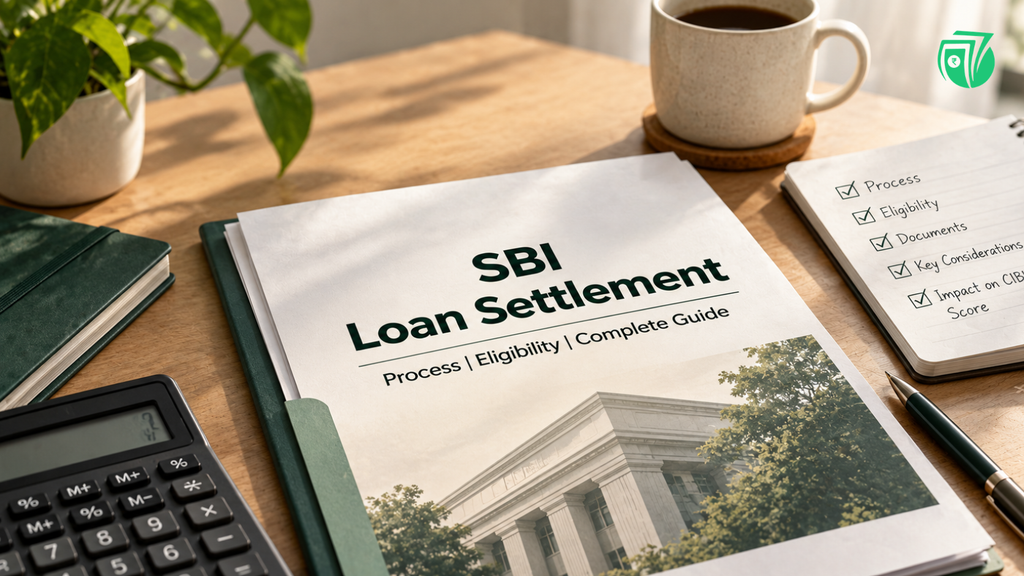
One option many of them explore is loan settlement. In this guide, we’ll explain SBI loan settlement in simple language: what it is, who can apply, what to try before settling, how the process works step by step, and what really happens to your CIBIL score afterwards.
Key Points at a Glance
- SBI loan settlement means the bank agrees to accept a reduced final amount to close your loan account.
- It is usually considered only after your account has been overdue for a long time, often after it becomes an NPA (unpaid for more than 90 days).
- SBI reviews each case separately. There is no fixed discount and no guaranteed approval.
- Your loan will usually be reported as “Settled” on your CIBIL report, which can make future loans harder to get.
- Settlement should be your last option, after trying restructuring or other relief.
What Is SBI Loan Settlement?
When you take a loan, you promise to repay the full amount with interest. Loan settlement is when the bank agrees to accept less than that full amount because you genuinely cannot pay it all. Once you pay the agreed amount, the bank stops chasing you for the rest.
Let’s understand this with an example. Meera runs a small boutique in Indore. She took a ₹3 lakh personal loan from SBI to expand her shop. A year later, a new mall opened nearby and her sales dropped sharply. She paid her EMIs from her savings for a few months, but eventually the money ran out. Her outstanding amount, including interest and penalties, crossed ₹2.5 lakh.
Meera visited her SBI branch, explained what had happened and showed her shop’s sales records and bank statements. After reviewing her case, the bank may offer to close the loan for a lower amount, payable within a fixed time.
This is only an example. Whether SBI agrees, and how much it reduces, depends entirely on your individual case.
Why would a bank accept less money?
It’s a fair question. When a loan remains unpaid for more than 90 days, RBI rules require banks to classify it as an NPA, or Non-Performing Asset. In simple terms, the bank now sees it as a loan that may not be fully recovered.
At that stage, recovering part of the money through a settlement can make more sense for the bank than spending years and legal costs trying to recover everything. The RBI allows banks to enter into these “compromise settlements” under their own board-approved policies.
So settlement is a legal and recognised process. It is not a loophole or a trick.
Settled vs Closed: why it matters so much
- Closed means you repaid every rupee you owed. Your credit report looks clean.
- Settled means the bank accepted less than the full amount. Future lenders can see this clearly.
That one word on your credit report can affect your ability to get loans and credit cards for years. That’s why settlement should never be treated as an easy shortcut.
Who Is Eligible for SBI Loan Settlement?
SBI doesn’t approve settlement just because someone asks. The bank looks closely at your situation. These are the factors that usually matter most.
1. Your account is seriously overdue
If you’re paying your EMIs on time, settlement is generally not available. The conversation usually begins once your loan has been unpaid for a long time, often after it becomes an NPA. But even NPA status doesn’t guarantee approval.
2. You have a genuine reason for not paying
The bank wants to understand why you stopped paying. Strong reasons include:
- Job loss or a major drop in income
- A serious illness or medical emergency in the family
- Death of the main earning member
- Business loss or closure
SBI may check your bank statements, salary slips or income tax returns to confirm that your difficulty is real.
3. You can’t pay, not that you won’t pay
This is where the bank draws a clear line. If a borrower has the money but chooses not to repay, the bank is unlikely to offer settlement and may take legal action instead. Settlement is meant for people who are genuinely stuck.
4. The type of loan you have
Unsecured loans such as personal loans and credit card dues are more commonly settled. Secured loans like home loans or car loans are often handled differently, because the bank can recover its money by selling the property or vehicle. Ask SBI how your specific loan will be treated.
Options to Try Before Choosing Settlement
Settlement should be the last door you knock on, not the first. Before you go for it, explore these options.
EMI restructuring
Ask SBI whether it can lower your monthly EMI by extending your loan tenure. You’ll still repay the full amount, just over a longer period. This works well if your income has dropped but not stopped completely. Best of all, it won’t leave a “Settled” mark on your credit report.
Temporary relief
If your problem is short-term, such as being between jobs, ask SBI whether any temporary payment arrangement is possible. Interest may continue to build during this period, so understand the total cost before agreeing.
Part payment
If you have some savings or are expecting money soon, paying part of your overdue amount can reduce the pressure and show the bank that you’re serious about repaying.
Lok Adalat
SBI often refers unpaid loan cases to Lok Adalats, which are “people’s courts” organised under the Legal Services Authorities. Here, you and the bank sit before a panel and try to reach an agreement. If both sides agree, the decision is final and carries the same legal force as a civil court decree, with no appeal.
If you receive a Lok Adalat notice, don’t panic and don’t ignore it. Attend with your documents. It can be a fair and fast way to resolve your loan.
If none of these options work for you, settlement may be the right path.
SBI Loan Settlement Process: Step by Step
Here’s how the process usually works.
Step 1: Check your loan status
Visit your SBI branch or use SBI’s official app or website. Find out how long your account has been overdue, whether it has become an NPA, and your exact outstanding amount, including interest and penalties. Don’t rely on figures given by a recovery agent over the phone.
Step 2: Take an honest look at your finances
Write down your monthly income, essential expenses and all your other EMIs or debts. This helps you decide whether settlement is truly needed and how much you can realistically offer.
Step 3: Gather your documents
Keep your ID proof, bank statements, income proof and proof of hardship ready. The full list is given below.
Step 4: Submit a written settlement request
Visit your SBI branch and ask to meet the branch manager or recovery officer. Submit a simple written application mentioning:
- Your name and loan account number
- Why you couldn’t continue paying
- Your current income and financial situation
- The amount you can pay, if you know it
- A request to consider your loan for one-time settlement (OTS)
Always collect an acknowledgement and keep a copy for yourself.
Step 5: Wait for the bank’s review
The bank will review your request, and it may need approval from senior officials. There’s no fixed timeline, so be patient and follow up politely. During this period, never make informal cash payments to anyone.
Step 6: Read the settlement offer carefully
If SBI agrees, you’ll receive a written settlement letter. Check:
- The exact settlement amount
- The payment deadline
- Whether you must pay at once or in parts
- What happens to the remaining dues
- How the loan will be reported to CIBIL
Some offers require part of the amount upfront and the rest within a set period. Make sure you can meet every deadline before accepting. Missing one can cancel the entire deal.
Step 7: Pay only through official channels
Pay exactly as stated in the settlement letter, directly to SBI. Never hand cash to an agent or transfer money to a personal account. Save every receipt.
Step 8: Collect your NOC and check your CIBIL report
After paying the full settlement amount, ask for a settlement completion letter or No Objection Certificate (NOC). This is your proof that the matter is closed. Keep it safe permanently.
After 30 to 60 days, check your CIBIL report. The loan should show as “Settled.” If it shows anything incorrect, contact SBI and raise a dispute with CIBIL.
Golden rule: Never pay a single rupee until you have SBI’s written settlement offer in your hands.
Documents Required for SBI Loan Settlement
Being prepared makes the process smoother. Keep these documents ready:
- PAN card and Aadhaar card
- Loan account number and loan agreement
- Bank statements for the last 6 to 12 months
- Salary slips, ITR or other income proof
- Job termination letter, if applicable
- Hospital bills and medical records, if applicable
- Proof of business loss, if applicable
- Your written settlement application
- Copies of previous letters or emails with SBI
SBI may ask for additional documents depending on your case.
What Is Rinn Samadhan and SBI OTS?
OTS stands for One-Time Settlement. You pay an agreed amount, usually in one go or within a short time, and the loan is closed.
Rinn Samadhan is the name of SBI’s special settlement drives for eligible stressed loans. These drives usually run for a limited period and cover specific loan types and amounts. When a drive is active, eligible borrowers may get better terms, such as relief on penalty interest.
Keep these points in mind:
- These schemes are not always active.
- Each drive has its own rules on which loans are covered.
- Be careful of WhatsApp messages or online posts promising fixed discounts. Always confirm with SBI.
Even when no special scheme is running, you can usually still request settlement through SBI’s regular OTS process. Before planning anything, ask your branch whether any scheme is currently active, whether your loan qualifies, how the amount will be calculated and what the last date to apply is.
Received an Arbitration Notice? Don’t Ignore It
Sometimes, instead of going to court, a bank may start arbitration proceedings to recover an unpaid loan. Many borrowers make the mistake of ignoring this notice.
Here’s why that’s dangerous. If you don’t respond, the arbitration can continue without you. This is called an ex-parte proceeding. The decision, called an award, may go fully in the bank’s favour for the entire outstanding amount plus interest and costs. Under the Arbitration and Conciliation Act, 1996, such an award can be enforced like a court decree, which may include action against your bank account or assets.
So if you get an arbitration notice, respond on time. Explain your financial difficulty and, where possible, propose a settlement. It’s also wise to take proper legal advice at this stage.
How Does SBI Loan Settlement Affect Your CIBIL Score?
This is the part most borrowers underestimate, so read it carefully.
When you settle a loan, SBI usually reports the account as “Settled” instead of “Closed.” To any future lender, this signals that you didn’t repay the full amount you borrowed.
Here’s what can happen:
- Your score may drop. How much depends on your overall credit history. Nobody can honestly promise you an exact number.
- The record stays for years. The settled status remains part of your credit history and can be seen by lenders for a long time.
- New loans become harder. Many banks hesitate to approve loans or credit cards for someone with a settled account.
- You may pay higher interest. Even if a lender approves your application, it may charge a higher rate.
That said, settlement may still be better than leaving a loan unpaid for years, with interest piling up, recovery calls continuing and legal action hanging over you.
How to rebuild your credit after settlement
Your score can recover with time and discipline:
- Pay every other EMI and bill on time, every month.
- Keep your credit card usage low.
- Avoid applying for many loans or cards at once.
- Consider a secured credit card backed by a fixed deposit to rebuild your repayment history.
- Check your credit report regularly for errors.
- If you later pay the waived amount, ask SBI whether your account status can be updated from “Settled” to “Closed.”
Be careful of anyone who promises to “remove” the settled status from your report for a fee. A credit report can only be corrected based on facts confirmed by the bank.
SBI Settlement Routes Compared
| Route | What It Means | Best For |
|---|---|---|
| Rinn Samadhan (when active) | SBI’s special time-bound settlement drive | Eligible loans covered under the current drive |
| Regular OTS | SBI’s standard one-time settlement process | NPA accounts when no special scheme is active |
| Lok Adalat | Settlement before a people’s court panel; decision is final | Cases SBI refers to Lok Adalat |
| Restructuring | Lower EMI over a longer tenure; full loan repaid | Borrowers whose income has dropped but not stopped |
The right route depends on your loan, your account status and SBI’s decision at the time.
Practical Tips for a Smooth Settlement
- Get everything in writing. Never act on a verbal promise from anyone.
- Keep a record of every interaction. Note the date, the officer’s name and what was discussed.
- Don’t borrow from costly apps or moneylenders to pay the settlement. You’ll only start a new debt cycle.
- Pay on time. Missing a settlement deadline can cancel the deal.
- Keep your NOC forever. It’s your proof if any dispute comes up later.
- Check your CIBIL report. Make sure the account is reported correctly.
How TrueSettle Can Help You
Loan stress can feel lonely and overwhelming. Many people suffer quietly for months before asking for help.
At TrueSettle, we help borrowers understand their situation, prepare the right documents and approach their bank with a clear, realistic plan. We’ll tell you honestly whether settlement makes sense for you, or whether another option could serve you better.
We can’t promise that SBI will approve a settlement or offer a specific amount. No honest adviser can. But we can make sure you walk into that conversation prepared and confident.
Struggling with your SBI loan? Talk to the TrueSettle team today and understand your options.
Frequently Asked Questions
1. How many EMIs do I need to miss before SBI considers settlement?
There’s no fixed number. Settlement usually comes up once an account has been overdue for a long time, often after it becomes an NPA (more than 90 days unpaid). Even then, approval depends on your situation.
2. Can I settle my SBI loan on my own?
Yes. You can approach your SBI branch directly with a written request and documents. Some borrowers take help from a debt advisor to prepare their case.
3. Does SBI guarantee loan settlement?
No. SBI can accept or reject your request after reviewing your case.
4. How much discount does SBI give in a settlement?
There’s no fixed discount. The amount depends on your outstanding dues, how long the loan has been unpaid, your financial situation and SBI’s policy.
5. Will loan settlement affect my CIBIL score?
Yes. Your loan will usually be shown as “Settled,” which can lower your score and make future loans harder to get.
6. What happens if I ignore an SBI arbitration notice?
The arbitration may proceed without you, and the award can go in the bank’s favour for the full amount. It can then be enforced like a court decree. Always respond on time.
7. Can I get a loan after settling my SBI debt?
It’s possible, but harder. Lenders may reject your application or charge higher interest. Building a good repayment record over time improves your chances.
8. Is Rinn Samadhan available all the time?
No. It runs as a limited-period drive. Confirm with SBI whether it’s currently active and whether your loan qualifies.
Disclaimer: This article is for general information only and is not financial or legal advice. SBI’s decision to approve a settlement, the amount and the terms depend on the bank’s policies and your individual case. Please verify all details directly with SBI before making any payment.