You’ve got a large credit card balance, the interest is making repayment feel like running on a treadmill, and then another card offers you a balance transfer. It looks like an easy escape — move the debt, get a lower rate, breathe easier. And it can genuinely help.
But here’s the thing worth understanding before you do it: a balance transfer can change where your debt sits. It doesn’t automatically reduce the debt itself. Used well, it’s a legitimate cost-reduction tool. Used carelessly, it’s just a way of relocating the same problem — sometimes with new fees attached.
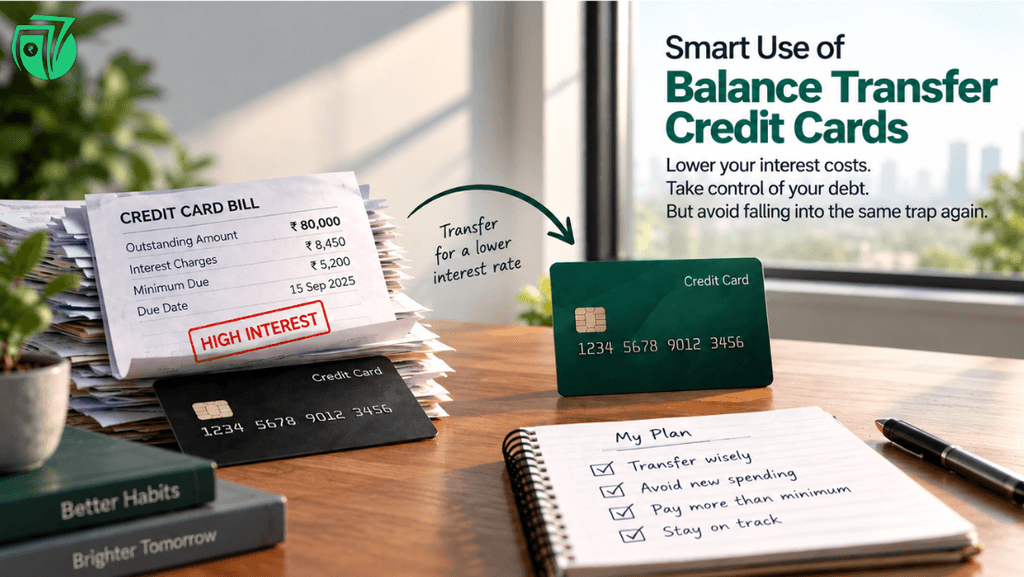
What Is a Credit Card Balance Transfer?
A balance transfer is exactly what it sounds like: moving your existing credit card balance from one card to another, usually to take advantage of a lower or promotional interest rate on the new card.
A few things typically apply:
- Your existing balance moves to the new card.
- The new card may offer a promotional or introductory interest rate for a limited period.
- There’s usually a transfer fee, calculated as a percentage of the amount moved.
- Once the balance is on the new card, repayment continues under that card’s specific terms and conditions.
It’s worth being clear that not every card offers the same terms — promotional rates, transfer fees, and eligibility conditions vary significantly between issuers, so what works well on one card won’t necessarily apply to another.
How Does a Balance Transfer Work?
Here’s a simple way to picture it:
Card A: ₹80,000 outstanding → balance transferred to Card B → new repayment terms apply → borrower repays Card B
The important thing to notice here is what didn’t happen: the ₹80,000 didn’t disappear. It moved. You’re still responsible for repaying that amount — just potentially at a lower cost, and under a different card’s terms.
When Can a Balance Transfer Make Sense?
Used thoughtfully, a balance transfer can offer real benefits:
- Lower interest cost during the applicable promotional period, which can meaningfully reduce how much you pay to clear the same balance.
- A more manageable repayment structure, especially if the new card’s terms are clearer or better suited to your situation.
- Consolidating multiple balances into a single card, which can simplify tracking and repayment.
- Creating a defined repayment plan, particularly if the promotional period gives you a clear window to focus on paying down principal.
The key qualifier here: the math needs to actually work out once you account for the transfer fee and any other applicable charges. A lower headline interest rate doesn’t automatically mean a better deal once fees are factored in.
The Biggest Risk: Thinking the Debt Has Disappeared
This is the section that matters most, because it’s where balance transfers tend to go wrong.
Transfer ≠ debt forgiveness. The balance is still yours to repay — you’ve just changed which card it sits on and, temporarily, what it costs you in interest.
Borrowers commonly fall back into debt trouble after a balance transfer when they:
- Continue spending heavily on the old card, effectively creating a second balance on top of the one they just moved.
- Use the new card for fresh purchases, adding new debt to the balance they transferred.
- Only make minimum payments, which barely touches the principal even at a lower rate.
- Fail to repay before the promotional period ends, after which the interest rate typically jumps — sometimes significantly.
- Transfer balances repeatedly, moving the same debt from card to card without ever actually reducing it, while paying a transfer fee each time.
A balance transfer works when it’s paired with a genuine repayment plan. Without one, it’s just a temporary discount on a problem that’s still growing.
Balance Transfer Fees, Interest and Other Costs to Check
Before you transfer anything, go through this checklist carefully:
- Transfer fee — usually a percentage of the amount moved.
- Applicable taxes or additional charges on top of the transfer fee.
- The promotional interest rate being offered.
- How long the promotional period actually lasts.
- The interest rate that applies after the promotional period ends — this is often much higher and easy to overlook.
- Minimum payment requirements on the new card.
- Late-payment charges, in case a payment is missed.
- Eligibility conditions — not every balance or every borrower qualifies for every offer.
These details are exactly what’s often buried in the fine print — and exactly what determines whether a balance transfer actually saves you money.
How Much Should You Transfer?
A useful way to think about this:
Transferable balance + transfer fee + your realistic repayment capacity.
Just because your available credit limit allows a certain amount doesn’t mean you should transfer that much. The real question to ask yourself is:
Can I realistically repay the transferred balance within the promotional period?
If the honest answer is no, transferring the full balance may just mean you’re facing the higher post-promotional interest rate on a large chunk of debt you haven’t managed to pay down — which can leave you worse off than if you’d stayed put.
The 5 Rules for Using a Balance Transfer Safely
- Transfer only what you can realistically repay within the promotional window — not the maximum your limit allows.
- Stop adding unnecessary spending to any card involved, old or new.
- Know exactly when the promotional period ends, and mark that date somewhere you’ll actually see it.
- Pay more than the minimum whenever possible — the promotional rate is only useful if you’re actually reducing the principal.
- Have a repayment plan before making the transfer, not one you figure out afterward.
Balance Transfer vs Personal Loan vs Debt Settlement
| Option | Main Idea | Potential Benefit | Key Consideration |
|---|---|---|---|
| Balance Transfer | Move the card balance to a new card | Potentially lower cost during a promotional period | The debt still needs to be fully repaid |
| Personal Loan | Convert card debt into a structured loan | A fixed, structured repayment schedule | Interest cost and loan eligibility apply |
| Settlement | Negotiate a reduced repayment with the lender | May resolve debt that’s become genuinely unaffordable | Comes with credit-report consequences |
These aren’t interchangeable options — which one makes sense depends heavily on your specific situation, how much you owe, your repayment capacity, and whether the debt is still manageable or has moved beyond what a balance transfer or restructuring alone can fix.
What If You Can’t Repay the Transferred Balance?
If it becomes clear partway through that you won’t clear the balance within the promotional period, don’t wait until the deadline arrives to deal with it:
- Don’t wait until the promotional period expires to reassess your plan.
- Recalculate your outstanding balance and be honest about what’s realistically achievable from here.
- Contact the card issuer if you’re facing genuine financial difficulty — some offer hardship provisions or revised terms.
- Review repayment or restructuring options before the higher post-promotional rate kicks in.
- Avoid taking on another expensive loan simply to cover the previous balance — this is exactly the cycle you’re trying to avoid.
A Simple Balance Transfer Repayment Plan
A basic formula to set a target:
Transferred balance ÷ months available = approximate monthly principal target
For example:
₹60,000 ÷ 12 months = ₹5,000/month
Keep in mind this is a starting point — you’ll also need to factor in the transfer fee and any interest that applies, so your actual required payment may be somewhat higher than this simple calculation suggests.
Common Balance Transfer Mistakes
- Choosing a card based only on the promotional rate, without checking fees or the post-promotional terms.
- Ignoring the transfer fee, which can quietly eat into the savings a lower rate was supposed to deliver.
- Missing the promotional-period deadline, and getting hit with a much higher rate on the remaining balance.
- Continuing to spend on credit cards after the transfer, undoing the benefit.
- Making only minimum payments, which barely dents the principal.
- Transferring balances repeatedly, paying fees each time without ever actually reducing the debt.
- Taking on more debt than your monthly income can realistically support, regardless of how attractive the promotional terms look.
Frequently Asked Questions
What is a credit card balance transfer?
It’s moving your outstanding balance from one credit card to another, typically to take advantage of a lower or promotional interest rate for a limited period.
Is balance transfer good for credit card debt?
It can be, if you have a realistic repayment plan and the fees work out in your favour. It’s not automatically beneficial — it depends on your ability to actually pay down the balance during the promotional period.
Does a balance transfer reduce the amount I owe?
No. It moves the balance to a new card, potentially at a lower interest rate, but the underlying amount you owe stays the same (before accounting for any transfer fee).
What fees are charged on balance transfers?
Typically a transfer fee, calculated as a percentage of the amount moved, along with any applicable taxes. Terms vary by card issuer.
Can I transfer the entire credit card balance?
Often, yes, subject to your available limit on the new card and the issuer’s eligibility conditions — but transferring the maximum amount isn’t always the wisest choice if you can’t repay it within the promotional period.
Does balance transfer affect my CIBIL score?
It can have a modest impact, since a new credit inquiry and account may be involved. Responsible repayment afterward generally supports your credit profile over time.
What happens when the promotional period ends?
The interest rate typically reverts to a standard, often much higher, rate on any remaining balance — which is why it’s important to know this date and plan around it.
Can balance transfer help me get out of credit card debt?
It can help reduce the cost of repaying debt you already have, provided you pair it with a genuine repayment plan and avoid adding new spending on top.
Is balance transfer better than a personal loan?
It depends on your situation. A balance transfer may offer a lower short-term cost, while a personal loan offers a fixed, structured repayment schedule — the better choice depends on your balance size, repayment capacity, and how disciplined you can be with a revolving credit product.
How can I avoid getting into debt again after a balance transfer?
Stop adding new spending to your cards, pay more than the minimum, track the promotional deadline closely, and go in with a clear repayment plan rather than treating the transfer as a fresh start.
A balance transfer is a repayment strategy, not a debt reset — and knowing the difference is what makes it actually work in your favour.
👉 Check your debt options with TrueSettle to see what approach fits your situation best.
👉 Get a free debt assessment if your credit card debt has grown beyond what a balance transfer alone can fix.